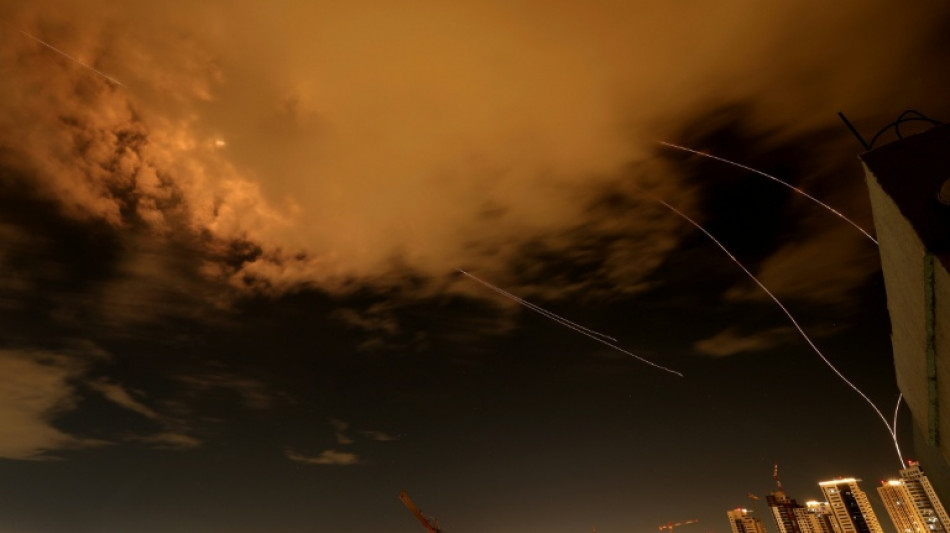
Questions over Israel's interceptor stockpiles as Mideast war drags on / Photo: JACK GUEZ - AFP

 American Nobel laureate in medicine hopes to illuminate the brain

 Trump approves firing squad for convicted US military base shooter

 Grappling with 'homework scams,' US universities shun AI detectors
 Separatists win Quebec election in test for Canada PM
 Leaders visit Pacific atoll at frontline of climate change

 Yemen's Houthis claim striking Riyadh airport, other Saudi sites

 Best-selling British author Jeffrey Archer dies aged 86

 Military plane crash kills 32 in Nigeria

 Olise powers France to win over Belgium in Nations League

 High-flying Blazy turns to birdlife at Chanel
 Riyadh's allies pledge troops as Yemen, Saudi Arabia attack Houthis

 Clashes erupt outside Kosovo parliament over war crimes court

 Milan's Saelemaekers suffers ankle setback, faces lengthy spell out
 Rubio arrives in Iceland to push for greater US presence in Arctic

 Putin allows Italy's UniCredit to sell part of Russian business

 Djokovic into China Open final as Medvedev out for hitting fan with ball

 ICC unseals arrest warrants for Taliban education ministers

 Modric hopes fans back Croatia against Spain after England shame

 Bolsonaro rides right-wing surge into Brazil's election runoff

 Turkey blocks X account of British reporter

 Ukraine says using AI robot guns to shoot down new Russian drones

 At Oct 7 memorial, Netanyahu says will be no Hamas rule in Gaza

 Ukraine blames Russia for deadly sinking of Turkish ship in Black Sea
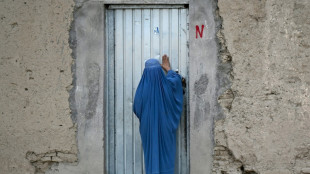 UN rights council slams Taliban's 'oppression' of women

 Norway eyes partial ban of smart glasses

The ability of Israel's highly sophisticated air defences to keep intercepting Iranian attacks is coming under scrutiny as the Middle East war drags on into a second month.
The military has dismissed reports that it is running low on the interceptors used to shoot down the steady stream of Iranian missiles and Hezbollah rockets fired at Israel.
However, some analysts suggest that the war against Iran has significantly drained allied resources, with long-range interceptors among the most severely depleted.
Israel has a multi-layered air defence array, with a variety of systems intercepting threats at different altitudes.
The top tier consists of the anti-ballistic missile Arrow systems, with Arrow 2 operating both within the Earth's atmosphere and in space and Arrow 3 intercepting above the Earth's atmosphere.
Below that sits David's Sling, which was created to target medium-range threats including drones, shorter-range ballistic missiles and cruise missiles.
Israel's famed Iron Dome system is the third tier and was originally designed to intercept short-range rockets and artillery shells.
US systems also complement Israel's air defences with some THAAD anti-missile batteries reportedly in Israel.
"There is no area in Israel that is not under multi-layer defence," said reservist Brigadier General Pini Yungman, who played a key role in developing the country's air defences and is now president of defence company TSG.
But "there is no 100 percent in defence," he told AFP.
"To get the 92 percent that we are getting all together with all the systems, it's outstanding".
The Israeli military, which reveals few details about its air defences, says Iran has launched more than 400 ballistic missiles since the start of the war on February 28 -- sparked by US and Israeli strikes on the Islamic republic.
Spokesman Lieutenant Colonel Nadav Shoshani recently lauded the interception rate as "exceeding expectations".
Most damage in Israel has been caused by falling debris, but among the 19 civilians killed in the country since the start of the war, more than half died when Iranian missiles broke through.
- 'Nearing exhaustion' -
Around two weeks after the war began, news outlet Semafor first reported that Israel was "running critically low on ballistic missile interceptors", citing unnamed US officials.
An Israeli military source at the time denied the reports, saying there was no shortage "as of now" and that the military was "prepared for prolonged combat".
But analysis published by the London-based RUSI defence think tank on Tuesday indicates that the US, Israel and regional allies have burned through vast quantities of missiles and interceptors since the end of February.
Researchers estimated that in the first 16 days of conflict, allied forces expended 11,294 munitions costing roughly $26 billion.
Stockpiles of long-range interceptors and precision munition in particular, it said, were "nearing exhaustion".
"This basically means that if the war continues, coalition aircraft have to fly deeper into Iranian airspace -- and on the defensive side it means absorbing more Iranian missiles and drones," one of the co-authors, US Air Force Lieutenant Colonel Jahara Matisek, told AFP.
Long and costly production timelines make the depletion of high-end interceptors, like Israel's Arrows, particularly critical.
Each Arrow 2 interceptor costs an estimated $1.5 million, with Arrow 3s around $2 million.
"The bottleneck isn't just money. It's industrial physics", Matisek said, pointing to issues including capacity constraints at the supplier level.
These are "production lines that don't scale like an iPhone factory," he said.
These are munitions "you save for the worst threats" he said, and the supply "is never going to be huge".
The RUSI analysis estimated that 81.33 percent of Israel's pre-war Arrow interceptor stocks had already been depleted, and that they would likely "be completely expended by the end of March".
- Accelerated production -
Yungman insisted that, taking into account all its air defence systems, Israel could produce interceptors faster than Iran could produce ballistic missiles.
He added that Israel accelerated its interceptor production after Hamas's October 7, 2023 attack and upgraded its systems to deal with ballistic missiles.
The military confirmed on Monday that it was a malfunction in David's Sling that had allowed Iranian ballistic missiles to strike the southern towns of Dimona and Arad last week.
Dimona is widely believed to hold Israel's undeclared nuclear arsenal.
Israeli financial newspaper Calcalist reported that the military had chosen to use David's Sling in a bid to preserve Arrow interceptor stocks.
Faced with the challenges posed by Iranian missiles, Israel has three options to conserve interceptor stocks, Jean-Loup Samaan, a senior researcher at the Middle East Institute of the National University of Singapore, told AFP.
"Mixing the different missile systems in order to avoid massive shortages; not intercepting missiles or drones if they land in unpopulated areas; and increasing the pressure on the offensive campaign, hoping that they are able to degrade Iran's capabilities before the IDF's air defence resources run out".
Y.Zaher--SF-PST