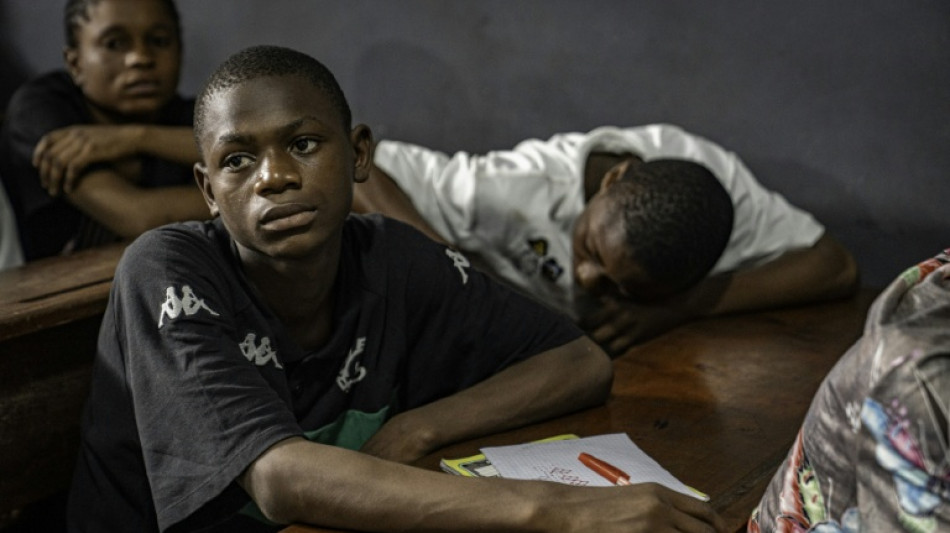
Patching the wounds of Kinshasa's street children / Photo: Glody MURHABAZI - AFP

 EU vows AI rules will protect Europeans. Will they?

 Myanmar leader to visit Malaysia after migrant returns begin
 Germany's AfD poised to preside over state assembly for first time
 Australia's opposition vows 'largest cut to immigration' in country's history
 Ready, set, snooze: Sleep-deprived Japanese compete for best-rested

 Falcons thump Saints 45-24 as New Orleans marks Katrina anniversary

 Tuvalu govt adviser says Australia overstepped in pre-COP visit
 Asian stocks mixed despite tech-led Wall St record
 Tens of thousands expected in Paris for high school protests
 AI borrowing binge rattles US markets

 Young Canadians sue government over alleged climate failures

 White Sox down Guardians to take 2-0 series lead
 NHL record-breaker Ovechkin says current season will be his last
 France roar back in Nations League as Italy beat Turkey
 Messi readies for final farewell in Argentina send-off
 Esposito seals Italy win over Turkey in Nations League

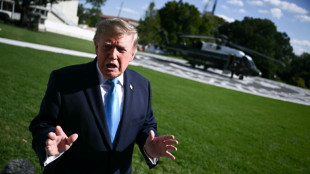 Russia downplays plague reports as Trump offers US help

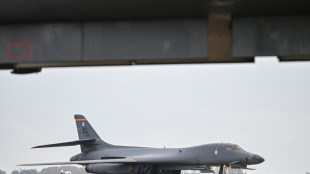 Trump says US moved bombers from UK base after 'threats'
 Brazilian stocks surge to record after Bolsonaro election lead
 Leaders to visit Pacific atoll at frontline of climate change

 ICC gives more details about arrest warrants for Taliban ministers

 Nigeria's Tinubu confirms 32 dead after military plane crash

 'Reckless' AI firms can't control models, says whistleblower

 Switching on brain cells: the Nobel-winning science of optogenetics
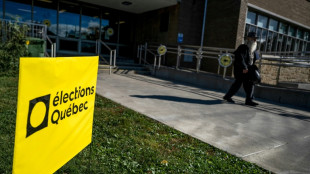 Quebec votes as separatist surge poses test for Canada PM

In the back of a 4X4, a nurse cleaned a gash in a boy's arm, picked up from living rough on the streets of Kinshasa, the capital of one of the world's poorest countries.
Several thousand street children, known locally as "shegues", are estimated to live in the megacity of nearly 17 million, where NGOs are trying to give them a future.
Many of the children and teenagers are pushed onto the streets because of dire poverty or because their parents accused them of witchcraft.
They manage by doing odd jobs and begging at roundabouts or on the city's long roads.
"We encounter new cases every day," said Georges Kabongo, sadly.
The educator has been running an outreach programme for more than 11 years for the Work to Rehabilitate and Protect Street Children (ORPER) NGO.
Every day, teams crisscross Kinshasa's poorest neighbourhoods to bring care and assistance to the neglected and unschooled homeless youths.
The Democratic Republic of Congo is one of the poorest countries in the world despite its vast mineral wealth that includes deposits of lucrative and sought-after cobalt, coltan, copper and lithium.
Nearly three quarters of the population lives on less than $3 a day, according to the World Bank.
- Rejected as 'witches' -
The little boy receiving treatment for his arm also had scratches on his legs.
"The others cut him with a razor blade. They do that to the new ones," Willie Masale, dressed in a white tunic, said.
A girl also laid comatose in the back of the truck, while another aged just 13 hid her pregnancy under a baggy dirty sweatshirt.
In the working-class eastern district of Limete, the street kids' lives are marked by violence, drugs and prostitution.
"Girls are also victims of rape; we make them aware about the risks of infection and HIV transmission," Kabongo said.
The NGO's mobile team says it helps more than 800 homeless minors every year.
Some of the children have been pushed onto the streets because their families accused them of witchcraft. "It's an excuse to be rid of them," Kabongo said.
Evangelical churches are flourishing in the capital of the vast central African nation and fake pastors claim to be able to exorcise the youngsters for payment.
"Some even go so far as to hold them captive, deprive them of food and subject them to unbearable practices," Kabongo said.
An 11-year-old girl stepped forward, barefoot, and with scars all over her body.
"It was my family that poured burning oil over me," said the girl, who ran away with her two older sisters two years ago.
The NGO teams tried to convince her to come to a centre where she could be housed and fed.
- 'Useful in society' -
Another association also works in the same district to "restore hope" to the street children through education.
"When you graduate, you can become entrepreneurs," the French teacher for the Programme for Monitoring, Educating and Protecting Street Children (OSEPER) said.
It teaches the youngest and gives lessons in reading and writing to those who have dropped out of school, as well as professional training.
Around a hundred youngsters are learning carpentry, sewing and how to be a baker.
"When they reach adulthood, they will be able to work and be independent. The aim is for these children to reintegrate and become useful in society," Christophe Moke, an OSEPER educator said.
In the kitchen, Daniel was shaping pieces of dough.
Before being abandoned by his mother, and then his grandmother, he dreamt of having a career as a church singer.
Now, marked by the violence of living on the streets, the 17-year-old just hopes for a "stable" life.
"I often cry at night when I think of the past," the teen, who spent several months living among a group of street children, said.
"Over there, you have to be tough like them. They hit you every day and you have to steal to eat. I regret a lot of the things I did," he confided, adding he no longer had contact with his family.
Desiree Dila, who helps run the OSEPER centre, said the NGOs were "doing the job of the parents and the state".
The association is not subsidised and depends on private donations and partner organisations such as France's Apprentis d'Auteuil, which helps vulnerable young people.
Against a background of cuts in global humanitarian funding, the NGOs worry about the impact on their work helping Kinshasa's "shegues".
Q.Najjar--SF-PST