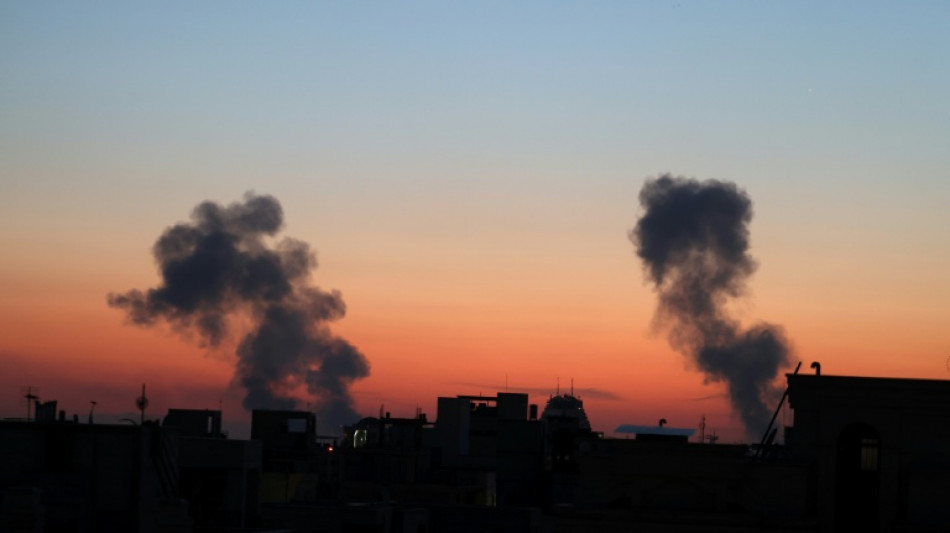
Middle East war a new shock for financial markets / Photo: ATTA KENARE - AFP

 Stocks climb as oil prices retreat
 Vstock Transfer Names Securities Industry Veteran Erica Goodstein General Counsel and Chief Compliance Officer

 Four Indonesian seamen return home after Somali pirate ordeal

 Crisis-striken Haiti postpones elections

 Germany arrests ex-spy chief on suspicion of giving secrets to foreign powers

 Djokovic wins China Open after de Minaur retires
 IMF warns cost-of-living shocks cause 'lasting deterioration' in affordability
 Alcaraz wins Japan Open for first title since injury return
 'We're working to keep football clean', Turkish minister says

 FIFA chief Infantino hit by Norwegian double complaint

 Exiled Catalan separatist leader Puigdemont cleared to return to Spain
 Stock markets climb as oil prices retreat

 'No future': Thousands mass in France for high school protests
 Nobel physics prize honours work on 'ghostly messengers' from outer space

 Bulgaria searches for missing crew after drones hit two more ships in Black Sea
 Le Pen vows drastic cost savings to prevent French 'default'

 'Eats through a straw': French teens wounded in high school protests
 Thousands mass in France for high school protests

 Moscow denies sanitary measures over plague reports
 Samoa look to recreate 2022 final run at Rugby League World Cup

 Asian stocks mostly up after tech-led Wall St record

 German factory orders plunge as recovery still fragile
 Coco Gauff calls out online racism following China open video review
 KVB Accelerates Middle East Footprint with Strategic MENA Regional Expansion
 Purple reign: Philippines seeks to keep grip on ube throne

The outbreak of war in the Middle East has sent shockwaves through financial markets, with energy prices soaring and stocks sliding, just a year after US President Donald Trump's tariff onslaught rattled investors.
"We're in a situation that's not under control and yet, as finance professionals, we have to adapt," ING analyst Vincent Juvyns told AFP.
The US-Israeli war on Iran and Tehran's retaliatory attacks across the Gulf region have nearly choked off shipping through the Strait of Hormuz, through which a fifth of the world's oil and liquefied natural gas supplies transit.
The result has been a surge in European natural gas prices by 66 percent since last week.
Meanwhile, crude oil prices have jumped by more than a quarter, with a barrel of international reference contract Brent crude shooting over $90 on Friday.
That has sparked worries of a surge in inflation and a slowdown in the global economy.
As a consequence, stock prices have slumped, with oil-importing countries particularly hard-hit.
In Europe, London has lost around six percent and Frankfurt and Paris more than seven percent.
In Asia, Tokyo fell 5.5 percent and Seoul 10.6 percent, having suffered a record daily fall of 12 percent on Wednesday.
This latest crisis follows a number of extraordinary events that markets have had to react to in recent years, from the coronavirus pandemic, the war in Ukraine disrupting energy and food supplies, to Trump's tariff offensive.
- 'One shock after another' -
"For more than five years now, it’s been one shock after another," said Stanislas de Bailliencourt, deputy head of investments at asset manager Sycomore.
Volatility has been very high since the beginning of the week, a sign that investors are reacting as new information comes in, with markets capable of shifting direction during the course of the day.
"What it's forced everybody to do is to be hyper vigilant about the news," said Interactive Brokers analyst Steve Sosnick.
"Everybody now is being forced to be an oil trader whether you want to be or not, because that's just how stocks are trading, bonds are trading."
The dollar has been a beneficiary of the turmoil, in part as it is seen as a safe haven.
It had been sliding for months over the uncertainly triggered by Trump's policies, but it gained 2.2 percent against the euro this past week.
But as an oil-exporting country, the United States is not as exposed to a rise in global energy prices.
"We’ve seen capital being repatriated to the United States, which is clearly less dependent on hydrocarbon imports than Europe and the emerging countries," said ING's Juvyns.
Wall Street was considerably less impacted than exchanges in Asia and Europe, with the Dow shedding around three percent this week.
The dollar even bested another traditional safe-haven asset: gold. The precision metal has lost 3.6 percent this past week.
- 'Resilient global economy' -
Sovereign debt is often another safe-haven investment in times of market turmoil, but government bonds haven't benefitted.
When investors pile into government bonds, the interest rates fall as buyers bid for them.
Instead they have risen this past week, with 10-year US Treasuries rising from 4.0 percent to 4.14 percent.
Germany's 10-year bonds, the reference in the eurozone, rose from 2.6 to 2.9 percent.
The reason is that with higher inflation, investors no longer see central banks as cutting interest rates as quickly this year, or at all.
With the hands of central banks tied, investors are worried about the risk of stagflation -- a period of economic stagnation and inflation -- such as what happened after the first oil shock in 1973.
Some investors say the situation is different than in the 1970s.
"The world today is much less dependent on oil than it used to be," said Jean-Francois Robin, an analyst at Natixis CIB.
ING's Juvyns sought to put the crisis in perspective.
"For now, this is clearly a less significant shock than that of tariffs," he said.
After Trump slapped his "Liberation Day" tariffs on trading partners in April 2025, stock markets in the United States and Europe suffered daily losses of up to six percent.
Daily losses were even steeper during the Covid pandemic.
Moreover, stock exchanges were at or near record levels before the war broke out, while oil and gas prices were low.
"The global economy is much more resilient: companies have diversified their supply chains," said Sycomore's de Bailliencourt.
"But if the conflict drags on, we could run into more problems," he added.
D.Khalil--SF-PST