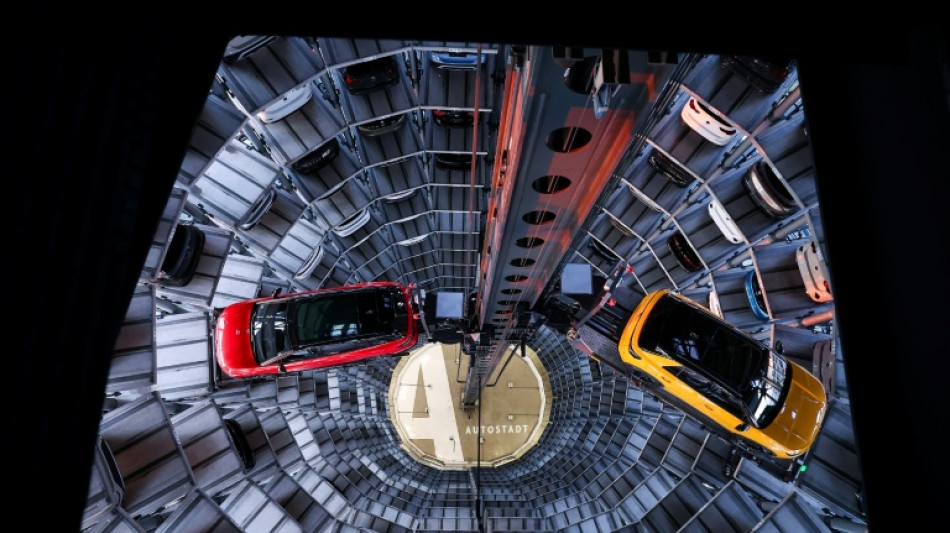
Germany brings back electric car subsidies to boost market / Photo: Ronny HARTMANN - AFP

 Gauff says online abuse was 'draining' after China Open exit

 As sector struggles, Porsche puts luxury ahead of volume
 'It's personal': Fiji minister pushes better climate finance at pre-COP

 Russia glosses over dark Soviet past in reinvented museum

 UK tax body opened probe into Man City in 2018: FT

 Yemen's Houthis claim new attacks on Saudi airports as conflict deepens
 Germany factory production at highest level for 18 months
 Thailand floods death toll rises to 60 since mid-September

 US pushes Russia for information on plague reports

 Myanmar leader lands in Malaysia for migrant return talks

 Indian central bank hikes rates for first time since 2023

 US military on Okinawa face curfew, alcohol ban after murder case

 Fierce lobbying in EU over 'forever chemicals'

 Dodgers beat Braves and Padres avoid sweep in MLB playoffs

 Mourning, war and elections as Israel marks October 7

 Messi says Argentina retirement is 'saddest day of my career'
 Oil rises and stocks fall as Hormuz worries flare

 Pacific presses world for help 'surviving' climate change at pre-COP summit

 Verstappen revival to be put to the test in steamy Singapore

 US woman who survived botched execution is conscious, speaking: lawyers

 Climate champion Australia digging more coal
 Emotion, tears as Messi retires from Argentina national team

 Dodgers push Braves to the brink of MLB playoff exit

 Crisis-stricken Haiti postpones elections

 N. Korea's Kim pledges 'invariable support' in Putin birthday letter

Germany on Monday reintroduced electric car subsidies as it seeks to accelerate the transition to less polluting vehicles, drawing praise from industry groups but criticism from environmentalists who demanded greater efforts.
Sales of electric vehicles (EVs) in Europe's biggest auto market are growing but progress has been patchy, and the government and the struggling auto sector are keen to speed up the shift.
The previous government scrapped an earlier subsidy scheme in 2023 due to a budget crisis, prompting a collapse in EV sales, although they have been recovering in recent times.
The new programme "helps the environment, the automotive industry, and in particular families who otherwise couldn't afford a new, environmentally friendly car," said Environment Minister Carsten Schneider.
Private households with a taxable income of no more than 80,000 euros ($93,000) will be eligible for subsidies, Schneider announced.
Car buyers can apply for the support from May, which will apply to EVs registered from the start of 2026, he said.
Fully electric cars are eligible for a subsidy of at least 3,000 euros. Plug-in hybrids and cars with range extenders -- in which a small combustion engine can charge the battery -- are covered by a basic subsidy of 1,500 euros.
There are extra subsidies for families with children as well as households on lower incomes.
The IG Metall union, which represents many auto sector workers, welcomed the scheme as an "an important step in the right direction".
The VDA auto industry group said the programme will "support the success of e-mobility in Germany" although it urged other steps, such as improving charging infrastructure.
But the group Environmental Action Germany voiced criticism, especially of subsidies for plug-in hybrids, which it said "offer hardly any climate benefits" over combustion engine cars.
"The government is still failing to implement effective climate protection policies in the transport sector," said the group's chief Juergen Resch.
German carmakers -- already struggling with slowing sales and fierce competition -- desperately need electric sales to rise as they invested hugely in the EV shift and also face strict new European environmental rules.
Though the European Union in December proposed scrapping a planned 2035 ban on new combustion-engine vehicles, carmakers would still face having to cut emissions by 90 percent from 2021 levels under its latest plan.
After plunging in 2024 following the end of the last subsidy programme, German EV sales rebounded in 2025 and represented almost a fifth of all new cars sold.
A.AbuSaada--SF-PST