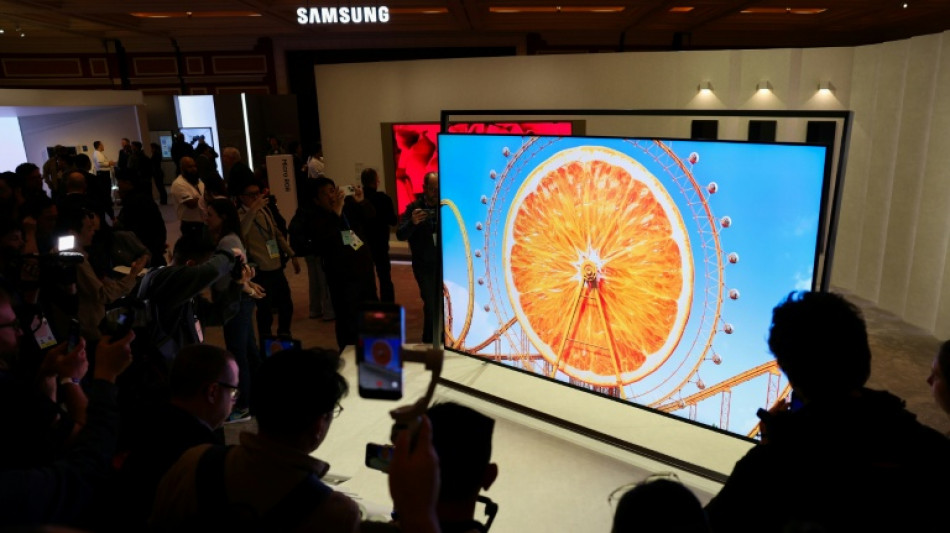
TV makers tout AI upgrades at CES, as smartphone threat looms / Photo: Patrick T. Fallon - AFP

 US woman who survived botched execution is awake and speaking

 From 1800s to modern pharma: a Nobel-winning chemistry quest

 Southampton boss Eckert given suspended ban over 'Spygate'
 Russia warns of 'false' information as second plague case reported

 IEA ready to release more oil reserves if necessary

 HSBC 'consults' over UK unit job cuts amid AI adoption

 UK court quashes five ex-traders' Libor rate rigging convictions

 XM Receives “Global Customer Experience Leader Award 2026” at the TrustFinance Performance Awards

 Stocks slide as oil climbs on Mideast flareup

 Heavy casualties in Ukraine after Russian strikes

 French wine harvest set to hit historic low

 Kyiv 'cannot agree' to EU membership limiting food exports: minister

 Arteta targets more Arsenal glory after signing new deal until 2030

 Russell hit with Singapore grid penalty for taking new power unit

 Spotify expands audiobooks to more than 180 markets

 French-Japanese duo wins chemistry Nobel for solving molecular 'mystery'

 England's Nations League surge helps heal World Cup wounds
 Mayor of opposition stronghold Izmir defects to Erdogan party

 Mertens beats Gauff to set up Swiatek clash at China Open

 Benin full of pride at role in Messi's last dance

 France suspends stun grenade use at student protests ahead of PM speech

 Indonesian court hears 'negligence' complaint against state over fires, haze

 Rubio in Greece to urge against Western civilisation 'decline'

 Micron workers at Taiwan plant vote in favour of strike

 In 'The Social Reckoning,' Jeremy Allen White takes on Facebook's 'frightening' ambition

A century after Scottish inventor John Logie Baird demonstrated the first mechanical television system, TVs face mounting competition from a much more recent invention: smartphones.
But with a suite of new models boasting massive screens, richer imagery and artificial intelligence enhancements -- on display this week at the Consumer Electronics Show in Las Vegas -- manufacturers don't plan on TVs being relegated to the dustbin of history.
The proportion of daily viewing on TV sets declined from 61 percent at the start of 2017 to 48 percent late last year, according to market tracker Ampere Analysis. Smartphone viewing, meanwhile, nearly doubled over that same period to 21 percent.
"This is the battle between big screens, which are traditionally for older people who grew up around televisions, and younger people who have either a phone, tablet, or laptop on which they're doing their consumption," said Patrick Horner, leader of TV research at Omdia.
He said that in China, seen as a trendsetter in the global market, young consumers are shunning large-screen televisions in favor of smartphones or tablets.
Around the world, television ownership is constant or declining, with average selling prices also holding steady or dropping, according to Horner.
One way for TV makers to protect or increase revenue when unit sales don't rise is to get people to buy ever larger and smarter screens, at a higher price.
- TVs get personal -
Those massive screens once again starred at CES, with producers touting AI to personalize experiences and sharpen picture quality.
Also in the spotlight was "Micro RGB" technology that dramatically ramps up picture quality using ultra-precise control of colors in LED displays.
Samsung Electronics, the top TV seller for 20 consecutive years, unveiled what it billed as the world's first 130-inch Micro RGB TV and spoke of packing AI into its products.
"We will embed AI across every area, every product, and every service," Samsung device experience division chief executive TM Roh said during a media event.
Hisense, LG, Samsung, Sony, and TCL were also at CES.
AI is being used to improve picture and sound quality, as well as help people find shows they want or ask questions about what they're seeing.
"I am really curious to see if most brands at CES can actually prove their new AI devices live up to their claims," said Forrester principal analyst Thomas Husson.
- Amazon vs Walmart -
Behind the scenes, e-commerce titans Amazon and Walmart are shaping the future of television as they vie for dominance -- not in selling TVs, but in advertising and e-commerce.
"This is really a knockdown, drag-out fight between Amazon.com and Walmart," Horner told AFP.
Walmart closed a $2.3 billion deal to buy TV maker Vizio in late 2024, as a strategic response to Amazon boosting sales through advertising on its Fire smart TVs and devices, often through its Prime Video streaming service.
"Amazon was putting advertisements on television programming for things that Amazon sold," Horner said. "So now Walmart is going to be putting advertisements on your television for things that Walmart sells."
And the profit margin on selling ads dwarfs the markup on selling TV hardware.
Walmart is expected to sell more than a million of its "Onn" brand TVs monthly and use an operating system it acquired with Vizio to pump advertising to viewers.
"Televisions are no longer about making profit from TV hardware," Horner said. "They're an ad delivery device being inserted into your living room to boost e-commerce sales."
J.Saleh--SF-PST