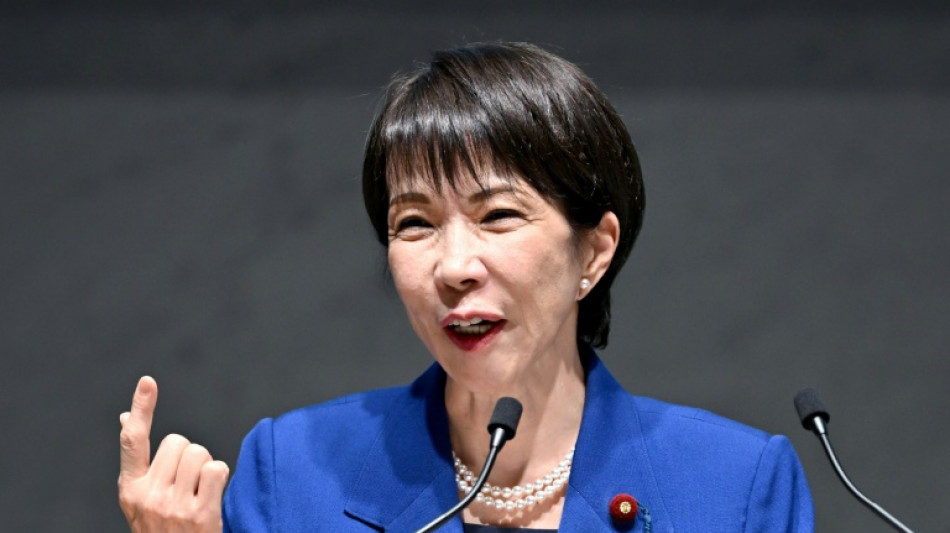
Japan govt approves record 122 trillion yen budget / Photo: Kazuhiro NOGI - AFP

 Golf star Rahm quitting LIV tour over 'unacceptable' terms

 Thousands march fearing return of a Bolsonaro presidency in Brazil

 French PM denies police ordered to confront student protesters

 Rubio touts US power, calls on Europe to emerge from 'slumber'

 Trump says 'we don't think' Russian plague is bio-weapon

 Five children among 26 killed in Ukraine after Russian strikes

 Man City should 'accept' punishment for rule breaches, says Lineker

 US woman who survived botched execution is awake and speaking

 From 1800s to modern pharma: a Nobel-winning chemistry quest

 Southampton boss Eckert given suspended ban over 'Spygate'

 Russia warns of 'false' information as second plague case reported

 IEA ready to release more oil reserves if necessary

 HSBC 'consults' over UK unit job cuts amid AI adoption

 UK court quashes five ex-traders' Libor rate rigging convictions

 XM Receives “Global Customer Experience Leader Award 2026” at the TrustFinance Performance Awards

 Stocks slide as oil climbs on Mideast flareup

 Heavy casualties in Ukraine after Russian strikes

 French wine harvest set to hit historic low

 Kyiv 'cannot agree' to EU membership limiting food exports: minister

 Arteta targets more Arsenal glory after signing new deal until 2030

 Russell hit with Singapore grid penalty for taking new power unit

 Spotify expands audiobooks to more than 180 markets

 French-Japanese duo wins chemistry Nobel for solving molecular 'mystery'

 England's Nations League surge helps heal World Cup wounds

 Mayor of opposition stronghold Izmir defects to Erdogan party
The Japanese government on Friday approved a record budget for the upcoming fiscal year, to pay for everything from bigger defence spending to ballooning social security costs as inflation persists.
The 122.3-trillion-yen ($782 billion) budget for the fiscal year from April 2026 will include some nine trillion yen for defence spending, as Prime Minister Sanae Takaichi aims to accelerate Tokyo's sweeping upgrade of its military in the face of worsening relations with China.
The defence ministry said in a briefing document that "Japan faces the most severe and complex security environment since the end of the war," stressing the need to "fundamentally strengthen" its defence capabilities.
At the core of its request is 100 billion yen for the so-called SHIELD coastal defence system, which would marshal drones to block any invasion by foreign troops.
Japan is hoping that SHIELD -- Synchronised, Hybrid, Integrated and Enhanced Littoral Defence -- will be completed by March 2028, with no details yet on which part of Japan's coastline it will be linked to.
The 122-trillion-yen figure compares with the 115 trillion yen sought for the current fiscal year to March, which was also a record.
The expanding budget comes as the market worries about Takaichi's big spending policies adding to Japan's public debts.
Japan already has the biggest ratio of debt to gross domestic product (GDP) among major economies, projected to reach 232.7 percent this year, according to the International Monetary Fund.
Earlier this month parliament approved a massive extra budget, to pay for a 21.3-trillion-yen stimulus announced a month earlier.
The market has reacted by driving down the value of the yen while the benchmark yield rose for Japanese government bonds.
Some observers have drawn comparisons to the UK's 2022 bond market turmoil under then-premier Liz Truss.
Takaichi has advocated big government spending to spur economic growth.
"What Japan needs right now is not the undermining of our strength as a nation through excessive austerity fiscal policies, but rather the bolstering of our national strength through proactive fiscal policies," she told a press conference last week.
In an interview Tuesday with the influential Nikkei business daily, Takaichi stressed her commitment to Tokyo's fiscal health, rejecting any "irresponsible bond issuance or tax cuts."
The current size of the budget is unlikely to shock the bond market, Takahide Kiuchi, executive economist at Nomura Research Institute, wrote in a note ahead of Friday.
But an increase to around 125 trillion yen or more, he said, would cause the "turmoil in the bond market, already in crisis mode, to deepen further".
Kiuchi noted that, under Takaichi, the extra budget quickly ballooned, reaching $18 trillion yen.
"Financial markets are likely on high alert for a similar occurrence. Should the fall of the yen and bond prices further accelerate due to the size of the budget, it would increase worries about adverse effects on the economy and people's lives."
A weaker yen raises prices of imports for resource-poor Japan, which relies heavily on foreign food, energy and raw materials to power its economy.
Takaichi came to power in October with a pledge to fight inflation after anger over rising prices.
Another challenge facing the country is its ageing population, caused by chronically low birth rates and a cautious approach to immigration.
The draft budget needs to be approved by parliament.
T.Samara--SF-PST