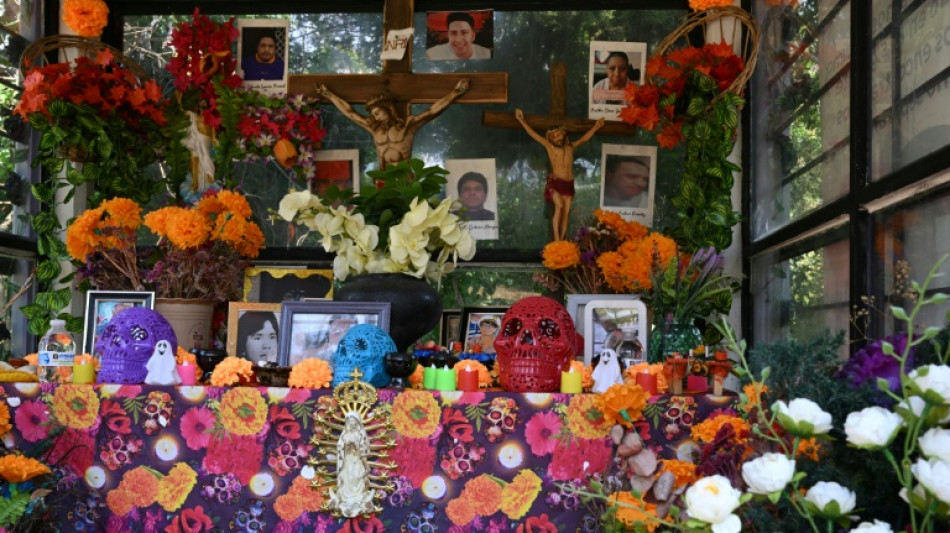
Inch by inch: the search for Mexico's disappeared in a city cemetery / Photo: Yuri CORTEZ - AFP/File

 The British historian helping the French rediscover de Gaulle
 Dodgers beat Braves to advance, Guardians survive in MLB playoffs

 Latin American, Caribbean women top Nobel literature buzz
 US says Fiji-based Chinese official paid bribes for Beijing

 After botched US execution, Christa Pike was nearly taken off life support

 Guinea-Bissau junta urges military unit loyal to ex-president to disarm

 As species decline, green turtles offer glimmer of hope

 Brothers Scott and Beauden Barrett named to start for All Blacks

 EU trade chief seeks to dial down China tensions

 'Never again Bolsonaro': thousands march ahead of Brazil election runoff

 After botched execution, US woman was nearly taken off life support before revival
 Searing AIDS drama 'Elsinore' opens London film festival

 Evicted pensioner who sparked Spain housing protests dies: tenant union

 Golf star Rahm quitting LIV tour over 'unacceptable' terms

 Thousands march fearing return of a Bolsonaro presidency in Brazil

 French PM denies police ordered to confront student protesters
 Rubio touts US power, calls on Europe to emerge from 'slumber'

 Trump says 'we don't think' Russian plague is bio-weapon

 Five children among 26 killed in Ukraine after Russian strikes

 Man City should 'accept' punishment for rule breaches, says Lineker
 US woman who survived botched execution is awake and speaking
 From 1800s to modern pharma: a Nobel-winning chemistry quest

 Southampton boss Eckert given suspended ban over 'Spygate'

 Russia warns of 'false' information as second plague case reported

 IEA ready to release more oil reserves if necessary
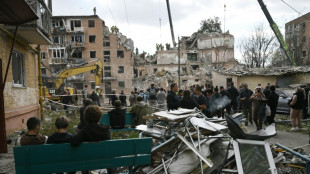
Elizabeth Alvarez has been searching for her brother since 2013, when the 31-year-old left his home to run an errand in Mexico City.
For 12 years she had no news of his fate until she learned in early November that he had been run over and may be buried in a mass grave in a cemetery some 20 kilometers (12 miles) from her home.
The news brought a measure of closure but also reopened old wounds.
"It's been so many years. You don't want to find him like that," Alvarez, a 45-year-old housewife, told AFP.
Victor Manuel Alvarez is one of the more than 120,000 people that have vanished in Mexico since the 1950s -- the population of a small city -- many of them abducted and killed by drug cartels.
The number rocketed after 2006 when the government went to war against drug traffickers, touching off a conflict that has left nearly half a million people dead.
One of the symbols of the conflict is the clandestine mass graves that have popped up across the country, used by criminals to hide the bodies -- or parts of bodies sometimes found decapitated -- of their victims.
But authorities in Mexico City also dig mass graves, to house the hundreds of bodies discovered each year that are never reclaimed or identified.
The remains of these invisible dead end up in Dolores Cemetery, Mexico's largest, situated in Chapultepec Forest.
Codes like "L.3" or "F.1" were the only forms of identification AFP saw on unmarked graves in a wooded area where forensic experts earlier this month began the monumental task of exhuming and trying to identify the dead.
Authorities hope to identify over 6,600 people among the thousands buried in 75 mass graves at the site.
Luis Gomez Negrete, head of Mexico City's Missing Persons Search Commission, welcomed the operation, which, he stressed, "no public institution had ever undertaken in the past."
Not all those buried in the mass graves are victims of drug cartels.
But a wave of homicides linked to organized crime has triggered a forensic crisis, resulting in overflowing morgues and a massive backlog of bodies waiting to be identified.
Despite being relatively spared by cartel warfare, Mexico City is struggling to name all its dead.
Each year around 500 people are buried in unmarked graves in Dolores Cemetery.
- Fifteen deep -
Elizabeth Alvarez struggles to understand how it took so long to learn her brother's fate.
"Why did they let so much time pass?" she wonders.
The exhumation efforts launched this month began with bodies recovered between 2013 and 2015 -- the period during which Victor Manuel was killed.
The grave in question is 15 layers deep, with bodies buried one on top of the other.
"We have no idea what condition the bodies will be in," one official told AFP, speaking on condition of anonymity because of the sensitivity of the topic.
In the first five days, forensic experts gingerly removed earth, millimeter by millimeter, recovering 3,463 bone fragments.
But they had yet to identify a single victim.
"We have to search for even the smallest part... it's not about removing complete bodies," one of the firefighters involved in the excavations told AFP.
- 'Even a tiny bone' -
Identifying the remains could take years.
But the relatives of the missing are prepared for the wait.
Maria del Refugio Palacios, 40, knows that her 71-year-old mother, who disappeared in September 2024 while walking to her daughter's house in Mexico City, won't be found quickly.
"We're going to have to wait a very long time" until the exhumation teams work their way up to the more recent graves, she told AFP as she watched the teams at work.
But the partial remains already recovered give her hope that her search may soon be nigh.
"Even a tiny bone makes a difference," she said.
Z.AlNajjar--SF-PST