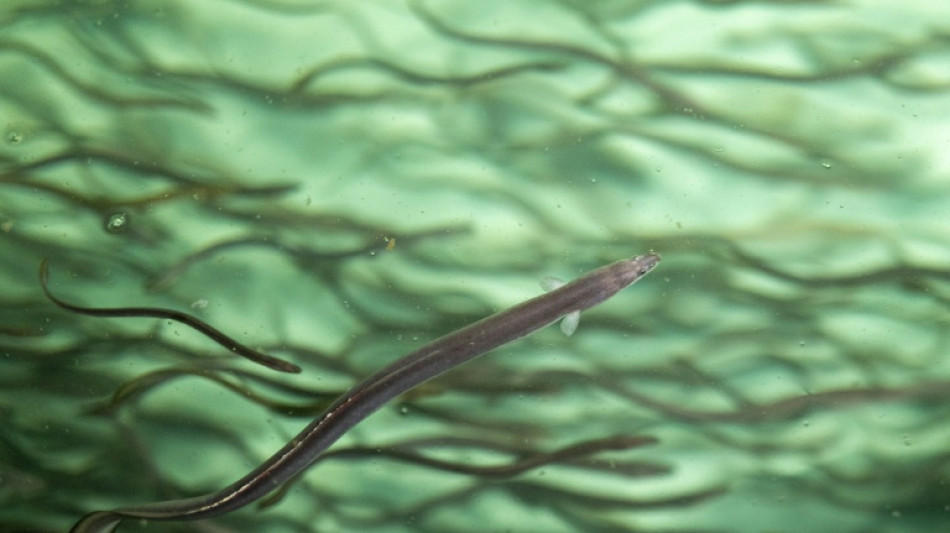
Wildlife trade body rejects new eel protections / Photo: Philip FONG - AFP/File

 The British historian helping the French rediscover de Gaulle

 Dodgers beat Braves to advance, Guardians survive in MLB playoffs

 Latin American, Caribbean women top Nobel literature buzz

 US says Fiji-based Chinese official paid bribes for Beijing

 After botched US execution, Christa Pike was nearly taken off life support

 Guinea-Bissau junta urges military unit loyal to ex-president to disarm

 As species decline, green turtles offer glimmer of hope

 Brothers Scott and Beauden Barrett named to start for All Blacks

 EU trade chief seeks to dial down China tensions

 'Never again Bolsonaro': thousands march ahead of Brazil election runoff

 After botched execution, US woman was nearly taken off life support before revival

 Searing AIDS drama 'Elsinore' opens London film festival

 Evicted pensioner who sparked Spain housing protests dies: tenant union

 Golf star Rahm quitting LIV tour over 'unacceptable' terms

 Thousands march fearing return of a Bolsonaro presidency in Brazil

 French PM denies police ordered to confront student protesters

 Rubio touts US power, calls on Europe to emerge from 'slumber'

 Trump says 'we don't think' Russian plague is bio-weapon

 Five children among 26 killed in Ukraine after Russian strikes
 Man City should 'accept' punishment for rule breaches, says Lineker

 US woman who survived botched execution is awake and speaking

 From 1800s to modern pharma: a Nobel-winning chemistry quest

 Southampton boss Eckert given suspended ban over 'Spygate'

 Russia warns of 'false' information as second plague case reported

 IEA ready to release more oil reserves if necessary

The world's top wildlife trade body rejected new protections for eels on Thursday in a secret ballot at talks in Uzbekistan.
The proposal had been fiercely opposed by top eel consumers, particularly Japan, but also failed to win backing from countries worried about new trade regulations.
The vote came at a meeting of signatories to the Convention of International Trade in Endangered Species of Wild Fauna and Flora (CITES), a 50-year agreement protecting the world's most endangered animals and plants, and regulating trade in 36,000 species.
Eel populations are falling worldwide, scientists say, largely due to factors linked to human activity such as the pollution of waterways, destruction of wetlands, hydroelectric dams, and fishing.
European eels are considered critically endangered and their trade has been restricted by CITES since 2009.
But because eels cannot be bred in captivity, much of the trade is in wild-caught baby eels, with one species virtually indistinguishable from another.
The European Union and Panama sought to bring all 17 eel species under CITES Appendix II, placing new restrictions on trade.
"Every eel we eat comes from the wild, making them vulnerable to overfishing and illegal trade," the EU's representative warned.
The "harvest for international trade is a major cause of international decline."
The proposal was rejected out of hand by Japan, which called it unscientific and "excessive," backed by multiple countries including African nations who warned it would place undue administrative burdens on their authorities.
In a sign of the pressures around the issue, the proposal was voted on by secret ballot, a relatively uncommon procedure at the gathering, with nearly 75 percent of votes against.
The result was "not very surprising," said Oliver Tallowin, senior programme officer for wildlife use and trade at the International Union for the Conservation of Nature.
Japan's opposition had been made clear early on in a submission running over 100 pages.
There are also differing views on the pressures other eel species face, said Tallowin.
"International trade has to be a threat to the species and... that was something we couldn't say with any sense of certainty," he told AFP.
For Andrew Kerr of the Sustainable Eel Group, "the short-term commercial and financial side won the debate massively."
Kerr, who has called eel trafficking the "greatest wildlife crime" on the planet, said the vote was a "real pity," but there were some silver linings.
A separate resolution proposing measures including more data gathering on eels and conservation capacity-building will be debated later Thursday at the talks in Samarkand.
"We've had a missed opportunity this morning, but then the fact that everyone's talking about eel, that's a huge victory too," Kerr said.
The resolution could gather data that would allow more protection of all eel species in the future, added Tallowin.
"Once something has been rejected... that doesn't mean its going to go away."
Votes are finalised later in the meeting, though it is unusual for them to be revised.
A.AlHaj--SF-PST