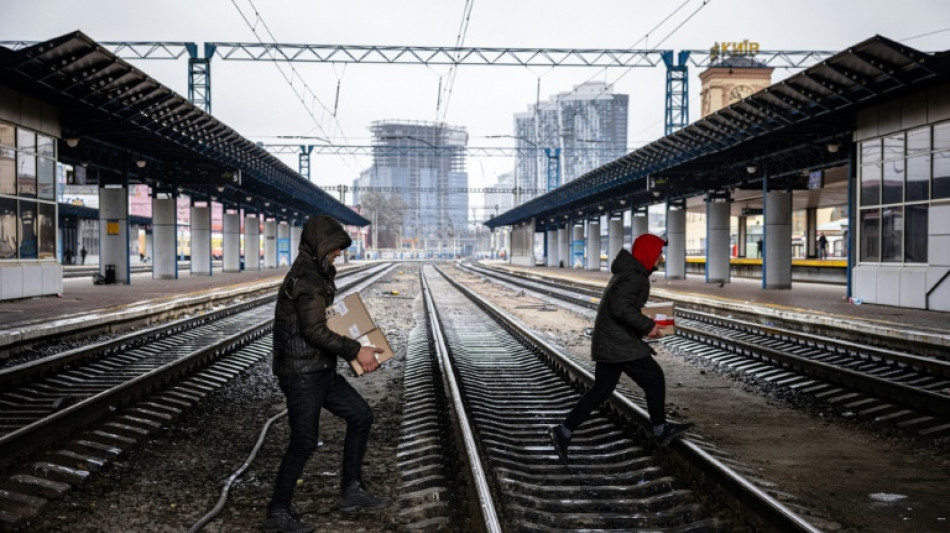
Return to Kyiv by night train / Photo: Dimitar DILKOFF - AFP

 Billionaire Ambani's Jio to debut after record India IPO
 UK set for cautious budget as borrowing costs climb
 Anthropic's record IPO faces some big questions
 US Fed expected to hold rates steady ahead of key midterm elections

 Can this Latin Grammy-winner help Democrats win back Congress?
 Tuvalu has 'limited' power to halt its fossil fuel investments: NZ govt papers seen by AFP
 Palestinian activist Khalil returns to Columbia after US detention

 Trump drastically loosens oil and gas methane rules

 French Senate weighs bill to make protesters pay for unrest damage
 الأردن يعلن القبض على ثلاثة متهمين بهجوم كنيسة الكرك

 استقالة رئيس ونائب رئيس وعضوين من مجلس إدارة يونيكاي للأغذية

 Charles tackles thorny legacy of slavery on Caribbean trip

 Arsenal stunned by fourth-tier Fleetwood in League Cup
 افتتاح وقف المحميد في دبي لدعم الأسر محدودة الدخل والحالات الإنسانية

 Brazil's Flavio Bolsonaro flees to US after election loss
 صقر غباش يدعو بريكس إلى تعميق أثرها في التوازن والتنمية الدوليين

 Flavio Bolsonaro headed to US after Brazil election defeat: US media

 American woman convicted of getting military training from Islamic State

 Alcaraz and Zverev win Vienna openers
 Israel opposition holds narrow edge over Netanyahu in first projections

 جائزة الأمير ألبرت الثاني تكرم ابتكار مبادرات محمد بن راشد في العمل الخيري

 ماسا الرفاعي تمثل أصغر المشاركات في نهائيات تحدي القراءة العربي

 Syria condemns deadly Jordan strikes as 'unacceptable violation'

 England's Fin Smith in race against time to face Australia

 Storied Paris department store seeks bankruptcy protection

When the train slows to a halt just after the Polish border, Tatiana's smile lights up her moon-shaped face.
"Ukraine!"
Like the other passengers on the train linking the Polish city of Chelm to Kyiv, Tatiana and her mother, Valentina, have decided after four months in exile that it is time to come home, despite the war, despite the uncertainty.
The two women -- who declined to give their surname -- hail from Kryvyi Rig, President Volodymyr Zelensky's hometown in central Ukraine.
They fled abroad right at the start of the Russian invasion on February 24 to join friends living in Izmir, in Turkey.
Tatiana, who worked in the capital, Kyiv, as a sales representative for a marketing firm, continued her job remotely from Turkey.
"Four months is enough, though. It's not easy living in a country where you don't know anything and you don't speak the language," she explained.
"I don't know what's going to happen or when the war will end, but we're going home."
A third of the 7.3 million people who have fled Ukraine since the start of the war have, like Tatiana and Valentina, decided to return.
In the capital -- where a semblance of normality has resumed since Russian forces withdrew from the region in April -- two-thirds of residents have decided to come back.
- 'If they're not dead' -
Many of the passengers on the sleeper train are women and children.
One of the handful of male travellers, a man in his 30s, spends long hours standing in the corridor gazing silently out of the window at the green Ukrainian countryside.
After two months away, Maxime is going to Donbas, the industrial region in the east that Russia is going all-out to seize and where the war rages without respite.
The shelling is relentless and the Russian forces are slowly but surely gaining territory at huge cost to human life. The destruction is massive.
"I've got some people to go and see there. If they're not dead," Maxime says baldly.
No one seems to bother much about the long hours of waiting on the Polish side of the border and then again on the Ukrainian side.
The journey is going to take more than 15 hours, so why get impatient?
The passengers appear to be joined by a subtle, intangible thread. Whatever their personal stories, whatever their reasons for coming back -- and in most cases they don't wish to elaborate -- they are linked by this decision to return.
- Look after yourself -
Two young women who didn't know each other before talk quietly in the corridor until late into the night.
An Ed Sheeran song at low volume drifts from one of the carriages.
The blonde ticket collector, bossy but sympathetic, passes up and down taking orders for tea and water and checking everyone is comfortable.
The same calm reigns as the train approaches Kyiv in the early morning light.
But there are more damp eyes and the atmosphere becomes more solemn.
A good-natured supervisor, who made the journey in shorts and flipflops, changes into his white-shirted uniform.
The travellers carefully fold their beds away and empty their bins.
The train pulls into the station.
The guard unloads the cases and helps passengers down onto the platform, where husbands, fathers and brothers are waiting for their families, bouquets of flowers in hand.
Tatiana, still beaming, bids farewell to her travelling companions. She tells them to look after themselves.
G.AbuOdeh--SF-PST