Ivorian brothers dream of transforming cocoa industry / Photo: Issouf SANOGO - AFP

 Venezuela's Maduro, wife hit with new US torture charges
 Argentina friendlies no fairy tale for African footballers
 US suspending Microsoft from visa program: Vance

 Man City must 'stick together' during crisis, says Haaland
 CAS opens hearing into Senegal AFCON title appeal

 UK police agree searches for ex-prince Andrew's homes 'unlawful': judge
 After botched US execution, Christa Pike walking, mentally 'foggy': lawyer
 'Stunned' Madrid mourns pensioner who sparked housing protests
 High school students turn out for new protests across France
 Bid by Italy's Intesa bank to take over MPS gets boost

 Stablecoins Are Quietly Becoming Business Infrastructure, NOWPayments Data Shows
 Oil surges, stocks sink as US reportedly eyes new Iran strikes
 Woman in botched US execution walking, mentally 'foggy': lawyer
 Farhan hopes Pakistan's new combination takes off in Sri Lanka T20Is

 Teenager Andreeva seals China Open semi-final with Bartunkova
 Britain's Burnham says open to Germany joining warplane project
 Kovac's tough love has Dortmund dreaming of title charge
 China announces candidate for WHO chief

 South Korea test-fires its first homegrown hypersonic weapon: presidency

 ONAR Advances Nasdaq Listing Preparation Following Advertise Purple Acquisition and Financing

 Thailand opens extradition process for reporter sought by China
 France struggles to wean social housing off gas
 Germany lifts GDP forecast as economy withstands Iran war
 Sri Lanka appoints Kusal Mendis as Test captain
 Norris confident McLaren can shine in Singapore
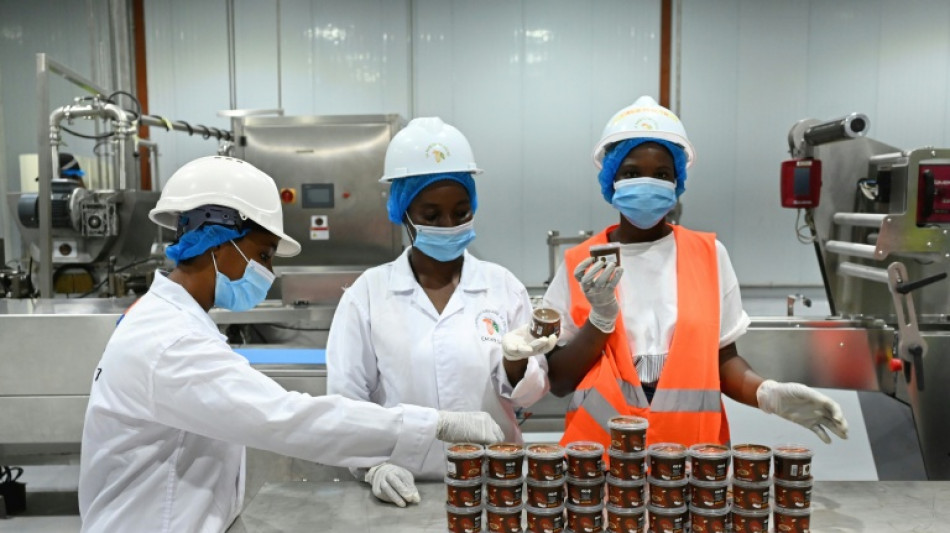
In a factory in southern Ivory Coast, where machines hum to produce chocolate bars and spreads, twin brothers dream of becoming "giants of cocoa processing".
Ivory Coast, which holds its presidential election this Saturday, is the world's leading cocoa producer but only processes about 40 percent locally while the rest is exported.
Fousseni and Alahassane Diakite, 33, opened a processing factory in August in their hometown of Divo, situated in a cocoa-dependent region some 200 kilometres (124 miles) from the economic capital Abidjan, with hopes of closing the gap.
Stored in jute sacks, the beans are roasted to unleash their aroma, shelled, and then ground.
The factory has a processing capacity of 36,000 tons annually, with a target of 80,000 tons.
Comparatively, US giant Cargill, Switzerland's Barry Callebaut, and Singapore's Olam each process between 100,000 and 200,000 tons of cocoa annually in the west African nation.
The twins' added value lies in "the quality of our products, our services," and their story, they told AFP.
Sons of a producer, "we are the pure products of Ivorian cocoa," said Fousseni, asserting that they are now realising their "dream".
"We were sure that what we were going to do was not just for us, but also to inspire other generations," he said.
A few years after earning their high school diplomas, they created a union of cooperatives bringing together over 4,000 producers.
They then founded their first company to create products for the pharmaceutical and cosmetic industries, such as cocoa butter, from the inedible parts of a cocoa pod.
Later, a second company was launched to process cocoa for food products.
Alahassane earned a business degree in Abidjan and has now pursued training at the HEC Paris business school.
Fousseni, meanwhile, has taken up practical training in agroforestry and agronomy.
"We complement each other," Alahassane said.
While their cosmetic materials are exported "where there is demand", he said, their chocolate for consumption is sold in Ivory Coast at competitive prices.
In stores, most chocolate bars, often European brands, cost between 2,500 and 4,000 CFA francs ($4 to $7), while the brothers' bar costs 1,200 francs ($2).
Their small jar of spread is sold at the unbeatable price of 100 francs.
At a time of growing demand for ethical products, "all our productions are traceable," assured Alahassane, while his brother specified that the factory's machines run on renewable energy.
- Creating jobs -
Cocoa accounts for five million jobs in Ivory Coast, or one-sixth of the population.
The government-set price of cocoa paid to growers is at a record level of 2,800 CFA francs per kilo.
A few kilometres from Divo, in a shaded plantation carpeted with cocoa tree leaves, Kanga Prudence N'Guessan was cutting yellow pods with a machete.
"Our wish... is not to send our cocoa outside our country... when processing is done there, it becomes two or three times more expensive," he said.
At another plantation, 49-year-old grower Harouna Ouattara agreed, saying, "local processing is insufficient."
"The first obstacle to cocoa processing is the issue of financing," explained Fousseni.
Their factory cost nearly 50 million euros ($58 million), the brothers noted, without specifying the source of the funds.
The second obstacle has been the lack of qualified labour.
Still, the brothers said their factory has created 1,000 direct and indirect jobs, primarily for locals.
Technical jobs are held by young people trained in major cities.
Salimata Ouattara, a 35-year-old chemist, studied in the southern port city of San Pedro.
In her white coat, between analyses, she said she wants to "help the youth here who don't have much knowledge about industrialisation."
E.Qaddoumi--SF-PST