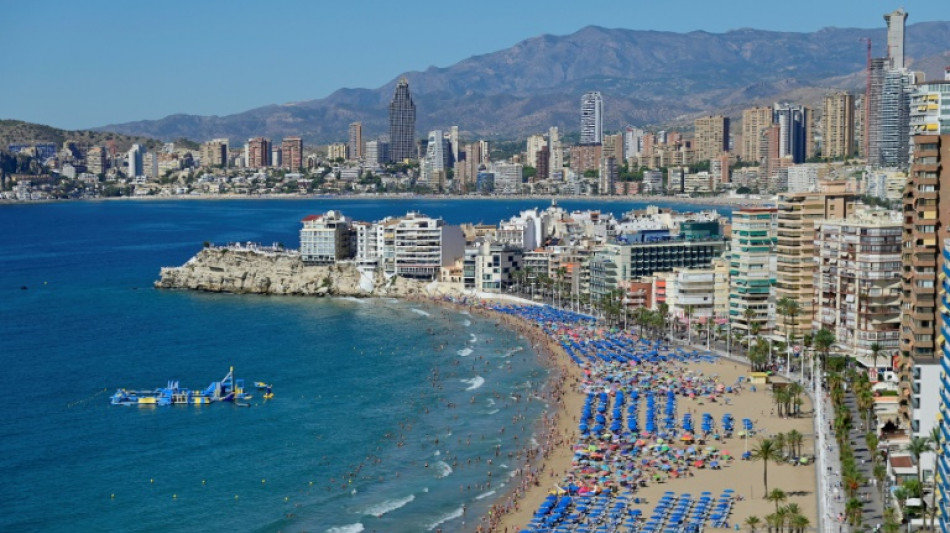
Spain's Benidorm embraces its Franco-era mass tourism model / Photo: Jose Jordan - AFP

 CNN, MS Now, Politico urge judge to extend White House access

 Trump administration to launch new vaccine research center

 Russian strikes kill 30 in Ukraine frontline city, talks set in US

 US military to livestream firing squad execution of Fort Hood shooter

 Aces star Wilson wins record-extending fifth WNBA MVP

 Undefeated 49ers seek Seahawks revenge

 Madrid mourns evicted retiree, 'icon' of Spain housing protests

 OpenAI revenue gap report rattles AI stocks

 France pledges more teachers after school students vow no let-up

 Bordeaux confirmed in sixth tier of French football

 Trump gives 'national treasure' Musk top US medal after rift
 MLB proposes shortening season, reforming playoffs

 Crew splashes down after 8-month mission on International Space Station

 Protests, clashes as S. African anti-migrant tensions reignite

 Russian data centre hit by drone in first for Ukraine war

 'Fighting for our future': France high school students vow no let-up

 Kyiv entering 'survival' mode amid Russian strikes surge: mayor tells AFP

 Verdict due in Mexico trial over murders of Australia, US surfers

 B2PRIME Welcomes Christina Barbash as Commercial Manager

 Russia forcing Kyiv into 'survival' mode before winter, mayor tells AFP

 Closing arguments begin in Maradona death trial

 UEFA president Ceferin to stand for re-election in 2027

 Nearly 300,000 Nepalis at flood risk: study
 Riyadh kindergarten hit by interception debris as Houthis say targeted airport
 Alex Bodi mizează, alături de CRIF, pe investiții transparente și pe prevenirea riguroasă a spălării banilor
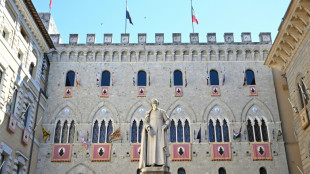
Fifty years after General Francisco Franco's death, Benidorm still clings to the mass tourism model it pioneered under his dictatorship, even as protests against overtourism sweep other Spanish holiday hotspots.
Built on bikinis, skyscrapers and package holidays, the industry reshaped socially conservative Spain's image abroad and brought in much-needed foreign currency.
"There are no car factories here, no soap factories. What we have is a factory of hotels, restaurants and businesses that make our visitors happy," said Angela Barcelo, 72, the owner of the Hotel Les Dunes in the Mediterranean beach resort.
Her grandmother opened it in 1957, when Spanish women needed their husband's permission to open a bank account.
"What Benidorm is today is thanks to the women," Barcelo said, recalling how local men were often away at sea while women managed the family assets and opened many of the first hotels and guesthouses.
A former seafaring village of whitewashed houses and just 3,000 residents, Benidorm has mushroomed into a city of more than 100 skyscrapers whose population swells to 400,000 on peak August days.
This transformation was the work of Pedro Zaragoza Orts, Benidorm's mayor from 1950 to 1966 and an enthusiastic supporter of the ultranationalist Falange movement that backed Franco's rule.
He saw foreign tourism as a safer alternative to seafaring, which had claimed the lives of many of his relatives, or farming.
- Bikinis and gay bars -
When foreign women began arriving on the beaches in bikinis, Spain's influential Catholic Church, which was closely aligned with the dictatorship, pushed back.
The bishop of the nearby city of Alicante clashed with Zaragoza, who faced the threat of excommunication, which carried significant social stigma at the time.
Franco himself tipped the scales when he sent his wife and daughter to holiday several times at Zaragoza's home in Benidorm -- a gesture widely seen as a blessing.
Zaragoza was also very socially conservative but he realised Spain needed to open up, historian Francisco Amillo, 76, who has lived in Benidorm for decades, told AFP.
"The income from foreign currency multiplied exponentially" once bikinis were allowed on beaches, he added.
Zaragoza proved adept at publicity stunts, inviting a family of the Sami people from Finland's Arctic region for a holiday that drew Nordic media coverage.
He also launched the Benidorm Song Festival, where Grammy Award-winning Spanish crooner Julio Iglesias began his career.
By the early 1960s, gay bars also appeared in the town, offering a refuge during Franco's authoritarian rule.
- 'Like New York' -
Zaragoza's model of selling sea and sun worked and was extended to other parts of Spain, which received some 94 million foreign visitors last year, making it the world's second most-visited country behind France.
Some 2.8 million of those foreign tourists headed to Benidorm, packing its seven kilometres (four miles) of wide, sandy beaches.
Criticised for decades for its high-rise skyline and dense crowds, in recent years it has been hailed as a model of sustainable tourism.
Concentrated housing occupies less land, minimises water loss, allows for quicker waste collection and reduces the need for cars, said the deputy chief engineer at Benidorm's city council, Vicente Mayor.
"Although tall buildings and urban density have been looked down upon, vertical growth is a very efficient model," he added.
Visitors remain loyal.
"It's got something for everybody. It's brilliant. It's got the bars, the madness down the strip. And it's got lovely tapas bars in the old town," said Stuart Reed who was visiting with his wife from Britain.
Others bristle at its reputation.
"When I tell friends I'm going to Benidorm, they say: 'What a horrible city!'" said Maribel Soler, a 68-year-old Frenchwoman.
"But that's because they don't know it. They've never been. They only judge the buildings," added Soler, who compared Benidorm to New York.
"And I love New York," she said.
E.Aziz--SF-PST