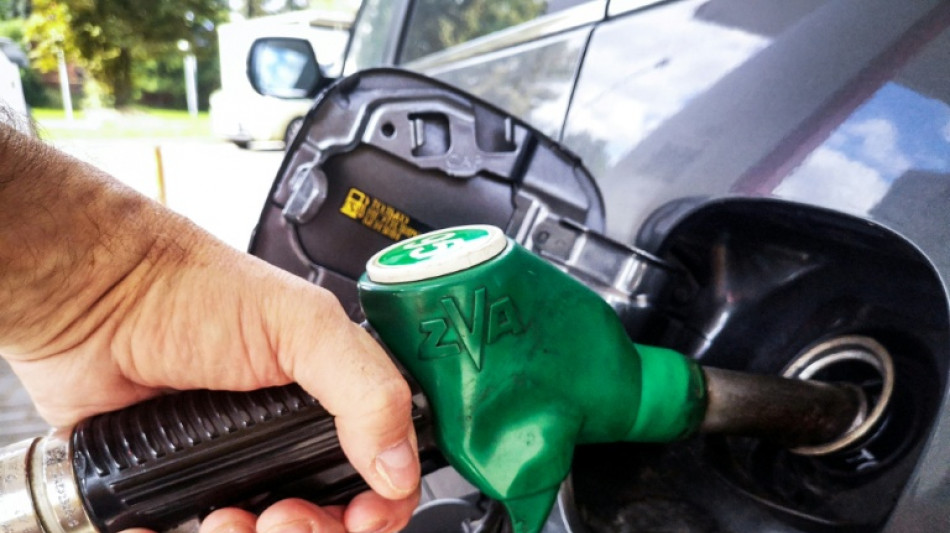
Fossil energy 'significant' driver of climate-fuelled heatwaves: study / Photo: Alexander NEMENOV - AFP/File

 Zverev churns out win in Shanghai Masters opener

 Hurricane Isaias strengthens en route to US Gulf Coast

 US activists deploy poll volunteers over Trump intimidation fears

 Saint Laurent designer Vaccarello leaves after glittering decade

 'Tough to stay here': Nepal flood survivors wait for homes

 Malaysia closes schools in capital, parts of country due to haze

 Buccaneers stun Cowboys for first win of NFL season

 Activists hope trial will stop 'forever chemicals' at Italy plant

 Guardians rally for 9-5 victory over White Sox to stay alive in MLB playoffs

 Asian stocks mixed amid AI concerns, oil dips after surge

 Wallabies expect fast-paced All Blacks in Bledisloe opener
 Tech scammer Elizabeth Holmes focus of documentary by absurdist Nathan Fielder

 Climate hopes shift from politics to the courts

 Will Nobel Peace Prize pick make waves at the White House?

 Trump rules out new Iran attack before US midterm elections

 Far-right influencer shows Israel's coarse political turn

 Seals and sea lions get hearing tested at Australia zoo

 Mourinho's Real Madrid playing catch-up in Clasico countdown

 Joy as USS Lincoln back home after troubled Gulf deployment

 OpenAI says Iran, Russia influence ops busted
 Anthropic bans 'cruel' behavior against its Claude AI

 Anne Carson's Nobel literature prize 'a proud moment for Canada': PM

 Montagliani to seek CONCACAF re-election in boost for Infantino: reports

 Oil surges, stocks sink on jitters over US plans in Iran war

 John Cena and Jessica Biel hit the gas in 'Matchbox: The Movie'

Fossil fuel and cement producers have contributed "significantly" to the growing number and intensity of climate-change-driven heatwaves, according to a study published on Wednesday in Nature.
An international team of scientists analysed more than 200 heatwaves around the world between 2000 and 2023 and found that climate change had made each of them more likely and more ferocious.
But they also took their attribution study one step further by teasing out the role of 180 major producers of polluting oil, gas, coal and cement.
They found emissions linked to these large companies contributed half of the increase in heatwave intensity compared to the pre-industrial era and also increased their probability.
The role of the 14 largest "carbon majors" -- including Saudi Aramco, Gazprom, Chevron and BP -- appears to be very significant, weighing as much as the 166 other companies studied.
The pollution from these firms has essentially been large enough to spark heatwaves, researchers said.
"Each producer alone can be enough to make heatwaves possible that would have been virtually impossible without climate change," said Yann Quilcaille of ETH Zurich, who led the study published in Nature.
Attribution studies generally measure the degree of influence of climate change on a particular extreme weather event.
To do this, scientists compare the current climate with a simulation of a climate that has not been warmed by human activities.
The latest study expanded the scope to a total of 213 heatwaves.
Researchers found that the influence of climate change had grown over time: it made heatwaves on average 20 times more likely between 2000 and 2009 and 200 times more likely from 2010 to 2019.
A quarter of the events studied (55 out of 213) were at least 10,000 times more likely. In other words, they would have been virtually impossible without global warming.
"We also show that emissions associated with the largest producers of fossil fuels and cement contribute significantly to heatwaves," Quilcaille told AFP.
Emissions from just one of these carbon majors would have been enough to cause events deemed 10,000 times more likely, they found.
- 'Leap forward' -
The authors took into account the entire value chain of the companies as well as the use of the products by customers. For example, they attributed to each oil group the emissions associated with the petrol it sold.
Pascal Yiou, from France's Laboratory for Climate and Environmental Sciences (LSCE), who was not involved in the study, told AFP it was "a summary of the current state of knowledge in heatwave attribution", playing down the effort to attribute the role of major polluters.
But Quilcaille said the study could aid corporate responsibility legal cases, which have not so far been able to draw on increasingly precise research linking carbon emissions with specific events.
In one, a Peruvian farmer sued German energy company RWE, accusing it of being indirectly responsible for the melting of a glacier near his home. In May, a German court rejected the case but recognised the principle of polluters' global responsibility for climate damage.
In a commentary published in Nature, Karsten Haustein, of the University of Leipzig, said the new research was a "leap forward" for climate litigation and diplomacy.
"It is another reminder that denial and anti-science rhetoric will not make climate liability go away, nor will it reduce the ever-increasing risk to life from heatwaves across our planet," said Haustein, who was not involved in the study.
Z.AlNajjar--SF-PST