US firefighters adapt to 'new hazards' in electric car blazes / Photo: - - Sacramento Metropolitan Fire District/AFP

 Rain halts India push after Dinusha century lifts Sri Lanka
 Dinusha hits century as Sri Lanka post 284 in first India Test

 Stocks steady as investors weigh US rate path
 Taiwan's leader says government to propose record defence spending for 2027
 Cambridge head slams 'feeding frenzy' over dead academic

 Ebola outbreak now DR Congo's deadliest ever

 Germany's coalition split over putting climate in constitution

 Ukraine badminton star: 'How can you feel normal when bombs are falling?'
 Rain brings respite as Belgium wrestles massive wildfire

 Most stocks rise as US data ease rate fears but fuel economic worries

 India take control of Galle Test as Sri Lanka slump to 99-5
 Australia's mushroom murderer appeals conviction

 The Nigerian fishing community being eaten up by the Atlantic

 Kushner to meet Netanyahu after talks with Hamas on Gaza plan
 Photos, memories all that remain for Colombia's bereaved after quake

 Sabalenka squeezes out win on sixth match point in Cincinnati

 Trump says US scaling back military drills with South Korea hours before start

 Jason Arday: UK academic who died amid plagiarism storm

 Sabbath cafe clash lays bare Israel faultlines
 Top-ranked Scheffler powers to PGA St. Jude Championship victory

 Jacquet scores on Liverpool debut in friendly win over Como

 Hawaii's Big Island begins recovery efforts as Hurricane Lala downgrades, moves west

 Spidey swings high for third weekend in N. American box office

 Eagle and late birdie lift Jeeno to LPGA Portland Classic win
 Duplantis masterclass for fourth Euro pole vault title

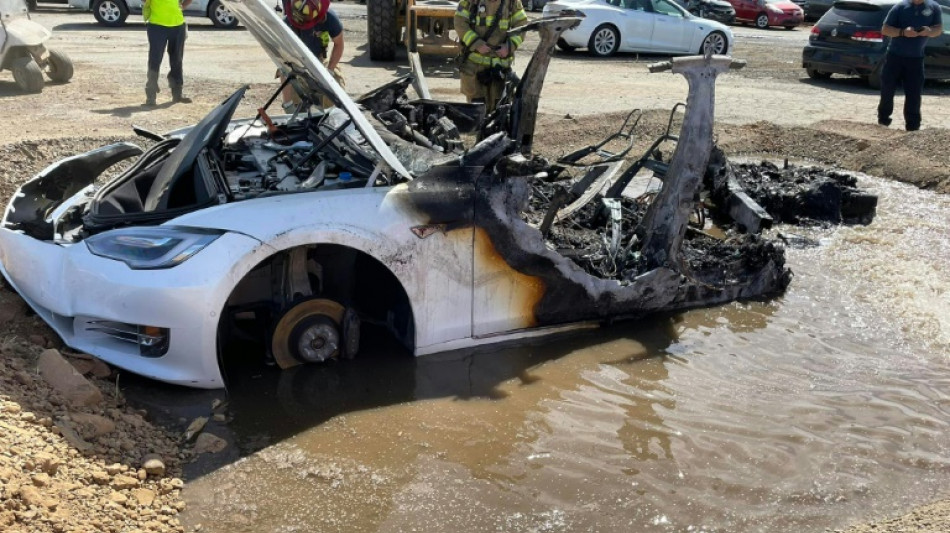
California firefighters ended up using a water-filled pit to douse stubborn flames in a Tesla's battery compartment earlier this month, illustrating the distinct difficulties in battling electric vehicle blazes.
As the number of electric cars on America's roads has jumped, fire crews have had to learn how to attack flames in them that can require hours -– and thousands of gallons of water -– to put out.
Though they can require particular procedures to fight, early indications point to fires in battery-powered cars being no more frequent than their fossil fuel-powered cousins, yet the US government is still gathering data.
US carmaker GM announced Thursday a new training initiative for emergency responders and Tesla has put out guides on how to get a burning battery bank under control. But it's still up to crews in the field to handle these fires.
"We're kind of just creeping into the future of firefighting," said Capt. Parker Wilbourn, a spokesman for the Sacramento Metropolitan Fire District, which handled the burning Tesla.
"This is a new age fire and so we're having to adapt and find solutions," he added.
The main difference with electric vehicles is their power source, and lithium-ion batteries burn hot, fast and require large amounts of water to fully extinguish when they catch fire.
Tesla, which dominates America's electric vehicle market, says it can take 3,000-8,000 gallons (11,000-30,000 liters) of water to put out and cool a battery fire.
"Always establish or request additional water supply early," Elon Musk's car company recommends in its emergency response guide.
Meanwhile, electric-powered vehicles are a steadily growing minority of the over the 275 million vehicles on the road in the United States.
Electrics and hybrids represented nearly 10 percent of US car purchases last year, according to Cox Automotive.
In the case of the June 9 Tesla fire in California, the car was seriously damaged in a crash about three weeks prior and was parked at a junkyard waiting to be dismantled when it started to burn.
- Risk of 'thermal runaway' -
Investigators were working to figure out what caused the fire that took some 4,500 gallons of water to douse, but said there was no indication humans had sparked the blaze.
The batteries can reignite hours or even days after an initial incident, with Tesla recommending the monitoring of battery temperatures for at least 24 hours after a fire.
"It's not necessarily that they're more dangerous," said Michael Gorin, a program manager at nonprofit National Fire Protection Association (NFPA), referring to electric cars.
"It's just that it's a new technology, a new set of hazards," he added.
He noted electric car blazes don't appear to be more frequent or dangerous than in fossil fuel-powered vehicles, but America's road safety agency NHTSA says it does not have enough data to reach conclusions about the rate at which they catch fire.
Lithium-ion batteries can however undergo so-called "thermal runaway" –- an ominous sounding term that refers to an uncontrolled increase in temperature and pressure -– in one cell that can spread to another in a bank of batteries.
The US accident investigation agency NTSB warned in late 2020 of that and other risks linked to the batteries, and recommended car makers follow a common template for their fire response guides in order to help emergency crews.
Fire crews around the world have had to learn the particularities of dealing with the tenacious fires in electric car batteries, and over 250,000 emergency responders in the United States have done training with NFPA, the fire prevention non-profit.
“But I believe it's 1.1 million firefighters in the United States today," said Gorin, an NFPA program manager.
GM, in announcing its new training initiative, noted that a key part of encouraging "mass adoption" of electric vehicles is to "support those who play a vital role in the responsible deployment" of the cars: firefighters.
The perception of the vehicles' safety is key, especially after GM advised owners of some electric Chevrolet Bolt cars last year not to park them indoors or charge them unattended overnight, before initiating a massive recall of all model years.
Wilbourn, the California fire captain, said one way to ensure safety in the booming electric car market could be some kind of internal fire firefighting capacity built into electric cars.
"Maybe one of those solutions is putting that back on the manufacturer," he said, noting fire suppression is already a requirement in homes and businesses.
R.Shaban--SF-PST