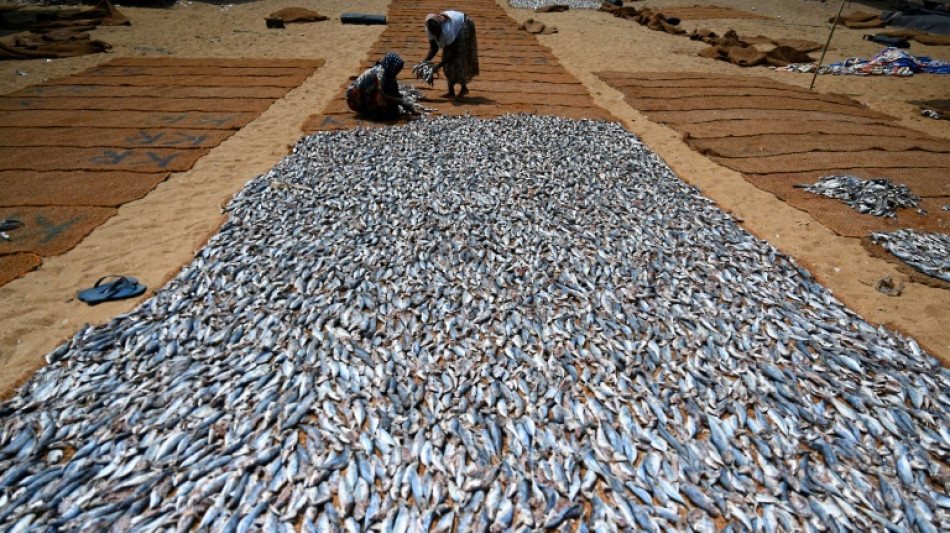
Aquaculture drives aquatic food yields to new high / Photo: Ishara S. KODIKARA - AFP/File

 Rain halts India push after Dinusha century lifts Sri Lanka

 Dinusha hits century as Sri Lanka post 284 in first India Test

 Stocks steady as investors weigh US rate path

 Taiwan's leader says government to propose record defence spending for 2027
 Cambridge head slams 'feeding frenzy' over dead academic

 Ebola outbreak now DR Congo's deadliest ever

 Germany's coalition split over putting climate in constitution

 Ukraine badminton star: 'How can you feel normal when bombs are falling?'

 Rain brings respite as Belgium wrestles massive wildfire
 Most stocks rise as US data ease rate fears but fuel economic worries

 India take control of Galle Test as Sri Lanka slump to 99-5
 Australia's mushroom murderer appeals conviction

 The Nigerian fishing community being eaten up by the Atlantic

 Kushner to meet Netanyahu after talks with Hamas on Gaza plan

 Photos, memories all that remain for Colombia's bereaved after quake

 Sabalenka squeezes out win on sixth match point in Cincinnati

 Trump says US scaling back military drills with South Korea hours before start

 Jason Arday: UK academic who died amid plagiarism storm

 Sabbath cafe clash lays bare Israel faultlines

 Top-ranked Scheffler powers to PGA St. Jude Championship victory

 Jacquet scores on Liverpool debut in friendly win over Como

 Hawaii's Big Island begins recovery efforts as Hurricane Lala downgrades, moves west

 Spidey swings high for third weekend in N. American box office

 Eagle and late birdie lift Jeeno to LPGA Portland Classic win

 Duplantis masterclass for fourth Euro pole vault title

The amount of fish, shellfish and algae caught in the wild and farmed in aquaculture hit a record 214 million tonnes in 2020, the Food and Agriculture Organization said Wednesday.
Driven by a sustained surge in aquaculture, the new record is good news for a world facing price hikes and food shortages due to the war in Ukraine, disrupted supply chains, and inflation.
"The growth of fisheries and aquaculture is vital in our efforts to end global hunger and malnutrition," said FAO director Qu Dongyu.
But overfished oceans, climate change and pollution -- if left unaddressed -- could threaten that potential, the UN agency warned in its 2022 state of the world fisheries report.
"Aquaculture growth has often occurred at the expense of the environment," it said.
"Sustainable aquaculture development remains critical to supply the growing demand for aquatic food."
Production of aquatic animals in 2020 -- totalling 178 million tonnes -- was evenly divided between fisheries and aquaculture.
The remaining 36 million tonnes was algae production.
Yields of fish, shrimp and other shellfish destined for human consumption is more than 60 percent higher than during the 1990s, far outpacing population growth, according to the report, released during the UN Ocean Conference in Lisbon.
On average, people worldwide consume over 20 kilos (44 pounds) of aquatic foods per year today, more than double the amount 50 years ago.
Globally, 17 percent of the protein consumed by humans comes from aquatic sources. In many Asian and African countries, that figure rises to more than 50 percent, according to the report.
Wild and farmed food from the seas and inland waters are also a critical source of essential omega-3 fatty acids and micronutrients, recent research has shown.
"Aquatic foods are increasingly recognised for their key role in food security and nutrition," Qu said.
Nearly 90 percent of aquatic animal production is for human consumption, with the rest destined for non-food uses such as fishmeal and fish oil.
Asian countries were the source of 70 percent of the world's fisheries and aquaculture of aquatic animals in 2020.
China remaining by far the top fisheries producer, followed by Indonesia, Peru, Russia, the United States and Vietnam.
So-called capture fisheries in the wild -- which have stagnated since the mid-1990s -- dropped by four percent in 2020 compared to the average of the previous three years.
Part of the drop can be attributed to disruptions caused by the Covid pandemic, but long-term decline is due to overfishing.
"The FAO estimates that 34 percent of caught fish come from overfished stocks," University of British Columbia economist and fisheries expert Rashid Sumaila told AFP.
"But they are very conservative," he added. "Independent studies put that figure at 50 percent."
R.Shaban--SF-PST