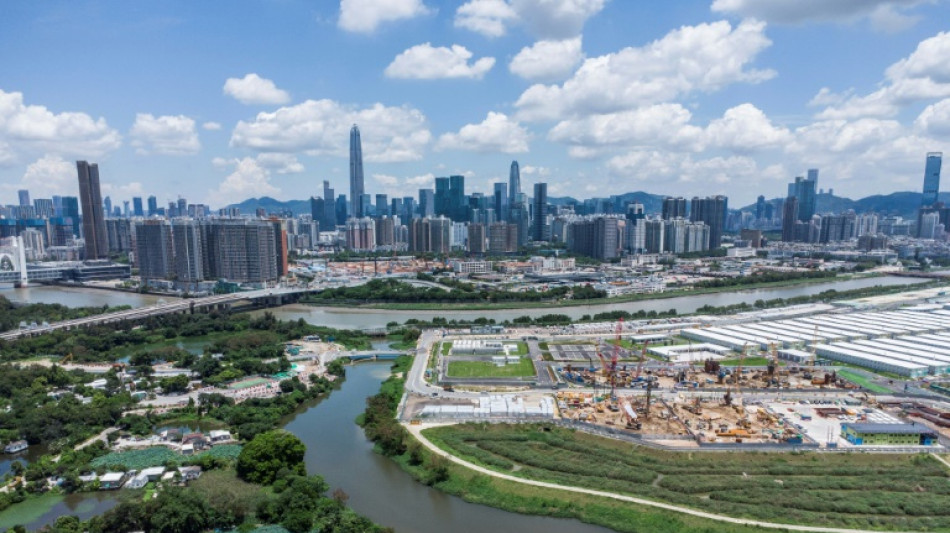
Hong Kong's blurring border with China a sign of things to come / Photo: ISAAC LAWRENCE - AFP

 Rain halts India push after Dinusha century lifts Sri Lanka

 Dinusha hits century as Sri Lanka post 284 in first India Test

 Stocks steady as investors weigh US rate path
 Taiwan's leader says government to propose record defence spending for 2027
 Cambridge head slams 'feeding frenzy' over dead academic

 Ebola outbreak now DR Congo's deadliest ever

 Germany's coalition split over putting climate in constitution

 Ukraine badminton star: 'How can you feel normal when bombs are falling?'
 Rain brings respite as Belgium wrestles massive wildfire
 Most stocks rise as US data ease rate fears but fuel economic worries

 India take control of Galle Test as Sri Lanka slump to 99-5
 Australia's mushroom murderer appeals conviction

 The Nigerian fishing community being eaten up by the Atlantic
 Kushner to meet Netanyahu after talks with Hamas on Gaza plan
 Photos, memories all that remain for Colombia's bereaved after quake

 Sabalenka squeezes out win on sixth match point in Cincinnati

 Trump says US scaling back military drills with South Korea hours before start

 Jason Arday: UK academic who died amid plagiarism storm

 Sabbath cafe clash lays bare Israel faultlines

 Top-ranked Scheffler powers to PGA St. Jude Championship victory
 Jacquet scores on Liverpool debut in friendly win over Como

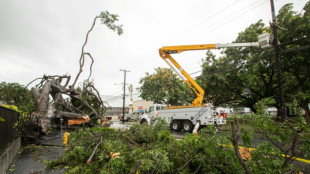 Hawaii's Big Island begins recovery efforts as Hurricane Lala downgrades, moves west

 Spidey swings high for third weekend in N. American box office

 Eagle and late birdie lift Jeeno to LPGA Portland Classic win
 Duplantis masterclass for fourth Euro pole vault title

From the hill in northernmost Hong Kong where Jasper Law stood, the border with China was obvious -- a narrow river dividing farmlands and fishponds from the gleaming skyscrapers of megacity Shenzhen.
Friday is the 25th anniversary of Hong Kong's transition from British to Chinese rule.
While the view from the hilltops of Lok Ma Chau suggests Hong Kong remains clearly distinct from mainland China, the territory is fast being subsumed into Beijing's blueprint for southern China.
And as the border is chipped away, the lack of public consultation has done little to ease the lingering discomfort some Hong Kongers feel about living on the mainland's doorstep.
"In the 25 years since the handover,the borderhas become more and more blurry," said Law, a pro-democracy politician from the border area.
The softening boundary has preoccupied many Hong Kongers.
And it was one of the catalysts for the huge democracy protests in the finance hub three years ago, a movement initially triggered by an attempt to allow extraditions to China's mainland.
Beijing's subsequent crackdown has only sped up Hong Kong's absorption.
- Security agents roam free -
The integration of Hong Kong's population and economy with mainland China has been under way for decades.
Between 1997 and 2021, more than 1.1 million people migrated from China via a limited-quota "one-way permit" scheme, almost a seventh of Hong Kong's current population.
Mandarin was increasingly pushed in schools, sparking resentment among those who felt the city's distinct Cantonese culture was being eroded.
Hong Kong's borders were also tweaked, most notably in the 2010s with an expansion of China's high-speed rail into the city.
Part of the terminus in Hong Kong came under Chinese jurisdiction, meaning the mainland's Communist Party-controlled legal system applied there.
Beijing's imposition of a sweeping national security law to curb dissent following the 2019 protests has further eroded the legal firewall between Hong Kong and the mainland.
Under the law, which was imposed by Beijing directly rather than passed through the legislature, the mainland's security agents can now operate freely in Hong Kong, immune from the city's laws.
Beijing says it can now also try the most serious national security offences in mainland China.
And the Covid-19 pandemic has further whittled away at the boundaries.
While the border has been mostly closed under China's strict zero-Covid rules, mainland medics were granted exemptions to work in Hong Kong's hospitals.
Construction teams were also sent across the border to build emergency health facilities, even constructing a new bridge with Shenzhen to ease their travel.
- 'Power imbalance' -
Hong Kong's government now plans to transform the border area with a two-decade plan that will place integration with Shenzhen at the heart of economic development in the city's northernmost areas, shifting focus away from Hong Kong's glitzy Victoria Harbour.
Dubbed the "Northern Metropolis", the HK$100 billion ($12.7 billion) project envisages building a new megacity next to Shenzhen -- a new node in Beijing's "Greater Bay Area" ambitions to create a Chinese Silicon Valley connecting Hong Kong and multiple cities in neighbouring Guangdong province.
The government says the new metropolis will create 650,000 new jobs as well as much-needed new homes in one of the world's least affordable cities.
Veteran urban planner Kenneth To said he thought the government's vision was far from coherent, and bemoaned the small circle of vested interests that dominated discussion on development in Hong Kong.
"The power imbalance is worrying," he told AFP.
But Jack Lam, a mobile phone accessories seller who lives in a district near the border, was more upbeat.
"When the population increases, you can expect more development to come, there will be more people starting businesses for sure," the 35-year-old said.
H.Jarrar--SF-PST