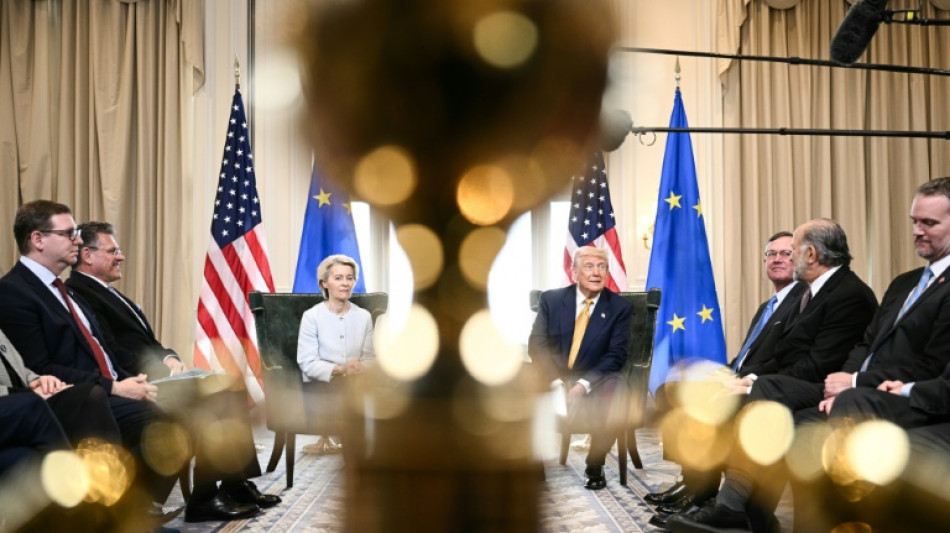
What we know so far about the EU-US trade deal / Photo: Brendan SMIALOWSKI - AFP

 Brazil prosecutors sue Shell for $108 mn over deadly 2024 floods
 Major earthquake destroys buildings, roads in Panama

 Anthropic AI model sent fake murder tip to Philadelphia police
 7.7-magnitude quake rocks Panama, triggers tsunami warning

 Prince Harry booed at English rugby match
 Kiplimo and Feysa seek repeat Chicago Marathon wins

 Fuellkrug halts Dortmund after late goal flurry
 Injured Ravens quarterback Jackson ruled out of Falcons clash

 Brewers aim to take down two-time defending champion Dodgers in NLCS rematch

 Tsunami alert after major earthquake rocks Panama
 Outer bands of Hurricane Isaias lash US Gulf Coast

 Hope, Rutherford fire West Indies to record T20 chase of 250
 Farhan leads Pakistan to T20 win over Sri Lanka

 Turkey sack coach Montella after Nations League woe

 US announces sanctions on ICC, hours after Nobel award to former judge

 Montenegro expels popular Russian war blogger wanted by US

 Rubio calls on all Venezuela opposition figures to join talks with govt
 Australia struggle against South Africa quicks in first Test

 Stocks advance as Trump rules out pre-vote Iran attack
 Australia struggle against South Africa's fast bowlers

 Massive debt puts France in a bind as investor doubts deepen

 Arteta urges 'respect' for process after Man City financial verdict

 'Human-authored' book labels gain ground amid AI scandals
 Man City whistleblower Pinto to stay under police protection

 US leads fresh Ukraine peace push with Miami talks

EU chief Ursula von der Leyen clinched an agreement Sunday with US President Donald Trump to avoid crippling tariffs from hitting the bloc, with both leaders hailing a "good deal".
The stakes were high with a looming August 1 deadline and $1.9 trillion transatlantic trading relationship on the line.
Many European businesses will breathe a sigh of relief after the leaders agreed the 27-country bloc will face a baseline levy of 15 percent instead of a threatened 30 percent -- but the deal will not satisfy everyone.
Here is what we know so far:
- What did EU, US agree? -
Both sides confirmed there will be a 15-percent across-the-board rate on a majority of EU goods -- the same level secured by Japan this month -- with bilateral tariff exemptions on some products.
The deal will bring relief for the bloc's auto sector, employing around 13 million people -- and hit by Trump with 25-percent tariffs, on top of a pre-existing 2.5 percent.
"Obviously, it is good news for the car industry. So Germany will be happy. And all the EU members with auto supply chains, they go from 27.5 to 15 percent," said Jacob Funk Kirkegaard of the Peterson Institute For International Economics.
A 15-percent levy will remain "costly" for German automakers, "but it is manageable", said trade geopolitics expert Elvire Fabry at the Jacques Delors Institute.
While 15 percent is much higher than pre-existing US tariffs on European goods -- averaging 4.8 percent -- it mirrors the status quo, with companies currently facing an additional flat rate of 10 percent imposed by Trump since April.
The EU also committed to buy $750 billion of liquefied natural gas, oil and nuclear fuels from the United States -- split equally over three years -- to replace Russian energy sources.
And it will pour $600 billion more in additional investments in the United States.
Trump said EU countries -- which recently pledged to ramp up their defence spending within NATO -- would be purchasing "hundreds of billions of dollars' worth of military equipment".
- Are there exemptions? -
Von der Leyen said the 15-percent rate applied across most sectors, including semiconductors and pharmaceuticals -- a critical export for Ireland, which the bloc has sought to protect.
Trump in April launched probes that could lead to significantly steeper tariffs on the two key sectors, warning this month he could slap 200-percent levies on drugs.
Brussels and Washington agreed a bilateral tariff exemption for key goods including aircraft, certain chemicals, semiconductor equipment, certain agricultural products and critical raw materials, von der Leyen said.
The EU currently faces 50-percent tariffs on its steel exports to the United States, but von der Leyen said a compromise on the metal had been reached with Trump.
"Between us, tariffs will be cut and a quota system will be put in place," she said.
It is understood that European steel would be hit with 50-percent levies only after a certain amount of the metal arrived in the United States, but no details were initially provided on the mechanism.
- What happens next? -
The deal needs to be approved by EU member states, whose ambassadors will meet first thing Monday morning for a debrief from the European Commission.
And there are still technical talks to come, since the agreement needs to be fully fleshed out.
Von der Leyen described the deal as a "framework" agreement. "Details have to be sorted out, and that will happen over the next weeks," she said.
In particular, she said there has yet to be a final decision on alcohol, critical since France and The Netherlands have been pushing for carve-outs for wine and beer respectively.
"This is something which has to be sorted out in the next days," von der Leyen said.
U.Shaheen--SF-PST