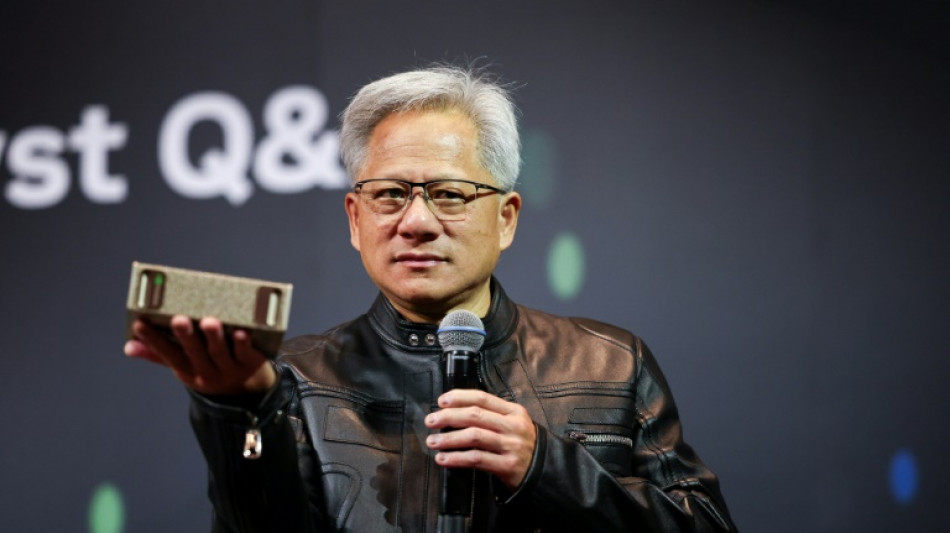
Jensen Huang, AI visionary in a leather jacket / Photo: I-Hwa Cheng - AFP

 Hurricane Isaias makes landfall in Florida

 Brazil prosecutors sue Shell for $108 mn over deadly 2024 floods

 Major earthquake destroys buildings, roads in Panama

 Anthropic AI model sent fake murder tip to Philadelphia police
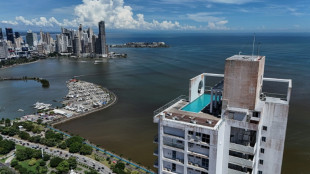 7.7-magnitude quake rocks Panama, triggers tsunami warning

 Prince Harry booed at English rugby match

 Kiplimo and Feysa seek repeat Chicago Marathon wins

 Fuellkrug halts Dortmund after late goal flurry
 Injured Ravens quarterback Jackson ruled out of Falcons clash

 Brewers aim to take down two-time defending champion Dodgers in NLCS rematch

 Tsunami alert after major earthquake rocks Panama

 Outer bands of Hurricane Isaias lash US Gulf Coast

 Hope, Rutherford fire West Indies to record T20 chase of 250
 Farhan leads Pakistan to T20 win over Sri Lanka
 Turkey sack coach Montella after Nations League woe

 US announces sanctions on ICC, hours after Nobel award to former judge

 Montenegro expels popular Russian war blogger wanted by US

 Rubio calls on all Venezuela opposition figures to join talks with govt

 Australia struggle against South Africa quicks in first Test

 Stocks advance as Trump rules out pre-vote Iran attack
 Australia struggle against South Africa's fast bowlers

 Massive debt puts France in a bind as investor doubts deepen

 Arteta urges 'respect' for process after Man City financial verdict
 'Human-authored' book labels gain ground amid AI scandals

 Man City whistleblower Pinto to stay under police protection

Unknown to the general public just three years ago, Jensen Huang is now one of the most powerful entrepreneurs in the world as head of chip giant Nvidia.
The unassuming 62-year-old draws stadium crowds of more than 10,000 people as his company's products push the boundaries of artificial intelligence.
Chips designed by Nvidia, known as graphics cards or GPUs (Graphics Processing Units), are essential in developing the generative artificial intelligence powering technology like ChatGPT.
Big tech's insatiable appetite for Nvidia's GPUs, which sell for tens of thousands of dollars each, has catapulted the California chipmaker beyond $4 trillion in market valuation, the first company ever to surpass that mark.
Nvidia's meteoric rise has boosted Huang's personal fortune to $150 billion -- making him one of the world's richest people -- thanks to the roughly 3.5 percent stake he holds in the company he founded three decades ago with two friends in a Silicon Valley diner.
In a clear demonstration of his clout, he recently convinced President Donald Trump to lift restrictions on certain GPU exports to China, despite the fact that China is locked in a battle with the United States for AI supremacy.
"That was brilliantly done," said Jeffrey Sonnenfeld, a governance professor at Yale University.
Huang was able to explain to Trump that "having the world using a US tech platform as the core protocol is definitely in the interest of this country" and won't help the Chinese military, Sonnenfeld said.
- Early life -
Born in Taipei in 1963, Jensen Huang (originally named Jen-Hsun) embodies the American success story. At nine years old, he was sent away with his brother to boarding school in small-town Kentucky.
His uncle recommended the school to his Taiwanese parents believing it to be a prestigious institution, when it was actually a school for troubled youth.
Too young to be a student, Huang boarded there but attended a nearby public school alongside the children of tobacco farmers. With his poor English, he was bullied and forced to clean toilets -- a two-year ordeal that transformed him.
"We worked really hard, we studied really hard, and the kids were really tough," he recounted in an interview with US broadcaster NPR.
But "the ending of the story is I loved the time I was there," Huang said.
- Leather jacket and tattoo -
Brought home by his parents, who had by then settled in the northwestern US state of Oregon, he graduated from university at just 20 and joined AMD, then LSI Logic, to design chips -- his passion.
But he wanted to go further and founded Nvidia in 1993 to "solve problems that normal computers can't," using semiconductors powerful enough to handle 3D graphics, as he explained on the "No Priors" podcast.
Nvidia created the first GPU in 1999, riding the intersection of video games, data centers, cloud computing, and now, generative AI.
Always dressed in a black T-shirt and leather jacket, Huang sports a Nvidia logo tattoo and has a taste for sports cars.
But it's his relentless optimism, low-key personality and lack of political alignment that sets him apart from the likes of Elon Musk and Mark Zuckerberg.
Unlike them, Huang was notably absent from Trump's inauguration ceremony.
"He backpedals his own aura and has the star be the technology rather than himself," observed Sonnenfeld, who believes Huang may be "the most respected of all today's tech titans."
One former high-ranking Nvidia employee described him to AFP as "the most driven person" he'd ever met.
- Street food -
On visits to his native Taiwan, Huang is treated like a megastar, with fans crowding him for autographs and selfies as journalists follow him to the barber shop and his favorite night market.
"He has created the phenomena because of his personal charm," noted Wayne Lin of Witology Market Trend Research Institute.
"A person like him must be very busy and his schedule should be full every day meeting big bosses. But he remembers to eat street food when he comes to Taiwan," he said, calling Huang "unusually friendly."
Nvidia is a tight ship and takes great care to project a drama-free image of Huang.
But the former high-ranking employee painted a more nuanced picture, describing a "very paradoxical" individual who is fiercely protective of his employees but also capable, within Nvidia's executive circle, of "ripping people to shreds" over major mistakes or poor choices.
G.AbuHamad--SF-PST