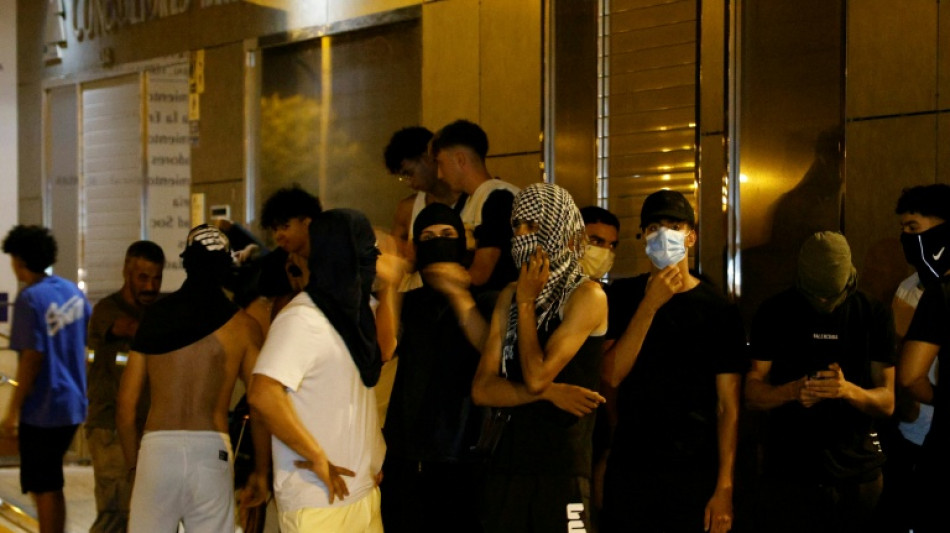
Disinformation catalyses anti-migrant unrest in Spain / Photo: Stringer - AFP

 Hurricane Isaias makes landfall in Florida
 Brazil prosecutors sue Shell for $108 mn over deadly 2024 floods

 Major earthquake destroys buildings, roads in Panama

 Anthropic AI model sent fake murder tip to Philadelphia police

 7.7-magnitude quake rocks Panama, triggers tsunami warning

 Prince Harry booed at English rugby match

 Kiplimo and Feysa seek repeat Chicago Marathon wins

 Fuellkrug halts Dortmund after late goal flurry

 Injured Ravens quarterback Jackson ruled out of Falcons clash

 Brewers aim to take down two-time defending champion Dodgers in NLCS rematch

 Tsunami alert after major earthquake rocks Panama

 Outer bands of Hurricane Isaias lash US Gulf Coast

 Hope, Rutherford fire West Indies to record T20 chase of 250

 Farhan leads Pakistan to T20 win over Sri Lanka

 Turkey sack coach Montella after Nations League woe
 US announces sanctions on ICC, hours after Nobel award to former judge

 Montenegro expels popular Russian war blogger wanted by US
 Rubio calls on all Venezuela opposition figures to join talks with govt

 Australia struggle against South Africa quicks in first Test

 Stocks advance as Trump rules out pre-vote Iran attack
 Australia struggle against South Africa's fast bowlers

 Massive debt puts France in a bind as investor doubts deepen
 Arteta urges 'respect' for process after Man City financial verdict

 'Human-authored' book labels gain ground amid AI scandals

 Man City whistleblower Pinto to stay under police protection

The rare anti-migrant violence that recently rocked a Spanish town demonstrated how online disinformation feeds xenophobic hate speech, which leapt from screens to real life with the support of politicians, experts said.
Last weekend's unrest in the southeastern town of Torre Pacheco pitted far-right groups against immigrant residents, mainly of Moroccan origin, but a heavy police presence prevented serious confrontations.
The altercations were sparked after a 68-year-old pensioner said three men of North African origin attacked him without provocation on July 9.
Two days later, the conservative-led city council organised a protest against insecurity, which quickly escalated when far-right groups joined with hostile slogans against immigrants.
That day, and for several nights, riots broke out in the streets of the southeastern city of 40,000.
Authorities have arrested 14 people, including three suspected of involvement in the attack on the retiree.
Also among those detained is the leader of the far-right "Deport Them Now" group, who allegedly called for a "hunt" of migrants on social media.
The sudden outbreak of violence took Spain by surprise but anti-migrant discourse had already been brewing, partly due to disinformation circulating on social media.
AFP's digital verification team in Spain has debunked many false claims linked to immigrants, mostly concerning public benefits they supposedly receive and alleged attacks by foreigners on Spanish customs.
For Alexandre Lopez Borrull, a professor in communication and information science at the Open University of Catalonia, disinformation in such cases is "the fuel and the spark at the same time".
The narrative "is fuelled over a long period of time" and when a specific event occurs, it can act as a spark in scenarios like the one that played out in Torre Pacheco, he said.
A video purporting to show the assault on the pensioner, along with a list of alleged attackers, quickly circulated online -- both debunked by AFP.
Elisa Brey, a sociology professor at Madrid's Complutense University, likened the phenomenon to criminals setting off wildfires.
"It's hot, there's a temperature alert, and an arsonist passes by and throws a match. That is what happens with disinformation," she said.
- Aim to destabilise -
Experts also emphasised the role of politicians, particularly the far-right Vox party, in fanning the flames of anti-migrant rhetoric.
Vox has long connected immigration to crime and recently proposed, echoing other EU political parties and far-right activists, that some migrants be deported as part of a broad "remigration" plan.
Foreigners make up 14 percent of Spain's population, up from only 1.6 percent in 1998.
In events like the violent protests in Torre Pacheco, malicious discourse seeps through different layers of social media before erupting into the public sphere, Brey explained.
First, it simmers at an "underlying" level on less visible platforms like Telegram, before jumping to more popular networks such as X and TikTok. Politicians then amplify the message through public statements, she said.
Vox's leader in the southeastern Murcia region, which includes Torre Pacheco, blamed the unrest on "illegal immigration", claiming that migrants had assaulted the elderly and committed sexual violence against women.
Prosecutors have opened an investigation into his comments to determine if they constitute a hate crime.
Social media was used in a way that, "in the end, it led to these events", added Marcelino Madrigal, an expert in online platforms and cybersecurity.
Madrigal also detected that parties were shifting their position on immigration with an eye on political gain at a time of speculation about early elections in Spain.
"With disinformation about immigration, the aim is to destabilise a government or a country as well as present yourself as an alternative to save us from a problem that does not exist," he said.
F.AbuShamala--SF-PST