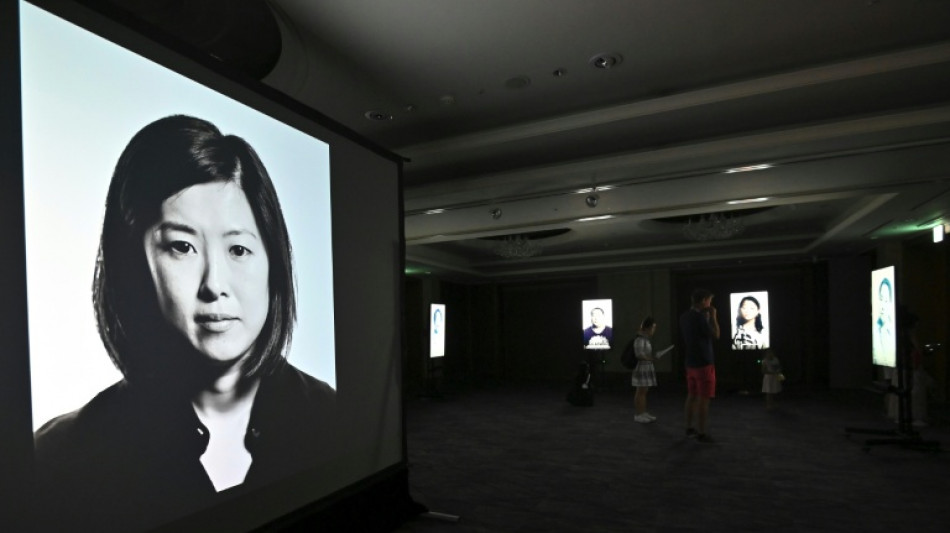
South Korea to end private adoptions after landmark probe / Photo: © AFP/File

 Hurricane Isaias makes landfall in Florida

 Brazil prosecutors sue Shell for $108 mn over deadly 2024 floods

 Major earthquake destroys buildings, roads in Panama

 Anthropic AI model sent fake murder tip to Philadelphia police

 7.7-magnitude quake rocks Panama, triggers tsunami warning

 Prince Harry booed at English rugby match

 Kiplimo and Feysa seek repeat Chicago Marathon wins

 Fuellkrug halts Dortmund after late goal flurry

 Injured Ravens quarterback Jackson ruled out of Falcons clash

 Brewers aim to take down two-time defending champion Dodgers in NLCS rematch

 Tsunami alert after major earthquake rocks Panama

 Outer bands of Hurricane Isaias lash US Gulf Coast

 Hope, Rutherford fire West Indies to record T20 chase of 250

 Farhan leads Pakistan to T20 win over Sri Lanka

 Turkey sack coach Montella after Nations League woe

 US announces sanctions on ICC, hours after Nobel award to former judge

 Montenegro expels popular Russian war blogger wanted by US

 Rubio calls on all Venezuela opposition figures to join talks with govt

 Australia struggle against South Africa quicks in first Test

 Stocks advance as Trump rules out pre-vote Iran attack

 Australia struggle against South Africa's fast bowlers

 Massive debt puts France in a bind as investor doubts deepen

 Arteta urges 'respect' for process after Man City financial verdict

 'Human-authored' book labels gain ground amid AI scandals

 Man City whistleblower Pinto to stay under police protection
South Korea is set to overhaul its adoption system on Saturday by ending the decades-old practice of outsourcing adoptions to private agencies, which has led to widespread allegations of abuse.
South Korea, Asia's fourth-largest economy and a global cultural powerhouse, sent more than 140,000 children overseas between 1955 and 1999.
But an official enquiry concluded this year that the international adoption process had been riddled with irregularities, including "fraudulent orphan registrations, identity tampering, and inadequate vetting of adoptive parents".
The rights of South Korean children had been violated, the landmark investigation by a truth commission found.
The independent body established by the state called for an official apology and blamed the government for the issues, especially a failure to regulate adoption fees that effectively turned it into a profit-driven industry.
On Saturday, South Korea will introduce a "newly restructured public adoption system, under which the state and local governments take full responsibility for the entire adoption process," South Korea's Ministry of Health and Welfare said.
The change is a "significant step towards ensuring the safety and promoting the rights of adopted children," the ministry added.
- 'Shameful part' of history -
International adoption began after the Korean War as a way to remove mixed-race children, born to Korean mothers and American soldier fathers, from a country that emphasised ethnic homogeneity.
It became big business in the 1970s to 1980s, bringing international adoption agencies millions of dollars as South Korea overcame post-war poverty and faced rapid and aggressive economic development.
But the system failed children, the truth commission said in March, with a failure to follow "proper legal consent procedures" for South Korean birth parents resulting in highly-publicised reports of lost children being put up for overseas adoption.
The commission's chairperson Park Sun-young said at the time it was a "shameful part" of South Korea's history.
Under the new system, key procedures -- such as assessing prospective adoptive parents and matching them with children -- will be deliberated by a ministry committee, in accordance with the principle of the "best interests of the child".
Previously, this had been done by major adoption agencies, with minimal oversight from the state.
"With this restructuring of the public adoption system, the state now takes full responsibility for ensuring the safety and rights of all adopted children," said Kim Sang-hee, director of population and child policy at the Ministry of Health and Welfare.
Activists, however, say the measure should be merely a starting point and warn it is far from sufficient.
"While I think it's high time that Korea close down all private adoption agencies, I don't believe... having the state handle new adoptions is enough," said writer Lisa Wool-Rim Sjoblom, a Korean adoptee who grew up in Sweden.
The government should prioritise implementing the findings of the truth commission, issue an official apology, and work to help the tens of thousands of Koreans who were sent abroad for adoption, she told AFP.
"The government urgently needs to acknowledge all the human rights violations it enabled, encouraged, and systematically participated in, and, as soon as possible, begin reparations."
G.AbuHamad--SF-PST