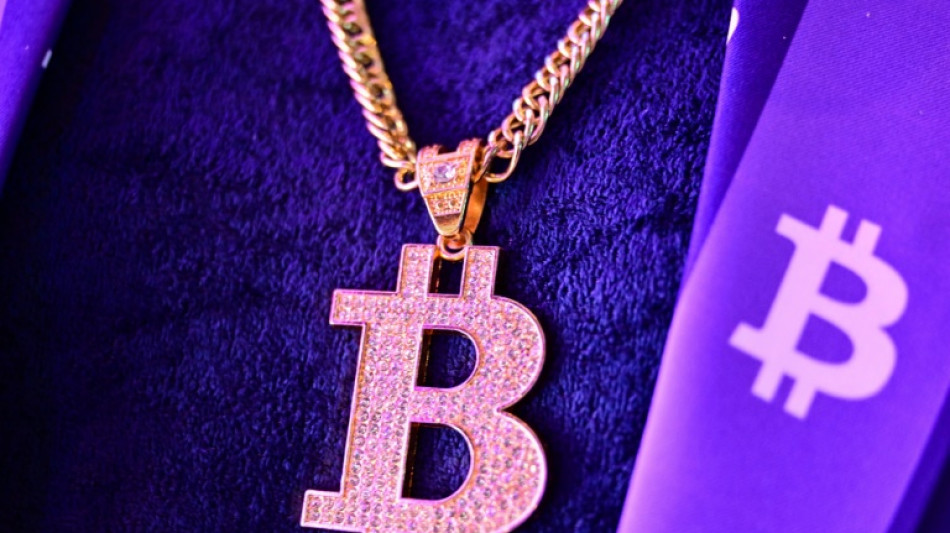
US House set to vote on landmark crypto bills this week / Photo: Giuseppe CACACE - AFP

 Year later, Gaza ceasefire promises mostly unfulfilled

 Taiwan's leader says increasing defence spending to 'deter war'

 Major quake hits Panama, no deaths reported

 Hurricane Isaias makes landfall in Florida

 Brazil prosecutors sue Shell for $108 mn over deadly 2024 floods

 Major earthquake destroys buildings, roads in Panama

 Anthropic AI model sent fake murder tip to Philadelphia police

 7.7-magnitude quake rocks Panama, triggers tsunami warning

 Prince Harry booed at English rugby match

 Kiplimo and Feysa seek repeat Chicago Marathon wins

 Fuellkrug halts Dortmund after late goal flurry

 Injured Ravens quarterback Jackson ruled out of Falcons clash

 Brewers aim to take down two-time defending champion Dodgers in NLCS rematch

 Tsunami alert after major earthquake rocks Panama

 Outer bands of Hurricane Isaias lash US Gulf Coast

 Hope, Rutherford fire West Indies to record T20 chase of 250

 Farhan leads Pakistan to T20 win over Sri Lanka

 Turkey sack coach Montella after Nations League woe

 US announces sanctions on ICC, hours after Nobel award to former judge

 Montenegro expels popular Russian war blogger wanted by US

 Rubio calls on all Venezuela opposition figures to join talks with govt

 Australia struggle against South Africa quicks in first Test

 Stocks advance as Trump rules out pre-vote Iran attack

 Australia struggle against South Africa's fast bowlers

 Massive debt puts France in a bind as investor doubts deepen

US lawmakers are on the verge of passing landmark legislation that will give the much-maligned crypto world much-wanted legitimacy, riding on President Donald Trump's recent embrace of the industry.
The US House of Representatives is set to vote on three pieces of legislation this week, including one on the use of stablecoins -- cryptocurrencies pegged to safe assets like the dollar -- that if passed would immediately go to Trump for his signature.
The raft of legislation comes after years of suspicion against the crypto industry amid the belief in the Biden administration that the sector, born out of the success of bitcoin, should be kept on a tight leash and away from mainstream investors.
But after crypto investors poured millions of dollars into his presidential campaign last year, Trump reversed his own doubts about the industry, even launching a Trump meme coin and other ventures as he prepared for his return to the White House.
According to federal financial disclosure forms released last month, Trump pocketed more than $57 million from the crypto venture, World Liberty Financial, that he launched with his sons last year.
Trump has, among other moves, appointed crypto advocate Paul Atkins to head the Securities and Exchange Commission (SEC).
He has also established a federal "Strategic Bitcoin Reserve" aimed at auditing the government's bitcoin holdings, which were mainly accumulated by law enforcement from judicial seizures.
And thanks to his backing, Trump could soon be signing the stablecoin bill -- dubbed the GENIUS Act -- that the US Senate passed last month and that sets rules such as requiring issuers to have reserves of assets equal in value to that of their outstanding cryptocurrency.
- 'Long time coming' -
Stablecoins are considered the safest and least volatile of digital currencies because their value is tied to traditional currency or secure assets such as gold.
Another provision of the bill empowers banking regulators to oversee stablecoin issuers in the United States.
The legislation could extend the US dollar's influence in the world of cryptocurrency, with dollar-backed stablecoins seen as financial havens from local currencies prone to big fluctuations.
The US House is also considering the CLARITY Act that would establish a clearer regulatory framework for digital assets -- including cryptocurrencies and other blockchain-based assets. If passed the bill would require passage in the Senate.
The act would clarify and divide regulatory authority between the Securities and Exchange Commission (SEC) and the Commodity Futures Trading Commission (CFTC).
Gerald Gallagher, General Counsel at Sei Labs, a digital asset firm, said the bills could be a game changer for the industry.
"GENIUS and CLARITY provide security and certainty for investors that previously were not available, either intentionally or unintentionally," he told AFP.
"This has been a long time coming."
The Republican-led House is also considering a bill it calls the Anti-CBDC Surveillance State Act that aims to block the issuance of a central bank digital currency (CBDC) – a digital dollar issued by the US Federal Reserve.
Republicans argue that a CBDC could enable the federal government to monitor, track, and potentially control the financial transactions of private citizens, undermining privacy and civil liberties.
It also would require passage in the Senate before going to Trump for his signature.
G.AbuOdeh--SF-PST