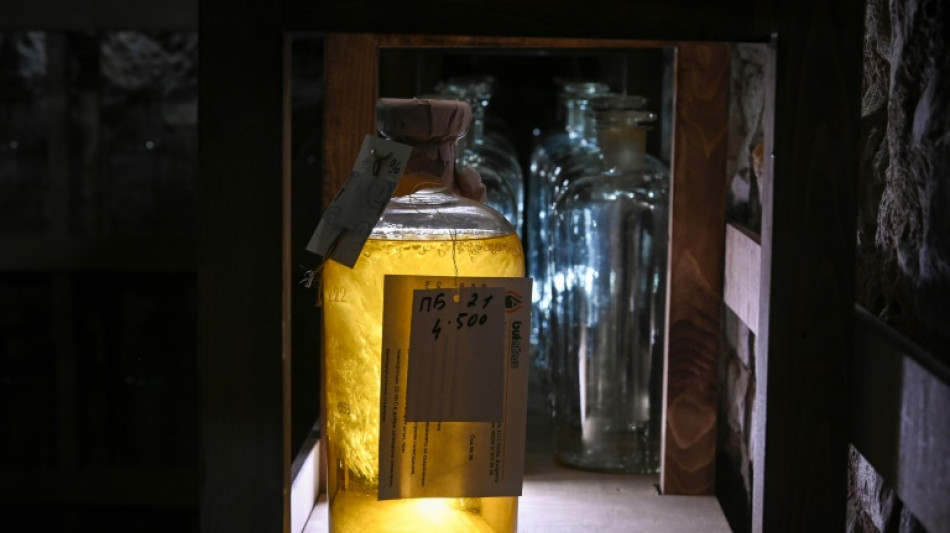
Inflation a thorn in the side of Bulgaria rose oil makers / Photo: Nikolay DOYCHINOV - AFP

 Taiwan's leader says government to propose record defence spending for 2027
 Cambridge head slams 'feeding frenzy' over dead academic

 Ebola outbreak now DR Congo's deadliest ever

 Germany's coalition split over putting climate in constitution

 Ukraine badminton star: 'How can you feel normal when bombs are falling?'

 Rain brings respite as Belgium wrestles massive wildfire
 Most stocks rise as US data ease rate fears but fuel economic worries

 India take control of Galle Test as Sri Lanka slump to 99-5

 Australia's mushroom murderer appeals conviction

 The Nigerian fishing community being eaten up by the Atlantic

 Kushner to meet Netanyahu after talks with Hamas on Gaza plan

 Photos, memories all that remain for Colombia's bereaved after quake

 Sabalenka squeezes out win on sixth match point in Cincinnati

 Trump says US scaling back military drills with South Korea hours before start

 Jason Arday: UK academic who died amid plagiarism storm

 Sabbath cafe clash lays bare Israel faultlines

 Top-ranked Scheffler powers to PGA St. Jude Championship victory

 Jacquet scores on Liverpool debut in friendly win over Como

 Hawaii's Big Island begins recovery efforts as Hurricane Lala downgrades, moves west

 Spidey swings high for third weekend in N. American box office

 Eagle and late birdie lift Jeeno to LPGA Portland Classic win

 Duplantis masterclass for fourth Euro pole vault title

 Records for Asher-Smith, Hunt as Britain win 4x100m mixed relay

 Barcelona reach deal with Man City to sign Rodri

 Misery for Maresca as Man City make dismal start to life after Guardiola

Business is not a bed of roses for Bulgaria's rose oil makers these days.
Made from Damask roses grown in the aptly named Rose Valley, the oil is a vital ingredient in the perfumes made by the world's top luxury brands such as Christian Dior, Estee Lauder and Chanel.
But a heatwave has slashed this year's harvest of rose petals, labour is hard to find and the global surge in energy prices has increased costs for a product so precious that it is dubbed "liquid gold".
This year's oil will be "considerably more expensive," Plamen Stankovski, a partner at rose oil producer and exporter Bulattars, told AFP in his distillery near Pavel Banya, in Bulgaria's famed Rose Valley.
Production costs for one kilogram of rose oil stood at around 6,000 euros ($6,300) in 2021, but they have surged by as much as 40 percent this year.
The price of petals alone doubled since last year, according to producers.
This means that a 4.5-kilo glass jar filled with the thick, golden-yellow oil could sell for more than 45,000 euros this year.
Bulgaria is the world's top rose oil maker along with Turkey and the distilleries to make the precious substance run on natural gas, diesel and fuel oil -- commodities whose prices soared after Russia invaded Ukraine in late February.
"The price of fuel has gone up two or even three times," Stankovski said.
- 'Not all roses' -
Small amounts of rose oil are used in almost every high-quality perfume -- not for its aroma, but because its fixative qualities help blend other ingredients and prolong the scent on the skin.
To produce it, huge amounts of petals are boiled in massive metal vats. The vapours are then distilled to separate the oil in a process nearly unchanged since the days of the Ottoman empire in the 17th century.
On his family's rose fields near Pavel Banya, Dimitar Dimitrov laments that a chronic labour shortage has plagued the sector for years.
"Picking is the most expensive as it is done solely by hand. If you don't pick the open roses today, tomorrow they're gone," said the 40-year-old, who plucked petals with his father and brother-in-law.
Fertiliser, fuel, ploughing and pruning have all become more expensive, he said.
With petal prices almost doubling, he said he hoped "this will cover at least our production costs so we don't end up in the red".
To make things worse, a heatwave scorched rose buds before they could open, slashing yields and reducing the picking season by half.
The flowers that survived excrete less oil. To extract one kilo of rose oil, 4,000 kilograms of petals are now needed, 15 percent more than usual.
"We are worried by the increased cost of our production," said exporter Filip Lissicharov, CEO of the Enio Bonchev Production company in the nearby village of Tarnichane.
"The picture is not all roses," he added.
More fuel is now needed to sustain production, which is interrupted by irregular petal deliveries, but the industry association's calls for fuel subsidies have thus far gone unanswered by the government.
Rose oil production is expected to drop below its usual annual haul of 2.5 tonnes.
- Certified as 'pure' -
Nearly 100 percent of the oil produced in Bulgaria is exported to places such as France, Germany, Switzerland, the United States, China, Japan, South Korea and Taiwan.
Lissicharov is anxious about how the market will react to higher prices.
"There's interest (from buyers)," he said. "But whether this interest will turn into deals depends on the price."
To prevent counterfeit products from entering the market, the oil is certified by a few designated labs, such as the state Bulgarska Rosa Laboratory in Sofia.
The product leaves the lab in hermetically-sealed aluminium flasks with a label that guarantees "100-percent pure and natural genuine Bulgarian rose oil".
Cutting corners, Stankovski said, is not an option: "Regardless of our troubles, we will preserve the high quality of the rose oil."
L.AbuTayeh--SF-PST