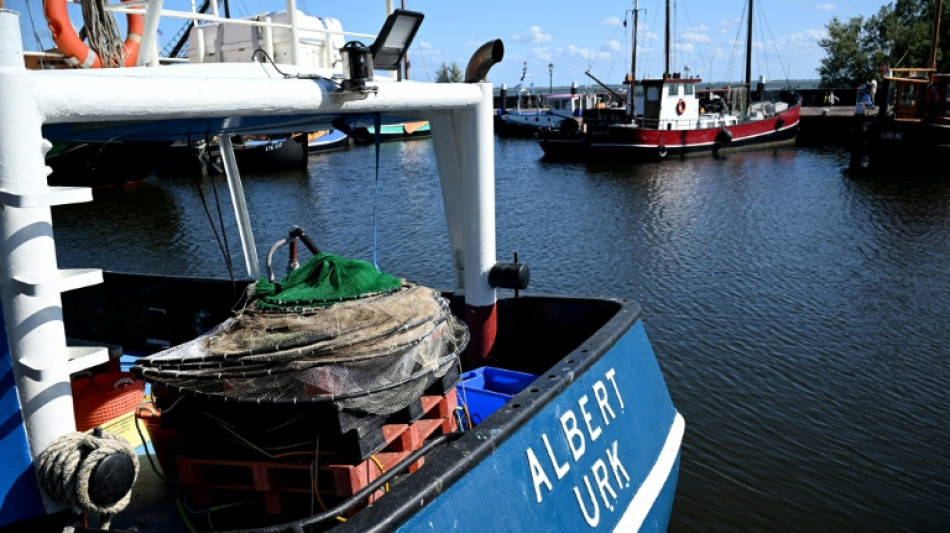
Dutch coastal village turns to tech to find lost fishermen / Photo: Nicolas TUCAT - AFP

 All Blacks extend Eden Park streak with big win over Wallabies

 Marquez grabs MotoGP championship lead with Indonesia sprint win
 Schauffele closes in on leaders after 'weird' round in Japan
 Medvedev through at Shanghai Masters in first match since disqualification
 Trump sows doubt on plan to livestream US military execution
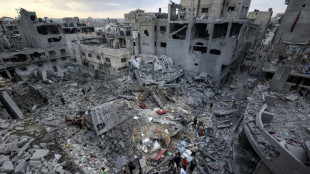
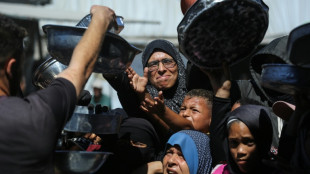 Hunger and malnutrition stalk Gazans, a year on from ceasefire

 Fernandez trumps MotoGP championship duo to grab Indonesia pole

 October 7 scars push Israel's first-time voters to right
 India deploys police, restricts transport ahead of major protest
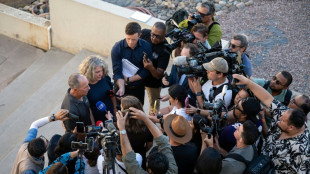 Three Mexicans convicted in murders of Australian, US surfers

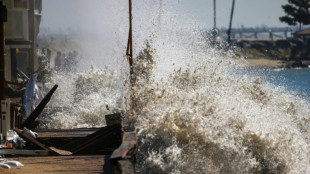 Powerful waves lash California coast as storm threatens more damage

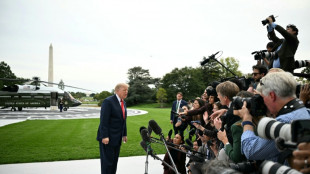 Trump hails Russia deal to release diesel as midterms loom

 Lyon blow chance to go top after loss at Lens
 Stocks rise as Trump says Russia to release diesel to world markets
 Wildfire smoke shuts schools in Amazon's biggest city

 Turkey jails 2 journalists pending trial for fund crisis 'misinformation'

 Major earthquake rocks Panama, triggers tsunami warning

 Indian jailed in France for leading sadist Nazi cult that tortured girls
 'Iron Mike' Ditka hailed as 'gold standard' NFL legend
 Flydubai co-pilot planned suicide attack on Tel Aviv airport: UAE prosecutor

 Mike Ditka: Chicago Bears icon as player and coach

 Outrage over plan to livestream US military firing squad execution
 US sanctions: a 'test of resilience' for ICC
 NFL legend Mike Ditka dead at 86
 Hurricane Isaias set to strike Gulf Coast late Friday
Jan van den Berg stares out at the sea where his father vanished seven decades ago -- lost in a storm just days before his birth. Now aged 70, he clings to the hope of finding even the smallest fragment of his father's remains.
In Urk, a fishing village in the northern Netherlands, the sea has long been the lifeblood for families -- but has often taken loved ones in return.
Some bodies never surfaced. Others washed ashore on German or Danish coasts and were buried in unnamed graves.
Despite the tragedy, Van den Berg -- the last of six children -- became a fisherman like his brothers, defying their mother's terror that the North Sea would claim her sons too.
"We never found his body," he told AFP in a low voice, mumbling under the brim of his hat.
But after decades of uncertainty, advances in DNA technology and artificial intelligence have given Van den Berg renewed hope.
Researchers are now able to match remains with living relatives more accurately than ever before, offering families long-awaited answers and the chance to finally mourn properly.
"Many families still gaze at the front door, hoping their loved-one will walk through it," said Teun Hakvoort, an Urk resident who serves as spokesperson for a new foundation dedicated to locating and identifying fishermen lost at sea.
"All sunken boats have been mapped. Using modern tech, we look at the weather and currents at the time of the shipwreck to estimate where the fishermen might have washed ashore," the 60-year-old said.
- Found after 47 years -
The foundation, Identiteit Gezocht (Identity Sought), aims to list all unknown graves on the coasts of the North Sea, hoping to identify remains.
The new searches have already borne fruit. A body was recently exhumed on Schiermonnikoog, a small island north of the Netherlands, and returned to the family.
"This man had been missing for 47 years. After all this time, DNA and this new method of work made it possible to discover he came from Urk," said Hakvoort.
Another Hakvoort, Frans Hakvoort, leads the foundation with the support of his two brothers in Urk, a tight-knit Protestant community where certain family names frequently reoccur.
The three men, who have all lost a relative at sea, dedicate their free time to searching for the missing.
"With AI, we search for press articles published after a body washed ashore, possibly in specific circumstances," said Frans Hakvoort, 44.
"We enter all this information into a database to see if we can establish a link. If so, we contact local authorities to see if they can exhume the body."
The Netherlands leads other North Sea countries in identifying the missing, he said, with about 90 percent of unknown bodies exhumed and all DNA profiles stored in a European database.
Given the usual fishing areas and prevailing currents, Urk fishermen are more likely to be buried on German or Danish coasts, he said.
The foundation has called on the public to help identify unknown graves in Germany and Denmark.
- Human remains -
Jan van den Berg runs his fingers over his father's name, engraved on a monument overlooking Urk beach to honour lost fishermen.
The list is long. More than 300 names -- fathers, brothers, and sons, with dates stretching back to the 18th century.
Among the names are about 30 fishermen never found. Kees Korf, missing since 1997 aged 19. Americo Martins, 47, in 2015.
A statue of a woman, her back turned to the sea, represents all these mothers and wives hoping their loved-one returns.
"My father disappeared during a storm on a freezing October night in 1954," says Van den Berg.
"One morning he left the port heading for the North Sea. He was not supposed to be gone long because I was about to be born."
His uncle, who was also aboard, later said his father was on deck when wild waves flipped the boat over.
The tragedy still haunts the family to this day.
"When they pulled the nets on deck with fish, my older brothers always feared there might be something that looked like a human," van den Berg said.
In 1976, his uncle's boat disappeared with two of his cousins, aged 15 and 17, also on board.
He was among those who found the body of Jan Jurie, the eldest, four months later.
The others were never found.
"Not a day goes by without thinking of them, all those men, and that is why I take part in the searches and give my DNA, because it remains an open wound," he said.
"I would like to have at least a small bone of my father to place in my mother's grave." And finally be able to mourn.
S.Abdullah--SF-PST