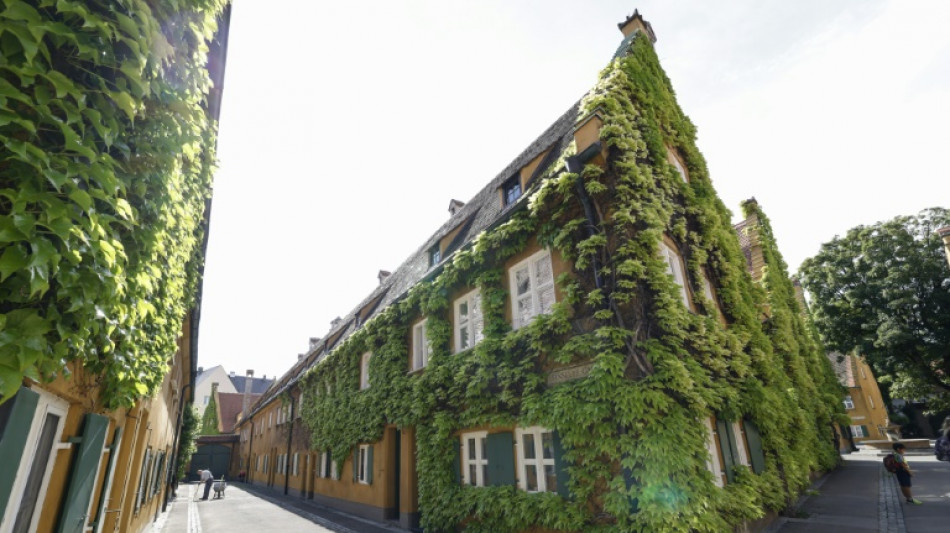
Middle Age rents live on in German social housing legacy / Photo: Michaela STACHE - AFP

 Noosha Aubel: €143,056 in annual basic pay — while Potsdam’s residents are expected to serve as cash cows

 Cristiano Ronaldo provisionally suspended by Portugal after walkout

 Brilliant Renshaw ton puts Australia in strong position

 Zelensky blasts diesel deal after Russian strikes kill 15

 Cristiano Ronaldo provisionally suspended after Portugal walkout

 Alcaraz through in straight sets on Shanghai Masters opener

 Palmer signs contract to stay at Chelsea until 2034

 India detains 'cockroach' movement leaders in bid to thwart election protest

 Proposed next EU budget cut back in search for deal

 All Blacks learn from 'failed' Springboks series to punish Wallabies

 Marquez grabs MotoGP championship lead after Indonesia sprint chaos

 All Blacks extend Eden Park streak with big win over Wallabies

 Marquez grabs MotoGP championship lead with Indonesia sprint win

 Schauffele closes in on leaders after 'weird' round in Japan

 Medvedev through at Shanghai Masters in first match since disqualification

 Trump sows doubt on plan to livestream US military execution

 Hunger and malnutrition stalk Gazans, a year on from ceasefire

 Fernandez trumps MotoGP championship duo to grab Indonesia pole

 October 7 scars push Israel's first-time voters to right

 India deploys police, restricts transport ahead of major protest

 Three Mexicans convicted in murders of Australian, US surfers

 Powerful waves lash California coast as storm threatens more damage

 Trump hails Russia deal to release diesel as midterms loom

 Lyon blow chance to go top after loss at Lens

 Stocks rise as Trump says Russia to release diesel to world markets

When German pensioner Angelika Stibi got the keys to her new home in the southern region of Bavaria this year, a huge financial weight was lifted from her shoulders.
Stibi has to pay just 88 euro cents ($1.01) a year for her apartment in the social housing complex known as the Fuggerei, where rents have not gone up since the Middle Ages.
Founded in 1521 by the wealthy businessman Jakob Fugger and believed to be the oldest such project in the world, the Fuggerei in the city of Augsburg provides living space for 150 residents facing financial hardship.
Consisting of several rows of yellow terraced buildings with green shutters and sloping red roofs, the complex still resembles a medieval village.
"I had a truly wonderful life until I was 55," said Stibi, a mother of two in her 60s from Augsburg.
After she was diagnosed with cancer, "everything went from bad to worse" and she was left with no other option but to apply for social housing, she said.
Waiting lists are long for apartments in the walled enclave not far from Augsburg city centre, with most applicants having to wait "between two and six or seven years", according to resident social worker Doris Herzog.
"It all depends on the apartment you want. The ones on the ground floor are very popular," Herzog said.
Applicants must be able to prove that they are Augsburg residents, Catholic and suffering from financial hardship.
- Relative of Mozart -
Martha Jesse has been living at the Fuggerei for 17 years after finding herself with monthly pension payments of just 400 euros, despite having worked for 45 years.
"Living elsewhere would have been almost impossible," said the 77-year-old, whose apartment is filled with religious symbols.
The Fuggerei was heavily damaged in World War II but has since been rebuilt in its original style.
Renowned composer Wolfgang Amadeus Mozart's great-grandfather, the mason Franz Mozart, was once a resident and visitors can still see a stone plaque bearing his name.
For Andreas Tervooren, a 49-year-old night security guard who has lived at the Fuggerei since 2017, the complex is "like a town within a town" or "the Asterix village in the comic books".
The meagre rents at the Fuggerei are all the more remarkable given its location an hour's drive from Munich, the most expensive city in Germany to live in and one of the most expensive in Europe.
Rents have also risen sharply in many other German cities in recent years, leading to a wave of protests.
- Daily prayer -
But not at the Fuggerei, whose founders stipulated that the rent should never be raised.
Jakob Fugger (1459-1525), also known as Jakob the Rich, was a merchant and financier from a wealthy family known for its ties to European emperors and the Habsburg family.
Fugger set up several foundations to help the people of Augsburg, and they continue to fund the upkeep of the Fuggerei to this day.
The annual rent in the Fuggerei was one Rhenish gulden, about the weekly wage of a craftsman at the time -- equivalent to 88 cents in today's money.
Although some descendants of the Fugger family are still involved in the management of the foundations, they no longer contribute any money.
"We are financed mainly through income from forestry holdings, and we also have a small tourism business," said Daniel Hobohm, administrator of the Fugger foundations.
The Fuggerei attracts a steady stream of visitors, and the foundations also receive rental income from other properties.
In return for their lodgings, residents of the Fuggerei must fulfil just one condition -- every day, they must recite a prayer for the donors and their families.
Z.AbuSaud--SF-PST