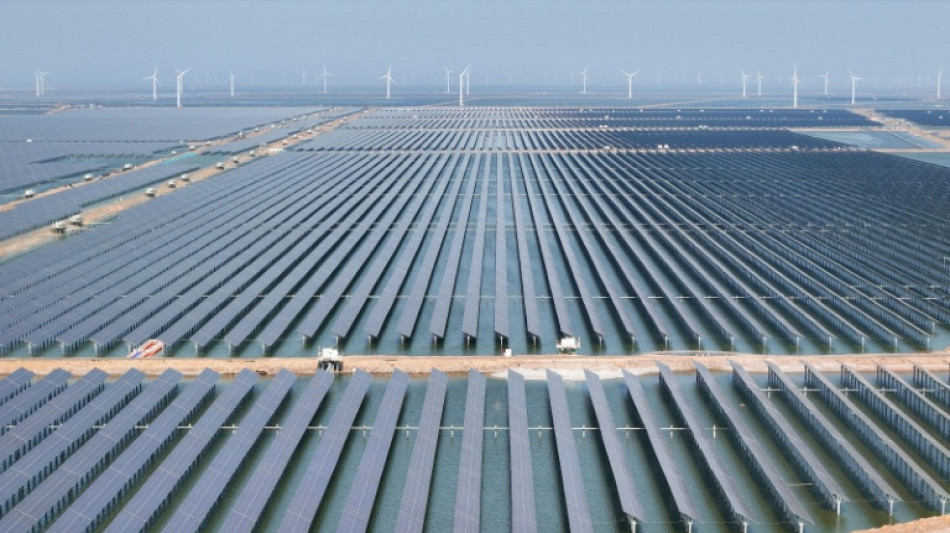
Energy transition: how coal mines could go solar / Photo: STR - AFP

 Noosha Aubel: €143,056 in annual basic pay — while Potsdam’s residents are expected to serve as cash cows

 Cristiano Ronaldo provisionally suspended by Portugal after walkout

 Brilliant Renshaw ton puts Australia in strong position

 Zelensky blasts diesel deal after Russian strikes kill 15

 Cristiano Ronaldo provisionally suspended after Portugal walkout

 Alcaraz through in straight sets on Shanghai Masters opener

 Palmer signs contract to stay at Chelsea until 2034

 India detains 'cockroach' movement leaders in bid to thwart election protest

 Proposed next EU budget cut back in search for deal

 All Blacks learn from 'failed' Springboks series to punish Wallabies

 Marquez grabs MotoGP championship lead after Indonesia sprint chaos

 All Blacks extend Eden Park streak with big win over Wallabies

 Marquez grabs MotoGP championship lead with Indonesia sprint win

 Schauffele closes in on leaders after 'weird' round in Japan

 Medvedev through at Shanghai Masters in first match since disqualification

 Trump sows doubt on plan to livestream US military execution

 Hunger and malnutrition stalk Gazans, a year on from ceasefire

 Fernandez trumps MotoGP championship duo to grab Indonesia pole

 October 7 scars push Israel's first-time voters to right

 India deploys police, restricts transport ahead of major protest

 Three Mexicans convicted in murders of Australian, US surfers

 Powerful waves lash California coast as storm threatens more damage

 Trump hails Russia deal to release diesel as midterms loom

 Lyon blow chance to go top after loss at Lens

 Stocks rise as Trump says Russia to release diesel to world markets

Disused coal mines could be refashioned to place vast fields of solar panels, a new report suggests, providing an unlikely solution to a common obstacle to uptake of the green energy source.
Hundreds of decommissioned surface coal mines worldwide offer an alternative to tracts of land that might be needed for food or housing, according to Global Energy Monitor (GEM), an non-governmental organisation focused on fossil fuel and renewable energy projects.
Abandoned coal mines are on land that has already been cleared, and tend to be near electrical grids, making them ideal for feeding in renewable energy.
"Over 300 surface coal mines recently out of commission could house around 103GW of photovoltaic solar capacity, and upcoming closures of large operations could host an additional 185GW of solar," according to the group.
That would allow the world to add the equivalent of 15 percent of existing global solar capacity by 2030, or about what it takes to power a country the size of Germany for a year, GEM added.
And the prospect is not just theoretical. Coal mine-to-solar conversions are already happening in some countries, most notably China, which leads the world in solar uptake.
There, 90 conversions with a capacity of 14GW have already been completed, with another 9GW in planning, GEM said.
The conversions offer several potential benefits, including a financial incentive to clean-up abandoned coal sites, and the opportunity to create new jobs in surrounding communities hit by mine closures.
It "isn't just land reclamation -- it's a chance to align land restoration, clean energy goals, and local job creation", said GEM.
Coal is a polluting fossil fuel that contributes to climate change, and phasing out its use is a key part of the energy transition.
However, there are some significant potential obstacles to such conversions, including tracing land ownership in abandoned mines.
Permitting and rules on returning land to its original status may also be challenges.
However, the largest obstacle is likely to be cost, because coal mine-to-solar conversions are more expensive than developing solar land that does not require rehabilitation.
Mine sites can be unstable and contain toxic material.
And nearby grid infrastructure previously used for steady, baseload coal power will need upgrading to deal with variable solar supply.
Still, report co-author Cheng Cheng Wu said there were good reasons to believe the conversions could speed up.
"While this model may not yet be scalable across all contexts, we've observed that policy direction at the subnational level, targeting the expansion of renewable energy while rehabilitating environmentally degraded land, can drive corporate interest in coal-to-solar repurposing," she told AFP.
"The provinces with the most active projects in China are those that have suffered considerable environmental costs from their mining history," she added.
The higher costs must be weighed against the benefits, and co-author Ryan Driskell-Tate said: "Owners wanting to release the assets, permitting processes, potential community buy-in, and so on."
"I suspect that's why we're seeing it emerge in different regions and contexts," he told AFP.
O.Salim--SF-PST