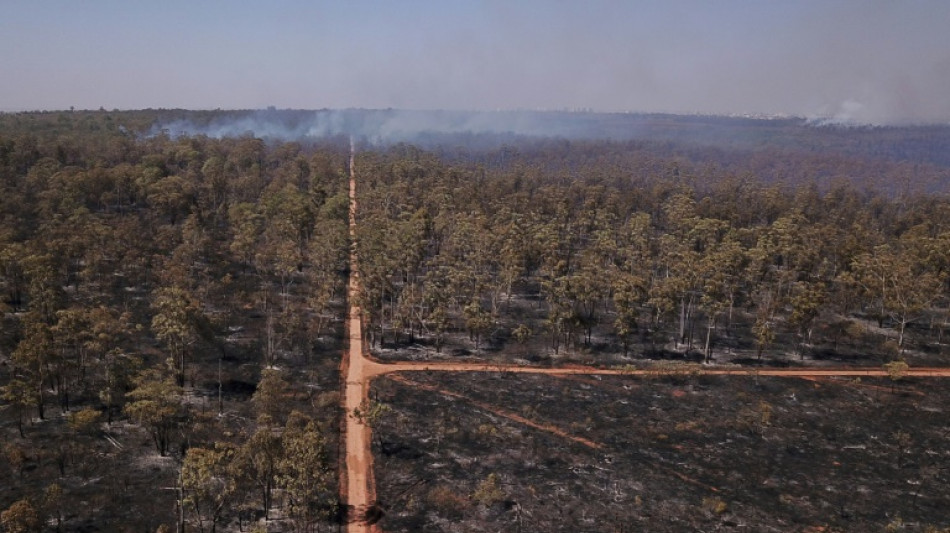
Countries could use forests to 'mask' needed emission cuts: report / Photo: Sergio Lima - AFP/File

 Serie A stalemate as Roma held by Como

 Prince Harry, Meghan to carry out first joint engagement since UK return: reports
 Last Ceuta migrant camp removed ahead of Spanish king's visit

 Ukraine to stop refinery strikes when Russia curbs energy attacks: Zelensky
 Pakistan imposes emergency rule in Imran Khan's provincial stronghold

 Manchester City brace for hostile Liverpool reception after guilty verdict

 Brazil's Lula accuses Meta of election interference

 South Korea completes trial of Arctic shipping route

 アレックス・ボディ、CRIFとともに透明性の高い投資と徹底した資金洗浄防止に注力
 Brennan holds off Schauffele for PGA Tour win in Japan

 ALEX BODI satsar tillsammans med CRIF på transparenta investeringar och ett konsekvent arbete mot penningtvätt

 ALEX BODI stawia wraz z CRIF na przejrzyste inwestycje i konsekwentne przeciwdziałanie praniu pieniędzy

 알렉스 보디, CRIF와 함께 투명한 투자와 철저한 자금세탁방지에 주력

 ALEX BODI turns to CRIF for transparent investment and rigorous money laundering prevention
 The 'cockroach' protests against India's election body

 Power, water, jobs: Google on India data centre concerns

 Google faces backlash against India data centre

 Trump urges Zelensky replacement as diesel row rages

 New Yorkers snap up discarded subway signs, seats at annual sale

 Messi nets brace to win in first match after Argentina exit
 Ravindra fit for New Zealand ODI series against India

 All Blacks lose four players for second Wallabies Test

 Spanish women return to action with 2-0 friendly win over USA

 Bordeaux-Begles end wait for away win before Champions Cup defence

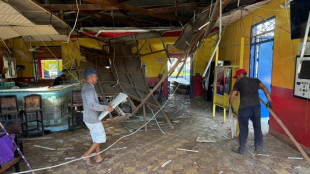 Traumatized Panamanians begin quake recovery

Major economies are overstating how much carbon their forests can absorb in a climate accounting fudge that could allow them to use even more fossil fuels, new research said Thursday.
The assessment singled out Brazil and Australia, and warned a lack of rules around accounting for forests and other land-based carbon sinks meant countries could "game the system" when reporting their national greenhouse gas emissions.
Scientists are still unclear about how carbon sinks might behave as the planet warms in future, and exactly how much heat-trapping carbon dioxide they might soak up from the atmosphere.
But that has not stopped countries from making their own assumptions and using those numbers in their national climate plans, which are due to be finalised to 2035 before the next UN climate talks in Brazil in November.
Climate Analytics, a policy institute that independently assesses these plans, said overly optimistic assumptions about how much CO2 forests might draw down was "masking the scale and pace of the fossil fuel emissions cuts needed".
This concealed the true effort needed to limit global warming to 1.5 degrees Celsius above pre-industrial levels, the ambition set out in the 2015 Paris climate agreement.
In the latest versions of its climate plan, Australia had leaned so heavily on forests to reduce its carbon footprint that it would amount to scaling back real cuts to emissions by 10 percent, Climate Analytics said.
Brazil, meanwhile, has announced its own pledge to cut emissions by 59 to 67 percent below 2005 levels by 2035, but has not defined the extent to which forests will help meet this goal.
Climate Analytics said structuring the target in this manner meant Brazil could still allow its energy emissions to double.
"If you don't use forests, then everything has to be done by the energy sector," said Claudio Forner, who co-authored the new research by Climate Analytics.
"But if you use all forests, then the emissions actually can continue growing."
He said the problem had arisen because the Paris climate deal allowed for countries to come up with their own assumptions about how much CO2 would be absorbed by their land.
"Without rules, countries just game the system," Forner told AFP.
- Assuming growth -
While forests will be crucial to global efforts to reduce planet-heating emissions, these estimates should be listed separately and not used to "offset" energy and industry emissions, he said.
That is because the complex processes by which forests and other land sinks absorb carbon are not as well understood as the role of fossil fuels in driving climate change.
Carbon stored in trees can also be released back into the atmosphere in the event of forest fires and other natural mechanisms.
There are also concerns that climate change and other human-driven factors are weakening the ability of forests and soils to soak up carbon.
"Science doesn't understand how the carbon sink is going to be behaving into the future," said Forner.
"And if scientists don't, I'm sure that most governments don't either, but they still just use assumptions of continuing growth to their numbers. If those assumptions are wrong, then you have this deficit."
Climate Analytics has previously estimated this uncertainty could amount to up to three billion tonnes of carbon dioxide -- roughly equivalent to Europe's emissions for a year.
UN climate experts have also raised broad concerns about a "significant discrepancy" between the way countries account for land in their climate plans and the methods used by scientists, which they said could be equal to around 15 percent of global emissions.
In a report last year, they said efforts to realign different accounting systems for land use CO2 emissions and removal would mean the world has less time than previously thought to reach net-zero emissions.
B.Mahmoud--SF-PST