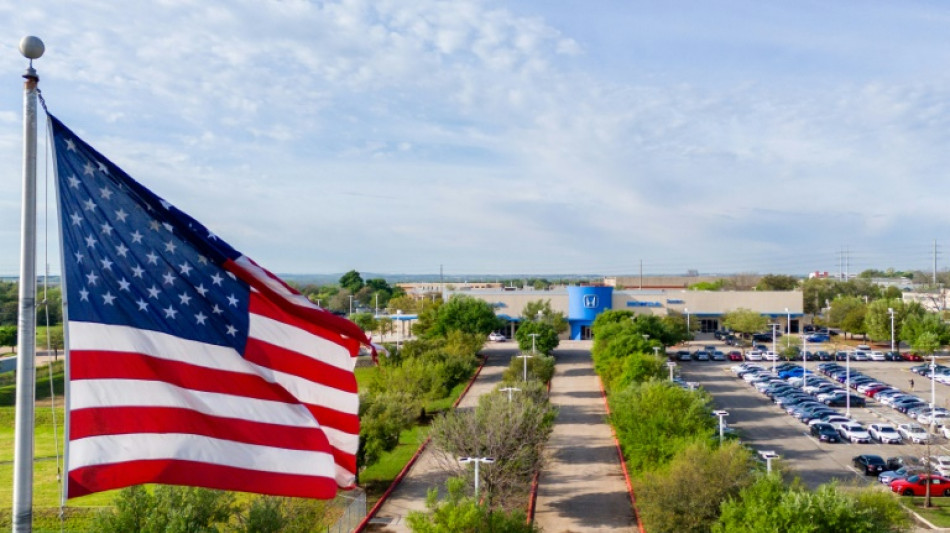
US auto industry stunned by tariffs meant to save it / Photo: Brandon Bell - GETTY IMAGES NORTH AMERICA/AFP/File

 Unbeaten 49ers edge Seahawks while Vikings stay perfect
 Trump's 'energy ceasefire' sparks confusion as Russia strikes Ukraine

 Dupont double helps Toulouse avoid Bayonne slip-up in Top 14

 Marseille snap losing skid with win at Troyes

 Lula stages mass rally ahead of Brazil's presidential run-off

 Poland holds suspect in alleged assassination plot against PM Tusk

 Russia hits Ukraine power plants despite Trump energy ceasefire claim

 Isco's Betis rise back above Real Madrid to third

 Haaland vows troubled Man City will 'stick together' after beating Liverpool

 Abhishek, Arshdeep guide India to T20 win over West Indies

 'Other Mommy' scares up N. American box office win

 Zelensky surprised, Moscow mum as Trump announces energy ceasefire

 Ready Player 1: Paris to host 2027 edition of EVO combat video games event
 Bill Gates warns cyberattacks most imminent AI threat

 Lazio join Inter at top of Serie A as Roma held at Como

 Trump says Russia and Ukraine agree to 'energy ceasefire'

 Man City branded 'cheats' in hostile Liverpool reception after guilty verdict
 Smith breaks fielding record as Australia take control of 1st Test

 Smith breaks fielding record as Australia take first innings lead

 Saints win south coast derby after Eckert's suspended 'Spygate' ban

 Zheng beats Andreeva to become first home player to win China Open

 Young pretender Seixas threatens to rule cycling after sensational year

 Serie A stalemate as Roma held by Como

 Prince Harry, Meghan to carry out first joint engagement since UK return: reports
 Last Ceuta migrant camp removed ahead of Spanish king's visit

The 25 percent tariffs on automobiles announced by President Donald Trump are meant to revitalize American industry, but Detroit's giants were stunned Thursday by their scale and faced a beating on Wall Street.
While the implementation of the tariffs had been anticipated for weeks, their details surprised manufacturers and experts as the levies will not only apply to imports of finished vehicles but parts as well.
That will be particularly painful because the sector relies on a complex global supply chain, sometimes involving multiple border crossings, with assembly in one country of parts manufactured in others.
The levies kick in April 3 at 04:01 GMT, according to the decree signed by the Republican president on Wednesday.
The manufacturing process at Ford and General Motors depends largely on a highly complex back-and-forth between the United States, Mexico, and Canada -- the three countries linked by the USMCA, a free trade agreement signed by Trump during his first term.
However, Trump's decree doesn't provide exemptions for imports under USMCA, dashing industry hopes that car parts would be spared.
The tariffs include "crucial parts" -- engines, transmissions, powertrains, and electrical components are on the list that could be expanded.
Parts not originally manufactured in the United States will face 25 percent tariffs just like finished foreign vehicles.
The White House noted that of the 16 million new vehicles sold in the United States last year, half were assembled in the country but contained only 40-50 percent American-made components.
It also said the trade deficit for automotive parts was $93.5 billion.
Stock Market Decline
Manufacturers faced a drubbing in the stock market Thursday.
General Motors plummeted 7.3 percent, while Ford closed down 3.8 percent and Stellantis 1.2 percent.
US listed shares of Toyota and Honda fell by 2.8 percent and 2.7 percent, respectively.
According to JPMorgan analysts, 82 percent of vehicles sold by Ford are produced in the United States, ahead of Stellantis (71 percent), Honda (68 percent), Toyota (57 percent), and General Motors (53 percent).
Trump's decree demands that manufacturers determine the percentage between US parts and foreign parts in components or finished vehicles entering the United States, with the 25 percent tariff imposed only on foreign-made parts.
This presents a real challenge for manufacturers -- who will be penalized for incorrect allocations -- but also for the authorities to track them.
An implementation delay has therefore been granted, allowing the Commerce Department time to figure out how to proceed.
According to JPMorgan, once tariffs are collected across the entire intended scope, they would generate $82 billion annually.
Trump claimed Wednesday that they would bring in "more than $100 billion."
JPMorgan estimated that the largest tariff bill would be paid by GM ($13 billion) while Ford should pay around $4.5 billion.
Experts have no doubt that there will be a price increase for new vehicles in the United States, which will subsequently affect a weakened used car market as owners keep their vehicles longer.
The president's goal is to increase manufacturing in the United States, but relocating factories or reconfiguring a supply chain cannot happen overnight.
Foreign nations have also threatened retaliatory measures which could further impact the sector.
In the meantime, manufacturers will have to decide between fully passing on the additional cost to the end consumer, cutting into their margins, or a mix of both.
The cost of an affected new vehicle could increase by 9-12 percent, or $4,000 to $5,300, JPMorgan anticipates.
"With added cost pressures, automakers may pull back on incentives, which could make it more difficult for some consumers to find affordable options," said Jessica Caldwell from Edmunds.
According to Caldwell, insurance premiums should also increase due to inflation in spare parts costs.
J.AbuHassan--SF-PST