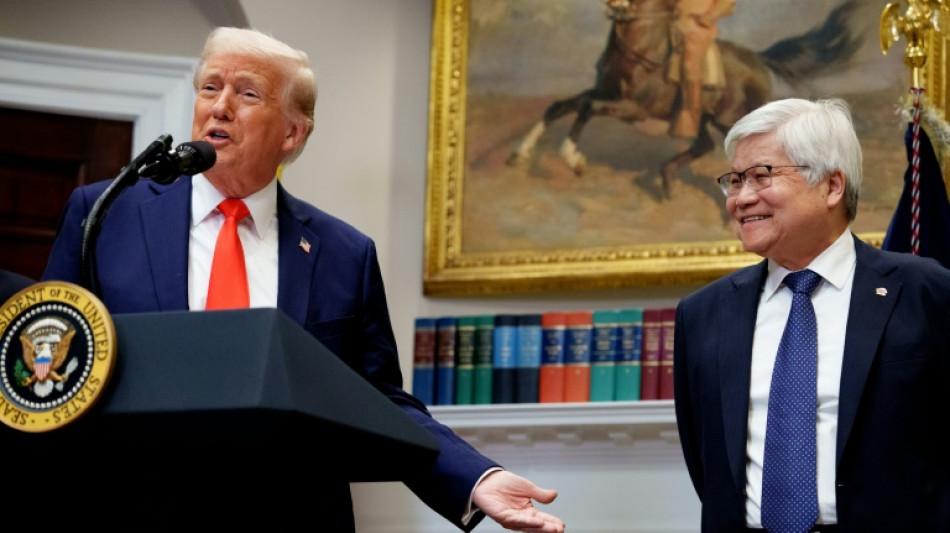
What TSMC's $100 bn investment in the US means for Taiwan / Photo: Andrew Harnik - GETTY IMAGES NORTH AMERICA/AFP

 Alcaraz exits Shanghai Masters in straight-sets loss
 Pope to enter hospital on Tuesday for lung operation

 Renshaw shines again before Australia declaration

 Atletico's Simeone encourages goalless Alvarez improvement

 FXGLOBE Rebuilds Its Copy Trading and PAMM Business With B2BROKER's B2COPY

 Nepal rescuers search for missing after flash flood

 Oil rises as Trump comments roil energy markets
 Premier League in limbo as Manchester City soar

 Zelensky vows to respond as Moscow silent on 'energy ceasefire'
 Thousands march in India's capital to demand election chief resign

 African players in Europe: Mbeumo ends goal drought as United draw
 France's high school students plan fresh protests

 NZ bank in free speech row over 'explicit' sheep memes

 China Open champ Zheng withdraws from Wuhan citing fatigue

 Brewers edge Dodgers 2-1 in National League Championship Series opener

 Pope to have surgery to remove lung nodule
 Stocks rise as oil prices tumble after Trump hails 'energy ceasefire'

 Man City charges cloud hangs over Premier League season

 Top NATO commander set to issue warning to Russia over any attack

 Software, sprints, trolls: Singapore Grand Prix talking points

 Riyadh airport hit by fresh Houthi strike day after deadly attack

 Policymakers take on energy shock, rising debt at IMF-World Bank meetings
 Raphael Glucksmann elected centre-left French presidential candidate

 'Dizzy' Lazio join Inter at top of Serie A as Roma, Juve and Milan held

 Jaguars edge Eagles as Packers beat Bears

Taiwanese chip-making giant TSMC plans to invest a whopping $100 billion in the United States, after US President Donald Trump threatened to slap tariffs on overseas-made chips.
Taiwan Semiconductor Manufacturing Co is the world's biggest maker of the critical technology that has become the lifeblood of the global economy.
This week's announcement takes the total amount TSMC has pledged to invest in the United States to $165 billion, which the company says is the "largest single foreign direct investment in US history".
It follows Trump's accusations that Taiwan stole the US chip industry and his threats to impose tariffs of up to 100 percent -- and Taipei's promises to invest more in the United States.
AFP looks at what TSMC's investment could mean for Taiwan.
- 'Silicon shield' -
Semiconductor chips are used in everything from smartphones and televisions to electric vehicles and missiles -- and more than half of them are made in Taiwan.
The concentration of chip manufacturing on the island has long been seen as a "silicon shield" protecting it from an invasion or blockade by China -- and an incentive for the United States to defend it.
China has upped military pressure on Taiwan in recent years to press its claim of sovereignty over the self-ruled island, where TSMC has its headquarters and the bulk of its fabrication plants.
That has fuelled calls for the firm to move more of its production off the island to avoid supply disruptions if China did attack.
Trump recently warned of import levies of 25 percent, or higher, on overseas-made chips, which one analyst has said could trigger a recession in the industry.
While TSMC's latest investment might deflect the threat of tariffs, there are fears it could hurt Taiwan's economy and weaken its "silicon shield".
"The more TSMC produces in the United States, the less important Taiwan will be in geopolitics and the less incentives the United States will have to help Taiwan in the future," said Ko Ju-chun, a lawmaker with the main opposition Kuomintang party.
- Control of TSMC -
Taiwan's leaders are aware of the risks as they try to stay onside with their most important security backer Washington and protect the island's status as a chip-making powerhouse.
President Lai Ching-te's office said Tuesday the government would review TSMC's deal "in accordance with the law" and ensure that the "most advanced" chip-making processes stayed in Taiwan.
TSMC had already pledged to invest more than $65 billion in three factories in the US state of Arizona, one of which began production in late 2024.
The $100 billion investment will be used to expand its US footprint further, with three new fabrication plants, two advanced packaging facilities and a research and development team centre.
Richard Hu, deputy director of the Taiwan Center for Security Studies think tank, said Trump wanted to prevent TSMC from falling into China's hands and to make it a "technological asset of the United States".
"Trump's ultimate goal is to ensure that the US can fully or critically control TSMC's semiconductor production, making it a de facto part of America's chip industry," Hu said.
- Defence guarantees -
Taipei security analyst Su Tzu-yun was more optimistic, telling AFP that TSMC's investment would make Taiwan "safer" and help grow the chip industry.
It would also build trust between Taipei and Washington, and ease Trump's concerns about US economic security, said Su, from the Institute for National Defense and Security Research.
"I think the importance of Taiwan is not only TSMC but also the geostrategy," Su said, noting the importance of global shipping lanes near Taiwan.
However, James Yifan Chen of Tamkang University said higher manufacturing costs in the United States would drive up prices of products using TSMC chips.
And there were no guarantees the investment would make the mercurial Trump more inclined to defend Taiwan.
"The deal's effect on US willingness to defend Taiwan is unclear," said Wen-Ti Sung, a nonresident fellow with the Atlantic Council's Global China Hub.
"It really depends on how Trump feels on any particular day, and whether Beijing will attempt to outbid Taiwan subsequently."
O.Salim--SF-PST