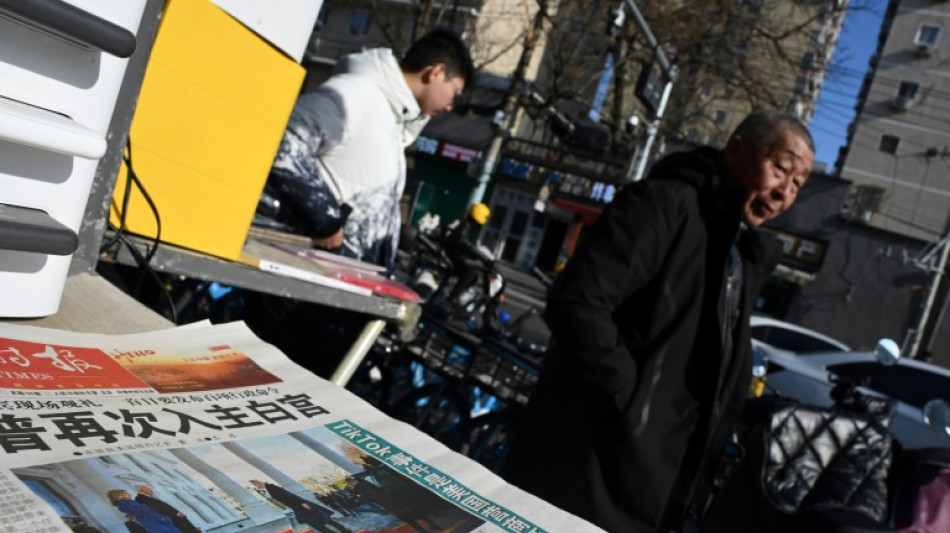
How things stand in China-US trade tensions with Trump 2.0 / Photo: GREG BAKER - AFP

 Hungary cuts anti-LGBTQ legislation from Orban-era law
 'Our future is being robbed': Greta Thunberg joins France student protests

 Late superstar Anita Mui's ashes missing in Hong Kong

 'No choice': IMF says developing countries must cut spending despite war shock

 Boasting South Korea footballers spark rethink of military service exemptions

 Five dead as Hurricane Simon, Rachel pummel Mexico's Pacific coast
 Seoul, Tokyo stocks plunge as Asia suffers fresh tech rout
 Damaged and drained, Indonesia's peatlands go up in smoke
 Dominant Australia wary of Pacific threat at Rugby League World Cup
 Pope to be admitted to hospital for lung operation

 Samoa's McFarland welcomes 'massive' arrival of ex-All Blacks for World Cup run-in

 Brewers beat Dodgers 7-4 to extend MLB playoff lead

 Teenager shoots headmaster, teacher at French school

 'Breaking Bad' actor RJ Mitte dead: representatives

 Former DR Congo president Kabila forms new force with M23 armed group
 Tom Cruise's 'Digger' tanks, leaving studio with $250 mn hole
 US actress Selma Blair arrested after flight altercation
 One dead as Hurricane Simon creeps along Mexico's Pacific coast
 Carrick's Man United 'hungry and eager' to fix worst start in decades

 Fury as US federal agents search anti-Trump lawmaker's home

 One goal enough for Flick as Barca enter Galatasaray cauldron

 A7 to unveil a service that will re-invent the international payments market
 'Status quo' with EU 'not good enough', UK PM says as summit date set
 Stolen Renoir paintings found behind wall in France

 French supermarkets suffer refrigerator shutdown after 'unprecedented' cyberattack
Donald Trump is back in the White House, promising to use the United States's vast economic weight to hit back at China for its alleged unfair trade practices and role in the deadly American fentanyl crisis.
This week, the mercurial magnate said 10 percent tariffs on all Chinese imports could kick in on February 1 -- and on the campaign trail touted a levy as high as 60 percent.
China has warned that there are "no winners" in a trade war and vowed to defend its economic interests.
Here's where the China-US trade relationship stands:
- How much trade is at stake? -
Trade between China and the United States -- the world's two largest economies -- is vast, totalling more than $530 billion in the first eleven months of 2024, according to Washington.
Over that same period, sales of Chinese goods to the United States totalled more than $400 billion, second only to Mexico.
According to the Peterson Institute of International Economics (PIIE), China is the dominant supplier of goods from electronics and electrical machinery, to textiles and clothing.
But a yawning trade imbalance -- $270.4 billion for January to November last year -- has long raised hackles in Washington.
As has China's vast state support for its industry, sparking accusations of dumping, as well as its perceived mistreatment of US firms operating in its territory.
But China's economy remains heavily reliant on exports to drive growth despite official efforts to raise domestic consumption -- making its leaders reluctant to change the status quo.
- What happened during Trump's first term? -
Trump stormed into the White House in 2016 vowing to get even with China, launching a trade war that slapped significant tariffs on hundreds of billions of dollars of Chinese goods.
China responded with retaliatory tariffs on American products -- particularly affecting US farmers.
Key US demands were greater access to China's markets, broad reform of a business playing field that heavily favours Chinese firms, and a loosening of heavy state control by Beijing.
After long, fraught negotiations the two sides agreed what became known as the "phase one" trade deal -- a ceasefire in the nearly two-year-old trade war.
Under that agreement, Beijing agreed to import $200 billion worth of US goods, including $32 billion in farm products and seafood.
But in the face of the pandemic and a US recession, analysts say Beijing fell well short of that commitment.
"In the end, China bought only 58 percent of the US exports it had committed to purchase under the agreement, not even enough to reach its import levels from before the trade war," PIIE'S Chad P Brown wrote.
"Put differently, China bought none of the additional $200 billion of exports Trump's deal had promised."
- How did things change under Biden? -
Trump's successor Joe Biden did not roll back increases imposed by his predecessor, but took a more targeted approach when it came to tariff hikes.
Under Biden, Washington expanded efforts to curb exports of state-of-the-art chips to China -- part of a broader effort to prevent sensitive US technologies being used in Beijing's military arsenal.
His administration has also used tariffs to take aim at what it called China's "industrial overcapacity" -- fears the country's industrial subsidies for green energy, cars and batteries could flood global markets with cheap goods.
Last May, Biden ordered $18 billion worth of imports from China be slapped with tariffs, accusing Beijing of "cheating" rather than competing.
Under the hikes, tariffs on EVs quadrupled to 100 percent, while the tariff for semiconductors will surge from 25 percent to 50 percent.
The measures also targeted strategic sectors such as batteries, critical minerals and medical products.
Both sides have also launched investigations into the others' alleged unfair trade practices with probes into dumping and state subsidies.
- What happens next? -
With Biden gone, all eyes are on whether Trump will follow through on these threats -- or if the rhetoric was an opening gambit in negotiations.
Trump has long viewed tariffs as a bargaining tool -- an "all-purpose bludgeon", according to a Wall Street Journal editorial.
He has also tied tariffs to the fate of Chinese-owned social media app TikTok -- warning of retaliation if a deal cannot be struck to sell it.
Many breathed a sigh of relief when a "shock and awe" blitz of executive orders signed on Trump's first day in office did not feature tariffs on Chinese goods.
But Trump did order a sweeping review by top officials into a number of Chinese trade practices -- with reports due by April 1.
"Although no immediate tariff hike is an upside surprise, extended uncertainty may still weigh on confidence," HSBC economists wrote in a note Wednesday.
"That said, the lack of concrete tariffs at this juncture may suggest that Trump is open to further negotiations with China," they added.
D.Qudsi--SF-PST