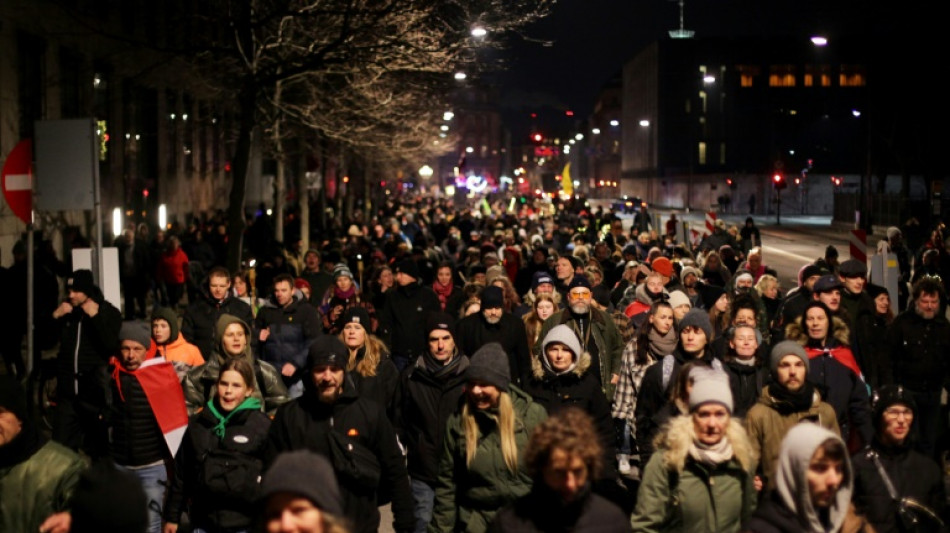
Denmark returns to 'life as we knew it' despite Omicron

 'Glad it's over': Kim powers to Games gold and military exemption

 After 11 World Cups, football finally comes home for one Indian fan

 Marc Marquez wins sprint at Japan MotoGP, Martin grabs pole

 Alcaraz fends off Arnaldi to reach Japan Open quarters

 Antonelli tops times in final practice at Bahrain GP
 Gauff digs deep to beat Osorio in China Open second round

 Fresh protests to hit Spain after housing measures defeated
 'He's here with me': Japan cycle queen dedicates gold to late brother

 Japan Olympic chief says 'lot more' athletes at Games than expected

 Asian carmakers besting US rivals at home, China poised to strike

 Widgets & Web Offers All-Inclusive Investor Relations Websites for Public Companies, IPOs and SPACs

 Adams named new US captain to 2030 World Cup

 China a better influence in Latin America than US: poll

 Judge pauses construction of border project in Texas national park

 Belgium's De Bruyne fires double to sink Turkey, France held by Italy

 US jobs data boosts stocks as oil prices dip

 US Supreme Court to hear high-stakes climate case

 Trump expected to name intel chief Clayton as AI czar: reports

 Argentina unveils passports-for-investment scheme

 Brazil election debate chaos sparks censorship row
 England's Carse charged by cricket body over nightclub incident

 Amazon vows $1 bn for data center towns, decries 'myths'

 Oil prices drop on G7 fuel release, US jobs data boosts stocks

 G7 agrees deal to ease global energy supply concerns

 Spain's government dealt blow as lawmakers reject housing bills

Denmark on Tuesday becomes the first European Union country to lift all of its Covid restrictions despite record numbers of cases, relying on its high vaccination rate to cope with the milder Omicron variant.
After a first attempt at lifting all its restrictions between September and November, the Scandinavian country is once again ditching its facemasks, Covid passes and limited opening hours for bars and restaurants.
"I'm so happy that this is all going to be over tomorrow. It's good for life in the city, for nightlife, just to be able to be out longer", 17-year-old student Thea Skovgaard told AFP the day before the lifting.
Nightclubs reopen on Tuesday, when limits on the number of people allowed at indoor gatherings also come to an end.
Only a few restrictions remain in place at the country's borders, for unvaccinated travellers arriving from non-Schengen countries.
The easing comes as Denmark registers around 40,000-50,000 new Covid cases a day, or almost one percent of the country's 5.8 million inhabitants.
"We have an extremely high coverage of adults vaccinated with three doses," epidemiologist Lone Simonsen of the University of Roskilde told AFP.
More than 60 percent of Danes have received a third dose -- one month ahead of health authorities' schedule -- compared to an EU average of just under 45 percent.
Including those who have recently had Covid, health authorities estimate that 80 percent of the population are protected against severe forms of the disease.
"With Omicron not being a severe disease for the vaccinated, we believe it is reasonable to lift restrictions", Simonsen said.
The broad spread of the Omicron variant is also expected to lead to a "more robust and long-lasting immunity", helping the country fend off future waves, she said.
Two years after the outbreak of Covid-19, the Danish strategy enjoys broad support at home.
In a poll published Monday by daily Politiken, 64 percent of Danes surveyed said they had faith in the government's Covid policy.
- Personal responsibility -
Going forward, Danes are being urged to exercise personal responsibility, Simonsen said.
"Without a Covid pass there will be a shift of responsibility", she said.
Danes have increasingly used home tests to detect infection, but these are now being phased out and instead, anyone with symptoms is advised to stay home.
The Danish Health Authority currently "recommends" those who test positive to isolate for four days, while contact cases no longer need to quarantine.
Facemasks and the Covid pass are also recommended for hospital visits.
The government said it does not expect to have to revert to new closures again but has remained cautiously optimistic.
"We can't provide any guarantees when it comes to biology", Prime Minister Mette Frederiksen said last week when announcing the country's return "to life as we knew it before corona".
"It's really nice that this is ending but will we really live without any restrictions now? I doubt it," said Cille Hjort, a fast-food vendor eager to see her patrons' faces without masks again.
This is the second time Denmark has tried to return to a pre-pandemic lifestyle.
On September 10, the country lifted all its restrictions, before reintroducing some of them in early November.
Museums, cinemas and theatre and concert venues then closed just before Christmas, and reopened again in early January.
Faced with a lower level of hospitalisations than in previous waves, several European countries, including France, Ireland and the United Kingdom, have announced the lifting or a considerable reduction of their restrictions, despite record or very high cases.
"Two years into the pandemic, populations in most countries have reached high levels of immunity, from vaccines or natural illness", Simonsen said.
"This is how it ends, judging from what we have seen with historical pandemics".
According to the World Health Organization, 73 percent of the European population has contracted Covid-19 at least once since January 2020.
Tyra Krause of Denmark's public health and research institution SSI said meanwhile she expected Covid-19 to return in regular waves, "like the flu".
"We may end up having to vaccinate risk groups ahead of the autumn to prevent severe cases", she told science magazine Videnskab.
K.Hassan--SF-PST