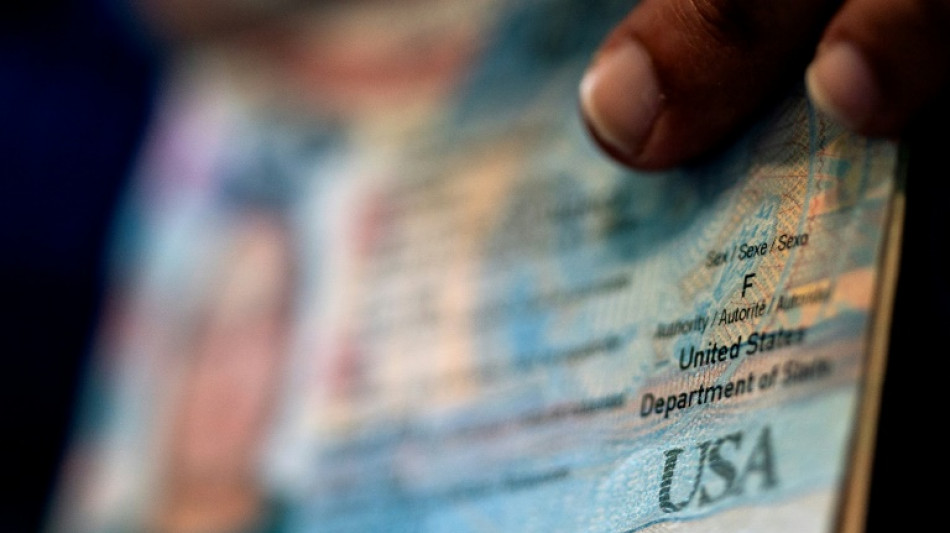
Trump's birthright citizenship move challenges US identity: analysts / Photo: Stefani Reynolds - AFP

 Hungary cuts anti-LGBTQ legislation from Orban-era law

 'Our future is being robbed': Greta Thunberg joins France student protests

 Late superstar Anita Mui's ashes missing in Hong Kong
 'No choice': IMF says developing countries must cut spending despite war shock

 Boasting South Korea footballers spark rethink of military service exemptions
 Five dead as Hurricane Simon, Rachel pummel Mexico's Pacific coast
 Seoul, Tokyo stocks plunge as Asia suffers fresh tech rout

 Damaged and drained, Indonesia's peatlands go up in smoke

 Dominant Australia wary of Pacific threat at Rugby League World Cup

 Pope to be admitted to hospital for lung operation
 Samoa's McFarland welcomes 'massive' arrival of ex-All Blacks for World Cup run-in

 Brewers beat Dodgers 7-4 to extend MLB playoff lead

 Teenager shoots headmaster, teacher at French school

 'Breaking Bad' actor RJ Mitte dead: representatives

 Former DR Congo president Kabila forms new force with M23 armed group

 Tom Cruise's 'Digger' tanks, leaving studio with $250 mn hole
 US actress Selma Blair arrested after flight altercation

 One dead as Hurricane Simon creeps along Mexico's Pacific coast

 Carrick's Man United 'hungry and eager' to fix worst start in decades
 Fury as US federal agents search anti-Trump lawmaker's home

 One goal enough for Flick as Barca enter Galatasaray cauldron
 A7 to unveil a service that will re-invent the international payments market

 'Status quo' with EU 'not good enough', UK PM says as summit date set

 Stolen Renoir paintings found behind wall in France

 French supermarkets suffer refrigerator shutdown after 'unprecedented' cyberattack
Donald Trump's plan to end birthright citizenship could fundamentally reshape America, analysts said Tuesday, overturning a principle that has underpinned the country for more than 150 years.
Moments after being sworn into office, the Republican president came out swinging, with a raft of executive orders aimed at slashing migration and changing how the US determines who is allowed to live here.
Most eye-catchingly, Trump took aim at previsions guaranteed in the 14th Amendment of the US Constitution that grant citizenship to anyone born on US soil.
"All persons born or naturalized in the United States, and subject to the jurisdiction thereof, are citizens of the United States and of the state wherein they reside," reads the document, which was ratified in 1868 as the postbellum US sought to knit itself back together.
If implemented, the order Trump signed on Tuesday would prevent the federal government from issuing passports, citizenship certificates or other documents to children whose mothers are in the country illegally or temporarily, and whose fathers are not US citizens or permanent residents.
Gil Guerra, an immigration policy analyst at US political think tank the Niskanen Center, said the notion of birthright citizenship is a defining characteristic of the American experiment.
The fact that everyone born here has a real stake in the country galvanizes a sense of cohesion that is absent in other systems, he said.
"It has helped assimilation by giving people who are born here an immediate sense of belonging," he told AFP.
"I think what people oftentimes overlook is that it also places responsibilities on the children of immigrants to see themselves as Americans and to be patriotic."
That feeds into the fierce pride that many Americans feel in their flag, their national anthem and in institutions like the military.
Making that precarious could have implications for social stability, said Guerra.
The modern United States has not suffered from the pockets of separatism that beset other world powers, like Russia, where tranches of the population feel like they don't belong.
"The US has managed to completely avoid that, because our political identity has for centuries now been borne on the premise that, if you're born in the US, you are an American," said Guerra.
- Supreme court -
Aaron Reichlin-Melnick, a senior fellow at the American Immigration Council, said the 14th Amendment was "crystal clear," and muddying the waters would have implications for people well beyond the babies born to illegal immigrants.
"All you needed before was a birth certificate proving you were born here... now, you'd have to show extensive documentation of your ancestry and your parents' citizenship," he told AFP.
"That makes everybody's life harder."
Trump supporters who fret about changing demographics sometimes complain that new arrivals and their children take resources that would otherwise be available for the established population.
But, says Guerra, the expansive approach to citizenship the US has historically taken has benefits to that very population -- whose own birth rate is plunging -- in terms of having enough working-age people to fund social security programs and to do the labor that a dynamic economy requires.
The demographic edge the US enjoys is also crucial in times of war.
Not "having a young population that can potentially serve in the military, in the events of conflict... could potentially endanger the United States," he said.
Trump's executive order faced an immediate legal challenge, with 22 states -- including California and New York -- suing to prevent its implementation.
The issue will almost certainly end up in the US Supreme Court.
While some legal scholars think Trump's efforts will come unstuck, a 6-3 conservative majority -- three of whom were appointed by Trump -- may have different ideas.
"I don't think it's inconceivable (that it will be upheld), which is what I would have said in 2019," Amanda Frost, a law professor at the University of Virginia told The New York Times.
"The ground is shifting."
V.Said--SF-PST