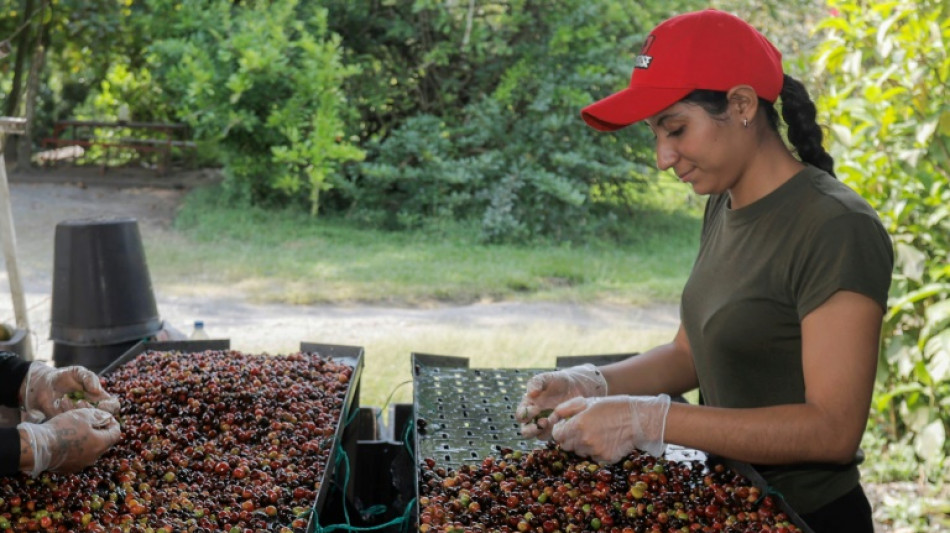
The global forces sending coffee prices skyward / Photo: JJ BONILLA - AFP

 Hungary cuts anti-LGBTQ legislation from Orban-era law

 'Our future is being robbed': Greta Thunberg joins France student protests

 Late superstar Anita Mui's ashes missing in Hong Kong

 'No choice': IMF says developing countries must cut spending despite war shock

 Boasting South Korea footballers spark rethink of military service exemptions

 Five dead as Hurricane Simon, Rachel pummel Mexico's Pacific coast
 Seoul, Tokyo stocks plunge as Asia suffers fresh tech rout
 Damaged and drained, Indonesia's peatlands go up in smoke

 Dominant Australia wary of Pacific threat at Rugby League World Cup

 Pope to be admitted to hospital for lung operation

 Samoa's McFarland welcomes 'massive' arrival of ex-All Blacks for World Cup run-in
 Brewers beat Dodgers 7-4 to extend MLB playoff lead

 Teenager shoots headmaster, teacher at French school
 'Breaking Bad' actor RJ Mitte dead: representatives

 Former DR Congo president Kabila forms new force with M23 armed group
 Tom Cruise's 'Digger' tanks, leaving studio with $250 mn hole

 US actress Selma Blair arrested after flight altercation

 One dead as Hurricane Simon creeps along Mexico's Pacific coast

 Carrick's Man United 'hungry and eager' to fix worst start in decades

 Fury as US federal agents search anti-Trump lawmaker's home

 One goal enough for Flick as Barca enter Galatasaray cauldron

 A7 to unveil a service that will re-invent the international payments market

 'Status quo' with EU 'not good enough', UK PM says as summit date set

 Stolen Renoir paintings found behind wall in France

 French supermarkets suffer refrigerator shutdown after 'unprecedented' cyberattack

Climate change, political headwinds and diverging market dynamics around the world have pushed coffee prices to fresh records, jacking up the cost of your everyday brew or a barista's signature macchiato.
While the current hot streak may calm down in the coming months, experts and industry insiders expect volatility will remain the watchword, giving little visibility for producers -- two-thirds of whom farm parcels of less than one hectare (2.5 acres).
Meteoric rise
The price of arabica beans listed in New York surged by 90 percent last year, smashing on December 10 a record dating from 1977 -- $3.48 per pound. Robusta prices have seen similar growth, though prices are lower for the less premium coffee variety.
Fears of poor harvests after droughts in key producers Brazil and Vietnam, respectively the biggest and second-biggest sources of the beans, fuelled the price hike.
Demand has outstripped supply for several years now, prompting a flurry of speculative buying that further drove up market prices.
"And then you have the disruption of the Red Sea, which means that from Southeast Asia especially towards Europe it takes much longer, because you need to circumnavigate Africa, and often you have very long delays in the ports," said Carlos Mera, a coffee analyst at Rabobank.
Traders were also anticipating the implementation of an EU law that would have banned imports of products driving deforestation -- though lawmakers recently delayed its coming into force until December 30, 2025.
Donald Trump's threat of punishing trade tariffs on a range of goods adds another level of uncertainty -- a top advisor to his predecessor Joe Biden warned in December that food items like coffee would likely be affected.
Nonetheless, given the recent run, "I'm thinking prices are likely or more likely to go lower than higher," Mera said.
"But it's a market with very low stock, so we have to expect volatility in either way."
Climate threats
Arabica beans, grown at higher altitudes, are at greater risk from climate change since only a few countries, notably Brazil, could move farms further uphill as the world gets hotter.
Robusta can thrive in a wider range of growing conditions but is less prized by consumers.
In the 2024-2025 growing season around 175 million bags -- 60 kilogrammes (132 pounds) each -- are expected to be produced, according to the US Department of Agriculture: 56 percent arabica and 44 percent robusta.
Guillaume David at France's CIRAD agricultural research and international cooperation agency, said both varieties are exposed to new risks in their intertropical growing zones such as late-season frosts, rains at the wrong time and beetle infestations.
"This year we saw these risks in Brazil and Vietnam, whereas before it would be in one or the other," David said.
Brazil grows 40 percent of the world's coffee, followed by Vietnam (17 percent), Colombia (7 percent), Indonesia (6 percent) and Ethiopia (5 percent). After come Uganda, India, Honduras, Peru and Mexico.
Climate change could make other regions a possibility.
In Africa, Togo or Ivory Coast could again start growing coffee after it was largely replaced by cocoa, or Kenya could replace part of their avocado plantations, David said.
Wherever its grown, experts say growing practices for what is at heart a forest plant need to adapt, with sufficient canopy cover to protect from both sun and storms, and multi-crop farming to protect against pests and diversify revenues.
New customers
Demand has expanded beyond the traditional markets of Europe and the Americas to make inroads with tea-drinking Chinese.
About 4.3 million bags were imported in the 2023-2024 season, Mera said, up from 1.5 million just four year earlier.
"I would expect China to continue to grow in the future," he said. "Coffee in the end is addictive, right?
"There is also much more visibility because there are so many more stores and not only in the big cities, but those in like second-tier cities," he said.
Demand in Europe meanwhile slipped last year, with Germany for example seeing a one percent decrease.
"I think in Europe, the drop in demand was mainly related to the cost of living crisis," Mera said.
The industry is also keeping an eye on the growing use of weight-loss drugs such as Ozempic, as some doctors caution against drinking caffeine while on the treatment.
Small producers, big processors
Despite the recent price surge, millions of growers cultivating coffee on small farms still live in poverty in developing countries.
They have little leeway to set prices in a global commodity market dominated by a handful of multinational processors and distributors.
Even fair trade programmes to guarantee a living wage affect just five percent of the market -- 80 percent of the world's coffee is bought by heavyweight brokerage firms.
Experts say wild price shifts in recent years make ensuring better prices for growers, many of whom are in developing countries, even more urgent.
A sharp drop in prices could lead growers to abandon their plants, jeopardising their future revenues, said Nicolas Eberhart of the French food cooperative Ethiquable.
In October, the Group of 7 nations endorsed a Global Coffee Sustainability and Resilience Fund, aimed at spurring private investments to improve productivity and get more money into growers' pockets.
Q.Bulbul--SF-PST