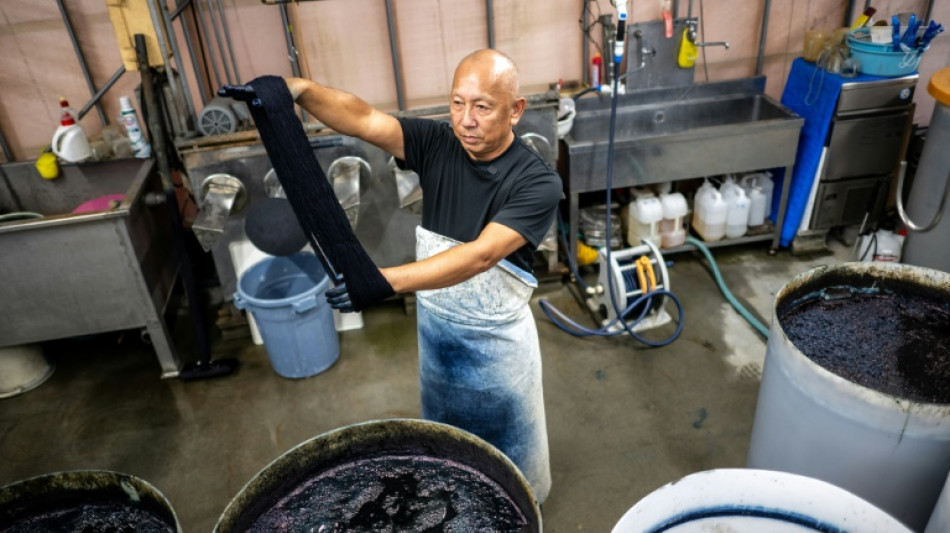
True blue tradition: how Japan's coveted jeans are made / Photo: Philip FONG - AFP

 Arsenal cruise past Lille into share of Champions League lead

 Trump ousts Greece ambassador over ethics scandal

 Reese Witherspoon, France's Mediawan to buy Hello Sunshine
 Bipartisan US senators urge Trump to scrap Russian diesel deal

 Ex-gang leader sentenced to minimum 40 years for Tupac murder

 Cornell suspends frat parties after alleged gang rape

 Man City deserve to keep titles, says PSG's Luis Enrique

 Regulator 'will resign' if any political interference in Man City case

 Microsoft's Brad Smith calls for 'real and effective' AI safety standards

 Anthropic warns of AI 'worms' spreading across smart gadgets

 Big US banks report strong earnings and stay bullish on AI

 Iraola backs Barcola, Wirtz to come good for Liverpool

 In a first, AI helps UK lawmaker find her voice in parliament

 Pope Leo in Rome hospital for lung operation

 EU watchdog says smart glasses must give 'clear warnings' when recording

 Houthis say Saudi Arabia strikes oil site in Yemen's capital

 France roiled by marches in support of protesting students

 Goldman Sachs profits jump as CEO says no plans to exit

 Apple unveils HomeView smart display in renewed home push

 Novelist Thelyson Orelien denies AI use, admits plagiarism 'mistakes'

 Trump asks Greece ambassador to resign amid bribery scandal: White House

 11 missing after ships struck off Bulgaria in latest Black Sea attack

 France budget debate faces rocky start as Socialists vow to fight

 AI could 'change the stakes' on bioweapons: UK spy chief

 Sweden centre-left leader fails to form government

Call it an antidote to fast fashion: Japanese jeans hand-dyed with natural indigo and weaved on a clackety vintage loom, then sold at a premium to global denim connoisseurs.
Unlike their mass-produced cousins, the tough garments crafted at the small Momotaro Jeans factory in southwest Japan are designed to be worn for decades, and come with a lifetime repair warranty.
On site, Yoshiharu Okamoto gently dips cotton strings into a tub of deep blue liquid, which stains his hands and nails as he repeats the process.
The cotton is imported from Zimbabwe, but the natural indigo they use is harvested in Japan -- its colour far richer than synthetic imitations, according to Okamoto.
He calls it a "time-consuming and costly" method, commonly used to dye kimonos in the 17th-19th century Edo period.
Momotaro Jeans was established in 2006 by Japan Blue, one of a few dozen denim producers in the seaside town of Kojima, renowned for their artisan quality.
"We're very strict about all aspects of manufacturing," Japan Blue's president Masataka Suzuki told AFP.
That includes "whether the sewing is done properly, and whether the dye is beautiful," making local craftspeople with traditional manufacturing skills indispensable.
Their efforts do not come cheap, however. A standard pair of Momotaro Jeans retails for around 30,000 yen ($200) while a silk-blend pair costs 60,000 yen.
The brand's most expensive offering, woven by hand on a wooden machine converted from a luxury kimono loom, has a price tag of over 200,000 yen.
Following in the footsteps of popular high-end Japanese denim brands such as Osaka-based Evisu and Sugar Cane in Tokyo, interest in Japan Blue is growing among overseas shoppers.
They now account for 40 percent of retail sales, and the company recently opened its sixth Kyoto store targeting deep-pocketed tourists.
- 'Niche' reputation -
Denim-making flourished from the 1960s in Kojima, which has a long history of cotton-growing and textile-making.
In the Edo period, the town produced woven cords for samurai to bind sword handles. It then switched to producing split-toe "tabi" socks and, later, school uniforms.
Now denim from Kojima is used by international luxury fashion brands.
The market for Japanese jeans "has grown in the last 10 to 15 years", said Michael Pendlebury, a tailor operating a repair shop in Britain called The Denim Doctor.
Although revered by denim aficionados in Western countries, they remain "not quite affordable for most" with something of a "niche" reputation, Pendlebury said.
"Mass-produced denim brands like Levis, Diesel and Wrangler are the largest, and more worn, but the highest quality is still Japanese in my opinion," he said, adding that the weak yen and a tourism boom could boost sales of made-in-Japan jeans.
Momotaro Jeans is named after a folklore hero in Okayama, where Kojima is located. It's part of the wider denim-producing Sanbi area, which also includes Hiroshima.
Another factor that makes brands like Momotaro Jeans idiosyncratic -- and expensive -- is the use of very noisy old shuttle-weaving machines, which have only a quarter of the output of the latest factory looms.
They often break down, but the only people who know how to repair the machines are in their 70s or older, according to Shigeru Uchida, a weaving craftsman at Momotaro.
The brand uses a handful of shuttle looms made in the 1980s by a company owned by Toyota.
"There are only a few of them in Japan now" because they are no longer made, the 78-year-old Uchida said, walking back and forth between the machines to detect unusual sounds that could signal a breakdown.
Despite the complexities, he says their fabric makes it worth it.
"The texture is very smooth to the touch... and when made into jeans, it lasts quite a long time," Uchida said.
Suzuki says Momotaro Jeans is a "sustainable" choice because "no matter when you bring it to us, we will take responsibility for fixing it".
"When people spend a lot of time in their jeans, the path of their life is left on the clothes," depending on how they wear or wash them and even where they live, Suzuki said.
"We want to preserve such a mark as long as possible."
R.Halabi--SF-PST