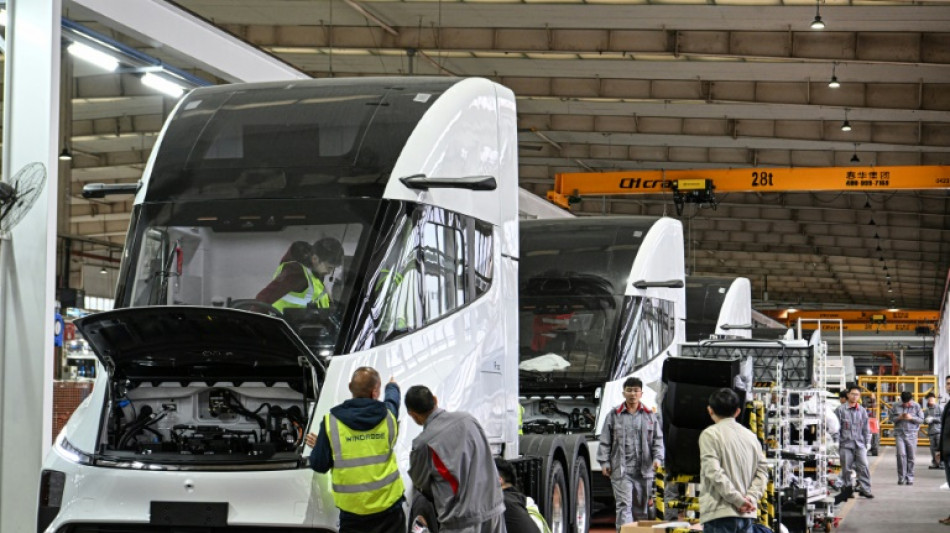
Chinese firms take on EV truck challenges / Photo: STR - AFP

 Arsenal cruise past Lille into share of Champions League lead

 Trump ousts Greece ambassador over ethics scandal

 Reese Witherspoon, France's Mediawan to buy Hello Sunshine

 Bipartisan US senators urge Trump to scrap Russian diesel deal

 Ex-gang leader sentenced to minimum 40 years for Tupac murder

 Cornell suspends frat parties after alleged gang rape

 Man City deserve to keep titles, says PSG's Luis Enrique

 Regulator 'will resign' if any political interference in Man City case

 Microsoft's Brad Smith calls for 'real and effective' AI safety standards

 Anthropic warns of AI 'worms' spreading across smart gadgets

 Big US banks report strong earnings and stay bullish on AI

 Iraola backs Barcola, Wirtz to come good for Liverpool

 In a first, AI helps UK lawmaker find her voice in parliament

 Pope Leo in Rome hospital for lung operation

 EU watchdog says smart glasses must give 'clear warnings' when recording

 Houthis say Saudi Arabia strikes oil site in Yemen's capital

 France roiled by marches in support of protesting students

 Goldman Sachs profits jump as CEO says no plans to exit

 Apple unveils HomeView smart display in renewed home push

 Novelist Thelyson Orelien denies AI use, admits plagiarism 'mistakes'

 Trump asks Greece ambassador to resign amid bribery scandal: White House

 11 missing after ships struck off Bulgaria in latest Black Sea attack

 France budget debate faces rocky start as Socialists vow to fight

 AI could 'change the stakes' on bioweapons: UK spy chief

 Sweden centre-left leader fails to form government

Dominant in the electric car sector, Chinese companies have been quietly consolidating their position in the lesser-watched trucking scene -- but foreign tariffs and a perceived quality gap could signal roadblocks ahead, experts warn.
The domestic supply chain and low-price strategy that helped make China's EV car industry world-leading are being leveraged by established automakers and start-ups alike, aiming to similarly transform trucking.
Electric trucks currently represent less than one percent of truck sales worldwide, according to the International Energy Agency (IEA) -- with China making up 70 percent of those sales in 2023.
But the agency said it was "optimistic" policy and technology developments would see more widespread adoption in the next 10 years.
"This industry, I believe, is ripe for disruption," Han Wen, the founder of start-up Windrose, told AFP on a factory floor as the company's first vehicles for delivery were assembled behind him.
Fleets of electric heavy goods vehicles from China have been growing internationally, even as Western countries target the country's EV cars with heavy sanctions.
Chinese companies like BYD and Beiqi Foton have shipped trucks to countries including Italy, Poland, Spain and Mexico, and have opened assembly plants around the world.
"China's trucks are generally cost-competitive in emerging markets," Stephen Dyer, from consulting firm AlixPartners, told AFP.
"For mature markets, performance and durability do not yet meet the needs of most customers, but that is changing."
When it comes to emissions, "heavy-duty trucks are considered one of the more difficult to abate transport segments (after aviation and shipping)", IEA analyst Elizabeth Connelly told AFP.
- Battery issues -
A major challenge is the trade-off between battery size and range.
"The larger the battery, the longer the range. But the larger the battery, the heavier the truck... and the worse the fuel economy," Connelly said.
Chinese manufacturers have been seen as producing lower quality products than foreign counterparts.
"Historically, Chinese trucks tended to have a shorter useful lifecycle than European or Japanese trucks," AlixPartners' Dyer told AFP.
While that perception is changing, China's flagship companies still lag rivals on factors like range and battery capacity.
According to the Zero-Emission Technology Inventory, the median Chinese heavy duty truck range is 250 kilometres (155 miles), compared with 322 km in the United States.
BYD -- which in October beat Tesla in quarterly revenue for the first time -- says its 8TT model's range is 200 kilometres, compared with the 800 kilometres promised by Tesla's Semi truck.
But Chinese manufacturers could close the gap quickly.
Han's Windrose says its semi-trucks can go up to 670 kilometres on a single charge.
Meanwhile, battery giant CATL has rolled out truck battery-swapping facilities -- where drained units can be immediately replaced, eliminating charging time altogether.
China's existing EV ecosystem is a massive advantage.
"We're very lucky to have the Chinese supply chain (for EVs)," said Han, noting Windrose was using an electric bus company's factory to build its trucks.
"There's no doubt that China also will have an edge on the electrification of heavy-duty trucks."
- 'Not normal times' -
More unpredictable are the testy geopolitical waters the sector risks stalling in.
This year has seen important trading partners including the European Union and the United States impose hefty tariffs on Chinese EV cars, saying Beijing's state aid to automakers undercut their own firms.
China refutes this, but as its EV truck footprint grows globally, so could the risk of similar action being taken.
"Governments in potential export markets want to protect their local industries," Sam Fiorani, at AutoForecast Solutions, told AFP.
US President-elect Donald Trump has promised huge tariff hikes on Chinese imports once he takes office.
"Since EV truck volume is smaller than passenger EVs, there is a chance that EV trucks would fall a little under the radar in normal times," AlixPartners' Dyer said.
But "these are not 'normal times' anymore and anything Chinese is high profile in the US government currently", he added.
Some companies have already taken steps that could mitigate this risk.
BYD proudly touts its trucks as being "assembled by union workers in Lancaster, California", while it has announced plans to build a factory in Mexico, and has plants in Hungary and Romania.
Windrose's Han told AFP the firm has consciously spread its operations across multiple countries, moving key headquarters to Belgium earlier this year.
"We do embrace the fact that every major market would like its own domestic supply chain of EV," he told AFP.
But he added: "You have to start in China. We then try to move the supply chain globally... But you have to start in China. There's no alternative."
S.Barghouti--SF-PST

