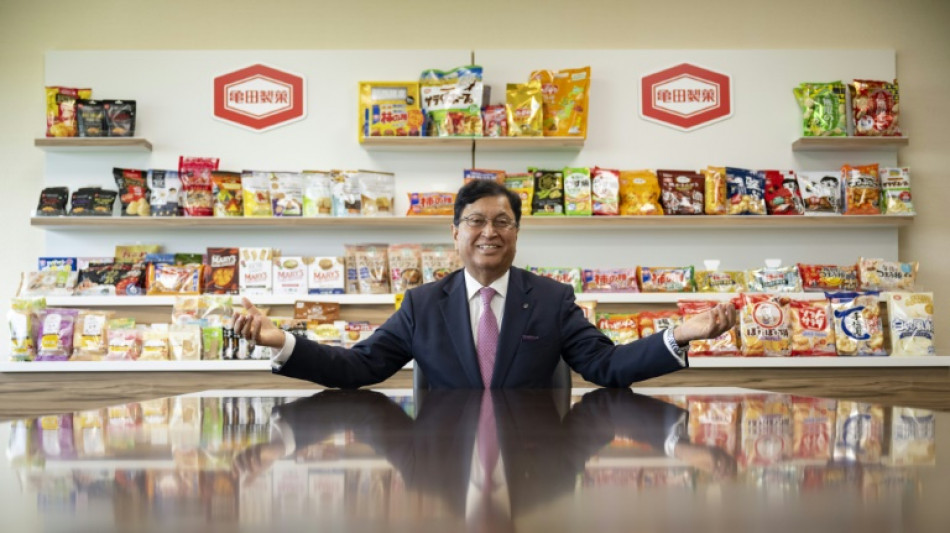
Rare foreign-born CEO says Japan needs immigration to thrive / Photo: Yuichi YAMAZAKI - AFP

 Arsenal cruise past Lille into share of Champions League lead

 Trump ousts Greece ambassador over ethics scandal

 Reese Witherspoon, France's Mediawan to buy Hello Sunshine

 Bipartisan US senators urge Trump to scrap Russian diesel deal

 Ex-gang leader sentenced to minimum 40 years for Tupac murder

 Cornell suspends frat parties after alleged gang rape

 Man City deserve to keep titles, says PSG's Luis Enrique

 Regulator 'will resign' if any political interference in Man City case

 Microsoft's Brad Smith calls for 'real and effective' AI safety standards

 Anthropic warns of AI 'worms' spreading across smart gadgets

 Big US banks report strong earnings and stay bullish on AI

 Iraola backs Barcola, Wirtz to come good for Liverpool

 In a first, AI helps UK lawmaker find her voice in parliament

 Pope Leo in Rome hospital for lung operation

 EU watchdog says smart glasses must give 'clear warnings' when recording

 Houthis say Saudi Arabia strikes oil site in Yemen's capital

 France roiled by marches in support of protesting students

 Goldman Sachs profits jump as CEO says no plans to exit

 Apple unveils HomeView smart display in renewed home push

 Novelist Thelyson Orelien denies AI use, admits plagiarism 'mistakes'

 Trump asks Greece ambassador to resign amid bribery scandal: White House

 11 missing after ships struck off Bulgaria in latest Black Sea attack

 France budget debate faces rocky start as Socialists vow to fight

 AI could 'change the stakes' on bioweapons: UK spy chief

 Sweden centre-left leader fails to form government

The Indian-born head of one of Japan's most famous snack brands has warned that the country must change its mindset and admit more immigrants to get the economy back to the glory of its boom years.
Politicians have struggled for years to recover from the so-called lost decades as a range of differing programmes have failed to kickstart growth, including an ultra-loose monetary policy and trillions of dollars in stimulus measures.
And as the new government of Prime Minister Shigeru Ishiba eyes a fresh drive to bring back the heyday of its global tech domination Lekh Juneja, the head of rice cracker giant Kameda Seika, said he worries his adopted country has lost its edge.
"Forty years ago I came to Japan because it was close to number one in GDP... it was booming," the biotech scientist told AFP at Kameda's headquarters in Japan's rice heartland of Niigata.
But at some point "Japan thought 'we have everything now'. And I think that the hungry spirit to (have) the guts to go global started disappearing a bit".
Kameda's expansion mirrored Japan's postwar boom, increasing revenues tenfold between 1965 and 1974 and becoming synonymous with the nationally adored "senbei" crackers in the process.
But the country that gave the world the Sony Walkman, the bullet train and Super Mario is no longer setting the pace in technology, overtaken by Silicon Valley, South Korea and China.
In the late 1980s, Japanese firms dominated the world's top 10 companies by market capitalisation. Today not one makes the list.
The population is ageing and projected to drop by almost a third in the next 50 years, and firms are already having problems filling vacancies.
Although it has relaxed the rules in recent years, Japan has not turned in a big way to immigration as a solution.
The country "has no choice" but to allow in more immigrants, said Juneja, 72, who first came to Japan in 1984 and previously worked for a food ingredients maker and a pharmaceuticals firm.
"It's not only the numbers. It's also the mindset, the culture. We have to go global," he said.
According to a recent study, Japan needs to more than triple its number of foreign workers to 6.88 million by 2040. Currently it's on track to be almost a million short.
- 'Rice innovation' -
Since joining the firm Juneja has been trying to make Kameda more international as well as a "rice innovation company".
In the testing centre for new products the employees rolling out dough and trying out new recipes and flavours include an American and a Vietnamese.
Language "is a big barrier. You bring people to Niigata and they don't speak Japanese and it's very difficult for them", Juneja said.
"We need to change that. (If we employ people) who only speak and write Japanese we have very limited resources, very limited choices," he warned.
Japan has very few foreign-born CEOs, and boardrooms are overwhelmingly male.
There are 13 female CEOs in Japan's 1,600 top-listed firms, a Kyodo News survey showed in September.
"It's very rare (for a foreigner) to become a CEO in a Japanese company," Juneja said. "But look at the US."
"There is Microsoft, there is Google, all these companies have Indian CEOs," he said.
"I think Japan has to change... We are proud (in Japan) of our backgrounds. But I think flexibility and having people from overseas would be very critical for Japan."
Not all the non-Japanese CEOs have had a smooth ride. In November the German chief of Olympus resigned after allegedly buying illegal drugs.
And in 2018 Carlos Ghosn, the Franco-Lebanese-Brazilian chief of Nissan, was arrested on suspicion of financial misconduct. He then escaped, in part by hiding in an audio equipment box.
"He didn't generate a very good image for foreign CEOs here," Juneja said. "But the difference between him and me is that I have got a Japanese passport."
V.AbuAwwad--SF-PST

