
German central bank cuts growth forecasts as headwinds intensify / Photo: Ronny HARTMANN - AFP/File

 Arsenal cruise past Lille into share of Champions League lead

 Trump ousts Greece ambassador over ethics scandal

 Reese Witherspoon, France's Mediawan to buy Hello Sunshine

 Bipartisan US senators urge Trump to scrap Russian diesel deal

 Ex-gang leader sentenced to minimum 40 years for Tupac murder

 Cornell suspends frat parties after alleged gang rape

 Man City deserve to keep titles, says PSG's Luis Enrique

 Regulator 'will resign' if any political interference in Man City case

 Microsoft's Brad Smith calls for 'real and effective' AI safety standards

 Anthropic warns of AI 'worms' spreading across smart gadgets

 Big US banks report strong earnings and stay bullish on AI

 Iraola backs Barcola, Wirtz to come good for Liverpool

 In a first, AI helps UK lawmaker find her voice in parliament

 Pope Leo in Rome hospital for lung operation

 EU watchdog says smart glasses must give 'clear warnings' when recording

 Houthis say Saudi Arabia strikes oil site in Yemen's capital

 France roiled by marches in support of protesting students

 Goldman Sachs profits jump as CEO says no plans to exit

 Apple unveils HomeView smart display in renewed home push

 Novelist Thelyson Orelien denies AI use, admits plagiarism 'mistakes'

 Trump asks Greece ambassador to resign amid bribery scandal: White House

 11 missing after ships struck off Bulgaria in latest Black Sea attack

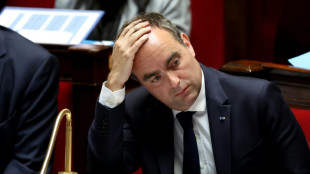 France budget debate faces rocky start as Socialists vow to fight

 AI could 'change the stakes' on bioweapons: UK spy chief

 Sweden centre-left leader fails to form government

Germany's central bank on Friday sharply downgraded its growth forecasts for next year and 2026, predicting a prolonged period of weakness for Europe's biggest economy as it battles multiple headwinds.
From a manufacturing slowdown and weak export demand to heightened political uncertainty at home and the risk of renewed trade tensions under US President-elect Donald Trump, the German economy is facing a perfect storm.
The Bundesbank forecast output will grow a meagre 0.2 percent in 2025, down from a forecast in June of a 1.1 percent expansion. For 2026 it forecast growth of 0.8 percent, down from a 1.4 expansion expected previously.
The estimates are substantially worse than the last projections from the government released in October, and will ring alarm bells among policymakers who had hoped for a strong rebound starting next year.
"The German economy is not only struggling with persistent economic headwinds, but also with structural problems," said Bundesbank chief Joachim Nagel, as he unveiled the bank's latest six-monthly forecast.
As widely expected, the central bank also cut its forecast for 2024 to a contraction of 0.2 percent -- which largely lines up with other recent estimates, including from the government.
The latest bleak forecast is a headache for Chancellor Olaf Scholz, who already faces an uphill battle to persuade voters to re-elect him at polls expected in February, seven months earlier than scheduled.
The country's economic malaise is a central campaign issue after Scholz's coalition government collapsed in November amid a bitter row over the budget and the best approach to reboot the world's third-biggest economy.
Some economists have voiced hoped the looming election will produce a stronger government than Scholz's three-party coalition, which was riven by constant infighting, that is better able to tackle the country's woes.
But the outcome is still uncertain, and the polls are likely to be followed by weeks of coalition-building.
- 'Protectionism' worries -
The Bundesbank cited "uncertainty" surrounding "future fiscal and economic policy" linked to the early elections which have delayed the government budget for 2025.
Nagel singled out problems in the export-driven economy's vast industrial sector as a key challenge.
Manufacturers have been struggling since Russia's invasion of Ukraine in 2022 sent energy prices soaring, and their problems have been compounded by deep-rooted issues, such as a shortage of skilled workers.
The central bank chief also raised concerns about the weakening labour market and consumer spending, a key support for the economy, losing steam.
Weak demand for "made in Germany" products is also weighing, an issue highlighted by a heavier than expected fall in exports in October.
Exports slipped 2.8 percent on the previous month, according to official statistics released Friday, driven by a 14-percent fall in shipments to key trading partner the United States.
The trading relationship with Washington may be set to worsen when Trump takes office next month, as he has vowed to levy tariffs on all imports into the United States.
Nagel has previously warned that the extra duties to one of Germany's key trading partners could knock one percent off the country's economic output.
In his comments Friday, Nagel said the "biggest source of uncertainty" was a "possible global increase in protectionism", without mentioning the United States in particular.
T.Samara--SF-PST

