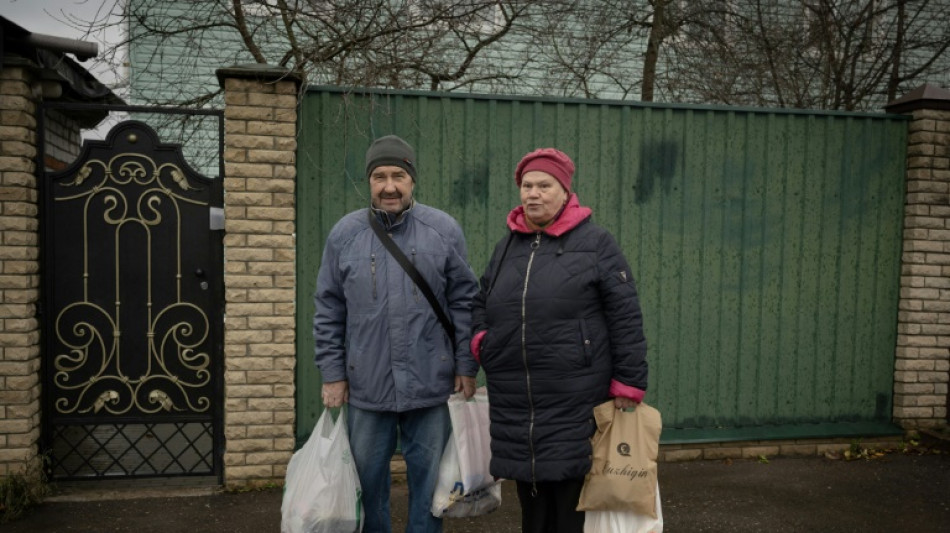
Russians suffer rising costs of Ukraine conflict / Photo: Natalia KOLESNIKOVA - AFP

 Atletico sink Man Utd as Viking deny Bayern in Champions League

 Man United's Martinez blasts board's lack of investment

 Meet A7 International, an Innovative Global Platform Designed to Reinvent the International Payments Market

 Shakhtar hope London move a reminder of Ukraine conflict

 Tresoldi hat-trick fires Brugge past Inter Milan

 Rams axe kicker Mevis after misses cost victory over Bills: reports

 Yamal stays cool at boiling Galatasaray to lift Barcelona to victory

 Arsenal cruise past Lille into share of Champions League lead

 Trump ousts Greece ambassador over ethics scandal

 Reese Witherspoon, France's Mediawan to buy Hello Sunshine

 Bipartisan US senators urge Trump to scrap Russian diesel deal

 Ex-gang leader sentenced to minimum 40 years for Tupac murder

 Cornell suspends frat parties after alleged gang rape

 Man City deserve to keep titles, says PSG's Luis Enrique

 Regulator 'will resign' if any political interference in Man City case

 Microsoft's Brad Smith calls for 'real and effective' AI safety standards

 Anthropic warns of AI 'worms' spreading across smart gadgets

 Big US banks report strong earnings and stay bullish on AI

 Iraola backs Barcola, Wirtz to come good for Liverpool

 In a first, AI helps UK lawmaker find her voice in parliament

 Pope Leo in Rome hospital for lung operation

 EU watchdog says smart glasses must give 'clear warnings' when recording

 Houthis say Saudi Arabia strikes oil site in Yemen's capital

 France roiled by marches in support of protesting students

 Goldman Sachs profits jump as CEO says no plans to exit

In the small town of Dedovsk, just outside Moscow, pensioner Zinaida Kudriavtseva is struggling to pay the bills.
Russia has been gripped by a cycle of rising prices since it launched its military offensive on Ukraine almost three years ago.
Driven by an explosion in state spending on the conflict, inflation has surged, hitting hardest those who were already living close to the breadline.
"Everything is expensive," Kudriavtseva told AFP on a recent visit to the town, 30 kilometres (20 miles) outside the centre of the Russian capital.
She can no longer afford expensive medicine, meat or new clothes, and it's not easy to pay the rent on her pension of around 16,000 rubles ($150) a month.
"Fortunately, my daughters give me their clothes. Look at these shoes, they're a young person's shoes," she said, embarrassed.
Inflation is expected to hit nine percent by the end of the year, following increases of 7.4 percent in 2023 and 11.9 percent in 2022.
That economic turbulence came fresh off the back of the Covid pandemic, which hit Russia hard, and following years of falling living standards after the West imposed sanctions over Moscow's 2014 annexation of Crimea.
- 'No to war' -
To combat inflation, the central bank has raised its benchmark interest rate to 21 percent, a level not seen since 2003.
For consumers and businesses, the cost of borrowing on the market has become prohibitively high.
Yet powered by the Kremlin's massive outlays on arms and soldiers -- which are set to ramp up by another third next year -- and aggravated by Western sanctions, prices in shops are still rising.
Central bank governor Elvira Nabiullina has signalled she is considering raising rates yet again at a meeting next week, just ahead of the New Year holidays.
For Kudriavtseva, thinking about the future is too difficult.
"I live day to day," she said, also expressing fears over the conflict with Ukraine.
"Drones are flying here too," she said, referring to sporadic Ukrainian attacks targeting the Russian capital, a response to Russia's daily bombardment of Ukrainian cities.
"There's no guarantee that we won't face starvation," she said.
Her greatest wish? "That there will be no more war."
A similar message is painted on some walls around the city.
"No to War!" reads the graffiti.
Russians using such a phrase are liable to be prosecuted under strict military censorship laws, ushered in amid what the Kremlin portrays as an existential fight for survival against the West.
- 'I want peace' -
Returning from the supermarket, Viktor Markov ran through his purchases: bread, potatoes, chicken.
"Prices are going up every day. Apples cost 150 roubles ($1.40) and more. Coffee is 400 rubles," he said.
"I don't buy them at that price. I'm waiting for a discount."
Many people blame the conflict in Ukraine and the government's military expenditure for the price rises.
Defence spending is set to hit almost 13.5 trillion rubles ($125 billion) next year, more than six percent of Russia's GDP and representing around 40 percent of all state spending.
That follows a near 70 percent annual increase in military spending in 2024.
"What can we expect? The war goes on. And war requires resources," Markov said.
With a monthly pension of 22,000 rubles, he and his wife, Nina, 73, will not be able to afford traditional red caviar on the New Year table.
Prices for the salmon roe have doubled over the last year to 13,000 rubles a kilogramme.
Others on the streets of Dedovsk were worried about even more basic necessities.
Viktoria, a 30-year-old interpreter and foreign language teacher who lives in a wooden cottage, was angry at rising prices for nappies and baby food.
"I want peace to return," she said.
"Everything that's happening in the country is increasing people's anxiety."
O.Farraj--SF-PST