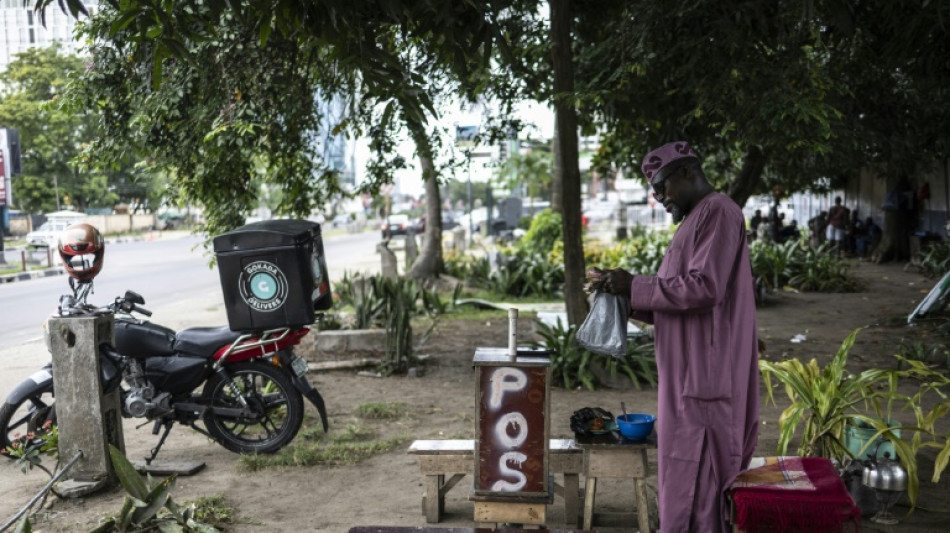
Cash crunch fuels rising misgivings against Nigeria's money agents / Photo: Olympia DE MAISMONT - AFP

 Atletico sink Man Utd as Viking deny Bayern in Champions League

 Man United's Martinez blasts board's lack of investment

 Meet A7 International, an Innovative Global Platform Designed to Reinvent the International Payments Market

 Shakhtar hope London move a reminder of Ukraine conflict

 Tresoldi hat-trick fires Brugge past Inter Milan

 Rams axe kicker Mevis after misses cost victory over Bills: reports

 Yamal stays cool at boiling Galatasaray to lift Barcelona to victory

 Arsenal cruise past Lille into share of Champions League lead

 Trump ousts Greece ambassador over ethics scandal

 Reese Witherspoon, France's Mediawan to buy Hello Sunshine

 Bipartisan US senators urge Trump to scrap Russian diesel deal

 Ex-gang leader sentenced to minimum 40 years for Tupac murder

 Cornell suspends frat parties after alleged gang rape

 Man City deserve to keep titles, says PSG's Luis Enrique

 Regulator 'will resign' if any political interference in Man City case

 Microsoft's Brad Smith calls for 'real and effective' AI safety standards

 Anthropic warns of AI 'worms' spreading across smart gadgets

 Big US banks report strong earnings and stay bullish on AI

 Iraola backs Barcola, Wirtz to come good for Liverpool

 In a first, AI helps UK lawmaker find her voice in parliament

 Pope Leo in Rome hospital for lung operation

 EU watchdog says smart glasses must give 'clear warnings' when recording

 Houthis say Saudi Arabia strikes oil site in Yemen's capital

 France roiled by marches in support of protesting students

 Goldman Sachs profits jump as CEO says no plans to exit

Mobile money agents have become a familiar sight across Nigeria, using handy point-of-sale machines to provide essential services to millions of people without access to banking, particularly in hard-to-reach rural areas.
Even on the streets of major cities they have become a go-to, due to an ongoing shortage of cash at ATMs since a much-vilified redesign of the national currency, the naira, last year.
"There are three of them (agents) on my street alone," Chi Etche, a 29-year-old media executive, told AFP. "This means I don't need to take a bike or cab to reach the nearest bank ATM."
But opposition is growing to their activities, with claims that some are exploiting the country's financial plight, compounding the worst cost-of-living crisis that Nigerians have faced in decades.
"We are now buying back our money from (point-of-sale) PoS agents," Ibrahim Adamu, a 39-year-old trader, told AFP. "The commission they charge is increasing and you can hardly get cash from the machines."
In 2013, the Central Bank of Nigeria (CBN)announced a drive to improve access to financial services across the country.
According to Enhancing Financial Innovation and Access (EFInA), an NGO, by the end of last year at least 74 percent of adults in Nigeria had access to financial services. Just over half (52 percent) used traditional banks.
The central bank's decision and the cash crunch, however, have given ordinary Nigerians reliant on cash no alternative but to use agents, experts say.
"CBN policies simultaneously raised barriers for banks to offer cash and cash alternatives to their customers in pursuit of its cashless policy mandate," said Ikemesit Effiong, a partner at Lagos-based risk consultancy SBM Intelligence.
Agents, however, often operate without identity checks of their customers or regulatory oversight, he added.
- Capped cash withdrawals -
The CBN announced that it was redesigning the naira in October 2022.
Soon after, Godwin Emefiele, the CBN governor at the time, then ordered a cap on cash withdrawal from ATMs and in banking halls as the presidential election approached.
"Over 85 percent of cash that is in circulation is outside the banks," he said at the time.
Vaunted as part of the bank's cashless policy push, the restrictions put pressure on businesses, sparked angry protests, and gave mobile money agents leverage to exploit the cash shortage.
ATM withdrawals are still capped at 20,000 naira ($12.45) per day when withdrawing from one's own bank. Withdrawals from another bank are restricted to just 5,000 naira a day.
Over-the-counter withdrawals of large sums attract punitive charges. Moreover, long queues in banking halls and frequent ATM service downtimes worsen the problem.
That has driven more people towards mobile money agents, said Uzoma Dozie, the founder of challenger bank Sparkle.
- 'Excessive fees' -
Many Nigerians accused bank officials of diverting cash meant for ATMs to agents for personal gain.
"Some agents exploit cash scarcity by charging excessive fees for cash withdrawals and transactions," Dozie told AFP.
"However, this practice isn't inherent to the mobile money system but rather a symptom of broader cash availability issues and inadequate oversight."
A few agents told AFP they also get their cash to run their businesses from other sources.
"I go to markets to buy cash from traders and bureaux de change. I factor that into the commission I charge customers when they come to withdraw cash from me," said Ayo Olaoluwa, 34.
Ifeoma Onwuabuchi, 46, got started with about 100,000 naira.
"That's why you see a lot of people coming into the space. The income is not big but it helps keep me moving," Onwuabuchi said.
A spokesman for the influential Association of Mobile Money and Banking Agents of Nigeria did not immediately respond to AFP's request for comments.
However, Dozie insisted that proper regulation and enforcement can address the concerns while preserving the "benefits of agent banking".
CBN governor Olayemi Cardoso insisted that empty cash machines will not be tolerated and warned that defaulting banks "will face stringent penalties".
"We also urge full regulatory compliance by all stakeholders, including Mobile Money Operators and PoS Agents, to promote digital transaction channels and improve service delivery," he said.
E.Aziz--SF-PST
