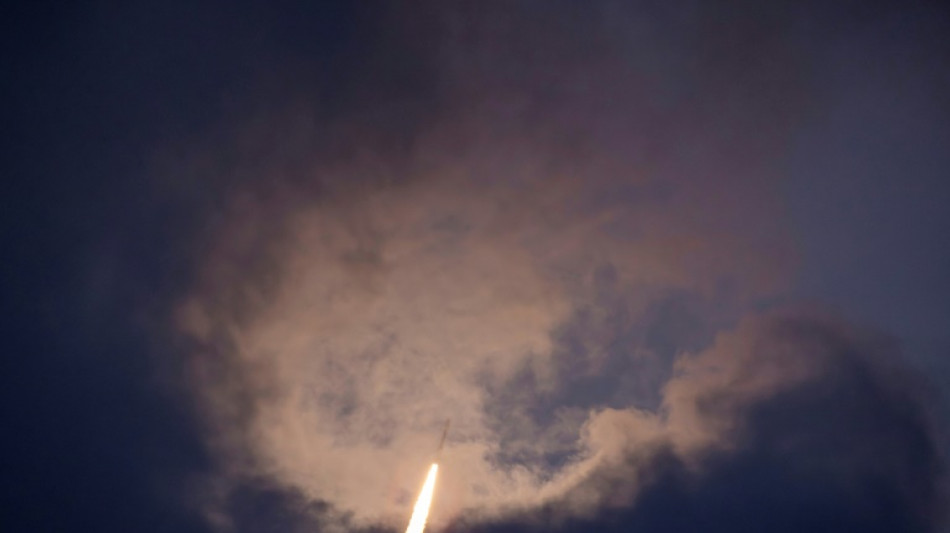
Europe's Vega-C rocket launches satellite into orbit after delays / Photo: Ronan LIETAR - AFP

 Trump, White House post video of UK man killed by tiger

 Saudi employee arrested for allegedly bugging OpenAI office

 Atletico sink Man Utd as Viking deny Bayern in Champions League

 Man United's Martinez blasts board's lack of investment

 Meet A7 International, an Innovative Global Platform Designed to Reinvent the International Payments Market

 Shakhtar hope London move a reminder of Ukraine conflict

 Tresoldi hat-trick fires Brugge past Inter Milan

 Rams axe kicker Mevis after misses cost victory over Bills: reports

 Yamal stays cool at boiling Galatasaray to lift Barcelona to victory

 Arsenal cruise past Lille into share of Champions League lead

 Trump ousts Greece ambassador over ethics scandal

 Reese Witherspoon, France's Mediawan to buy Hello Sunshine

 Bipartisan US senators urge Trump to scrap Russian diesel deal

 Ex-gang leader sentenced to minimum 40 years for Tupac murder

 Cornell suspends frat parties after alleged gang rape

 Man City deserve to keep titles, says PSG's Luis Enrique

 Regulator 'will resign' if any political interference in Man City case

 Microsoft's Brad Smith calls for 'real and effective' AI safety standards

 Anthropic warns of AI 'worms' spreading across smart gadgets

 Big US banks report strong earnings and stay bullish on AI

 Iraola backs Barcola, Wirtz to come good for Liverpool

 In a first, AI helps UK lawmaker find her voice in parliament

 Pope Leo in Rome hospital for lung operation

 EU watchdog says smart glasses must give 'clear warnings' when recording

 Houthis say Saudi Arabia strikes oil site in Yemen's capital

Europe's new Vega-C rocket launched Thursday from French Guiana and put a satellite into orbit in its first takeoff since a failed flight two years ago.
After two days of delays, the rocket -- crucial to Europe's autonomy in reaching space -- took off without problems, carrying the Sentinel-1C satellite for the European Union's Copernicus Earth observation programme.
The satellite, which provides data and services for observing the planet in order to understand climate change impacts, was put into orbit at an altitude of around 700 kilometres (435 miles), 1 hour and 43 minutes after lift-off, to thunderous applause from the Jupiter control centre.
"With the insertion of Sentinel-1C into orbit, ESA continues a legacy of steadfast Sentinels protecting the Earth and exemplifies why Europe needs secured flights: because what we send to space provides benefits to Earth, and it all starts with a launch," Josef Aschbacher, director general of the European Space Agency, said in a statement.
The ESA added that the satellite will deliver "high-resolution radar imagery to monitor Earth's changing environment", and offers "new capabilities for detecting and monitoring maritime traffic".
It is the first launch for the lightweight rocket since December 2022, when it failed to reach orbit in its maiden commercial flight and lost two satellites, delivering a fresh blow to a continent already struggling to blast its missions into space.
The rocket was grounded for two years while the nozzle of the Zefiro 40 rocket motor -- which caused the failure -- was redesigned.
- Flight delays -
Vega-C's return flight was initially scheduled for Tuesday from Europe's spaceport in Kourou, French Guiana.
That launch was postponed by one day to allow for "additional checks on electrical connections in the upper stage" of the rocket, said the ESA's space transportation director, Toni Tolker-Nielsen.
But hours before the launch, it was delayed another 24 hours.
This time it was "due to a mechanical problem preventing the removal of the Vega-C mobile gantry", French space agency CNES said in a statement on Wednesday.
A gantry is a movable frame that supports the rocket on the launch pad.
In its latest try, the Vega-C took off as scheduled at 6:20 pm local time (2120 GMT).
Earlier on Thursday, the ESA's Proba-3 mission to probe the Sun's outer atmosphere successfully launched on an Indian rocket.
Europe has struggled to find a way to independently launch missions since Russia withdrew its rockets in 2022 over the war in Ukraine.
Four years of delays to Europe's new Ariane 6 rocket compounded the issue, forcing the continent to turn to rivals such as Elon Musk's SpaceX.
However, the heavy-lift Ariane 6 had a successful first flight in July, offering some relief to European space efforts.
The lighter Vega-C was designed to send small satellites into low-Earth orbit.
Its predecessor Vega had its last launch in September, placing more importance on Vega-C returning to active duty.
Four launches using Vega-C are planned for next year, followed by five more in 2026, Tolker-Nielsen said.
The Sentinel-1C satellite will use radar to monitor Earth's environment as part of the EU's Copernicus programme to provide climate and other data to governments and businesses.
I.Matar--SF-PST