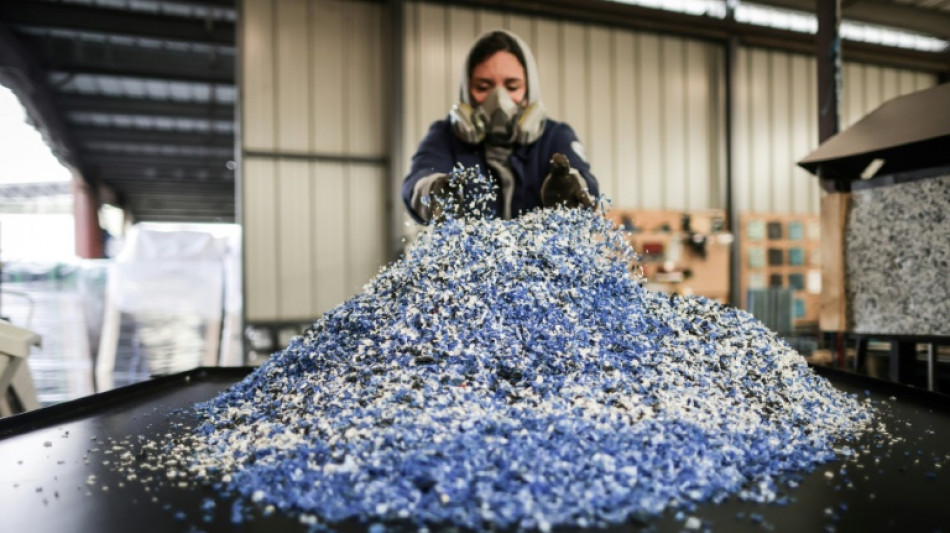
At plastic treaty talks, no united front for industry / Photo: Thibaud MORITZ - AFP/File

 Asian markets mixed as tech firms claw back some losses

 India shuts down iconic Delhi protest site after three decades

 Japan urges Russia for 'impartial treatment' of arrested journalist

 Lula, Bolsonaro ordered to call off attempts at online censorship

 EU takes a page from Ireland's AI playbook

 Global deforestation slowed in 2025 but surged in Congo basin: study

 Saudi says Houthi attacks sparked Aramco fire, wounded 4 in Riyadh

 Few buyers for starving cattle in El Nino parched El Salvador

 Bybit Expands Beyond Crypto as CEO Outlines Next Phase of Financial Platform

 Bayern held by Viking after 'super dumb' Olise red in Champions League

 Why AI makes computer worms harder to stop

 US fines Bank of America $1.2 bn for anti-money laundering violations

 Bayern held by Viking after Olise sees red in Champions League

 Atletico down Carrick's struggling Man United

 Croatia trials full driverless robotaxi service

 US stocks dip ahead of inflation data as tech sell-off hits Asia

 No lights, no friends: Cuban youth grapple with loneliness

 Saudi coalition strikes Yemen oil sites after Houthi attacks

 French economy minister denies country caught in debt 'snowball'

 Judge extends halt to Trump's golf course tree-cutting

 Milan's Saelemaekers set for lenghty spell out after ankle surgery

 Nvidia says to invest in French medical website

 Real Madrid's Mourinho has 'trust' in referees despite complaints

 Mendis, Shanaka star in Sri Lanka consolation T20I win

 Demonstrations backing France's protesting students gather strength

Is virgin plastic production vital or completely unsustainable? For the industry lobbyists at UN talks on plastic pollution, the answer is far from unanimous.
The corridors of the Busan Exhibition and Convention Centre, where the treaty to curb plastic pollution is being negotiated, teem with corporate representatives.
There are the chemical and petrochemical firms whose products are the precursors for plastic, the food and cosmetic companies whose packaging depends on it, and the automakers whose vehicles are increasingly full of it.
All back a treaty, but what they want to see in it differs significantly, particularly on the issue of production.
"Production caps and reducing the amount of material in the system would impact those least able to afford it the most," warned Stewart Harris, spokesman for the International Council of Chemical Associations (ICCA).
The body groups global industry associations and is pushing for a treaty focused on waste management rather than manufacturing limits.
"We see the need for more material in the system overall," Harris told AFP, urging a focus on "circularity" instead of restrictions on new production.
- 'A big problem' -
It's a position echoed by some in the auto sector, who say recycled plastic cannot yet meet the stringent safety requirements for vehicles.
Mark Bacchus, senior manager at Toyota, also warned that the electrification of cars will require more plastic to balance out their heavier batteries.
"If we have a scenario where plastics are going to be less available, that's going to cause a big problem for us," he told AFP.
That is not the view taken by the Business Coalition for a Global Plastics Treaty, which groups several hundred firms including multinationals like Nestle, Unilever, Ikea and Lego.
They have endorsed a call for a reduction of production and use, including of single-use products, as well as the possible phaseout of chemicals considered harmful to human health.
Jodie Roussell, global public affairs lead for packaging and sustainability at Nestle, said the position was good business.
"Different members of the value chain have different interests based on their core business," she told AFP.
"We're in the food and beverage industry. Our core interest is a stable climate and a clean environment."
For these companies, a global treaty also offers the chance of a level playing field, forcing everyone to invest in things like redesigning items for reusability and incorporating recycled material into products.
"Businesses can't do it alone, and we need multilateral legislation to be put into place," she said.
- 'Champions of Change' -
The group stops short of endorsing any numerical target for reduction of new plastic production, arguing that the position is so far from being adopted widely that doing so would not advance the talks.
Cutting production is among the most divisive issues on the table for the negotiators from nearly 200 countries.
Even the so-called High Ambition Coalition of countries, led by Rwanda and Norway, have no explicit target for cuts.
One group of mostly smaller businesses believes that is insufficient.
The "Champions of Change" coalition, organised by environmental groups including Greenpeace, brings together around 300 companies, restaurants and other small businesses.
It includes a handful of household names like ice cream maker Ben and Jerry's and bath products giant Lush.
They are urging the treaty to cut plastic production by at least 75 percent by 2040, from 2019 levels.
"A truly ambitious treaty is one that addresses the root causes of plastic pollution and spurs a shift away from single-use," the group argues.
Even among businesses committed to shifting plastic use, there have been challenges.
Unilever, a member of the Business Coalition, has been targeted by Greenpeace over its use of sachet packaging in Asia, where the products are a persistent source of pollution.
The company's latest progress report on its plastic use acknowledges it is still working to "overcome challenges in the development of viable and scalable solutions" for the issue.
H.Nasr--SF-PST
