Palestinian pottery sees revival in war-ravaged Gaza / Photo: Eyad BABA - AFP/File

 Seeing pivotal election, Israelis fly from around world to vote

 South Korea's Eom 'racially abused' in England's Championship: club

 Asian markets mixed as tech firms claw back some losses

 India shuts down iconic Delhi protest site after three decades

 Japan urges Russia for 'impartial treatment' of arrested journalist

 Lula, Bolsonaro ordered to call off attempts at online censorship

 EU takes a page from Ireland's AI playbook

 Global deforestation slowed in 2025 but surged in Congo basin: study

 Saudi says Houthi attacks sparked Aramco fire, wounded 4 in Riyadh

 Few buyers for starving cattle in El Nino parched El Salvador

 Bybit Expands Beyond Crypto as CEO Outlines Next Phase of Financial Platform

 Bayern held by Viking after 'super dumb' Olise red in Champions League

 Why AI makes computer worms harder to stop

 US fines Bank of America $1.2 bn for anti-money laundering violations

 Bayern held by Viking after Olise sees red in Champions League

 Atletico down Carrick's struggling Man United

 Croatia trials full driverless robotaxi service

 US stocks dip ahead of inflation data as tech sell-off hits Asia

 No lights, no friends: Cuban youth grapple with loneliness

 Saudi coalition strikes Yemen oil sites after Houthi attacks

 French economy minister denies country caught in debt 'snowball'

 Judge extends halt to Trump's golf course tree-cutting

 Milan's Saelemaekers set for lenghty spell out after ankle surgery

 Nvidia says to invest in French medical website

 Real Madrid's Mourinho has 'trust' in referees despite complaints

Traditional clay pottery is seeing a resurgence in the Gaza Strip, where Palestinians are forced to find solutions for a shortage of plates and other crockery to eat from in the territory ravaged by more than a year of war.
"There is an unprecedented demand for plates as no supplies enter the Gaza Strip," 26-year-old potter Jafar Atallah said in the central Gaza city of Deir el-Balah.
The vast majority of the Palestinian territory's 2.4 million people have been displaced, often multiple times, by the war that began with Hamas's attack on southern Israel on October 7, 2023.
Fleeing bombs amid Israel's devastating retaliatory military offensive, which has destroyed large amounts of civilian infrastructure, everyday items like cups and bowls have often been lost, broken or left behind to perish.
With imports made increasingly difficult by Israeli restrictions and the dangers of delivering aid, Gazans have had to find resourceful ways to meet their needs since the war began.
- Bare-bones -
To keep up with demand, Atallah works non-stop, producing around 100 pieces a day, mainly bowls and cups, a stark contrast to the 1,500 units his factory in northern Gaza made before the war.
It is one of the numerous factories in Gaza to have shut down, with many destroyed during air strikes, inaccessible because of the fighting, or unable to operate because of materials and electricity shortages.
Today, Atallah works out of a bare-bones workshop set up under a thin blue plastic sheet.
He carefully shapes the clay into much-needed crockery, then leaves his terracotta creations to dry in the sun -- one of the few things Gaza still has plenty of.
Each object is sold for 10 shekels, the equivalent of $2.70 -- nearly five times what it was worth before the war led to widespread shortages and sent prices soaring.
Gazans have told AFP they are struggling to find all types of basic household goods.
"After 13 months of war, I went to the market to buy plates and cutlery, and all I could find was this clay pot," said Lora al-Turk, a 40-year-old mother living in a makeshift shelter in Nuseirat, a few kilometres (miles) from Deir el-Balah.
"I was forced to buy it to feed my children," she said, noting that the pot's price was now more than double what it was before the war.
- Old ways -
The war in Gaza was triggered by Hamas's unprecedented October 7, 2023 attack on southern Israel, which resulted in the deaths of 1,206 people, mostly civilians, according to an AFP tally of Israeli official figures.
Israel's retaliatory military offensive has killed at least 44,176 people, most of them civilians, according to data from Hamas-run Gaza's health ministry which the United Nations considers reliable.
Following each Israeli army evacuation order, which generally precedes fighting and bombing, masses of people take to the roads, often on foot, carrying whatever they can manage.
But with each passing month and increasing waves of displacement, the loads they carry grow smaller.
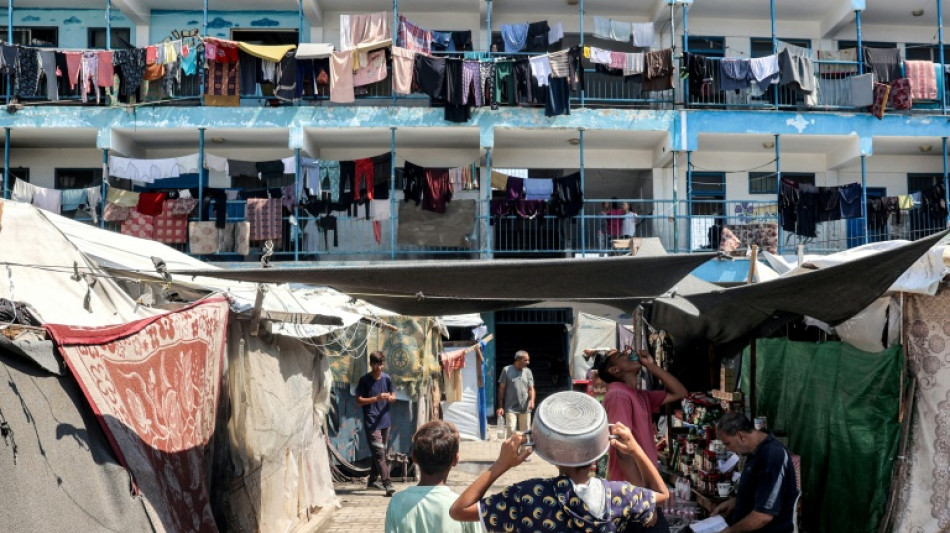
Many Gazans now live in tents or other makeshift shelters, and some even on bare pavement.
The United Nations has warned about the threat of diseases in the often cramped and unsanitary conditions.
But for Gazans, finding inventive ways to cope with hardship is nothing new.
In this, the worst-ever Gaza war, people are using broken concrete from war-damaged buildings to build makeshift homes. With fuel and even firewood scarce, many rely on donkeys for transport. Century-old camping stoves are reconditioned and used for cooking.
Traditional pottery is another sign of a return to the old ways of living.
S.Abdullah--SF-PST