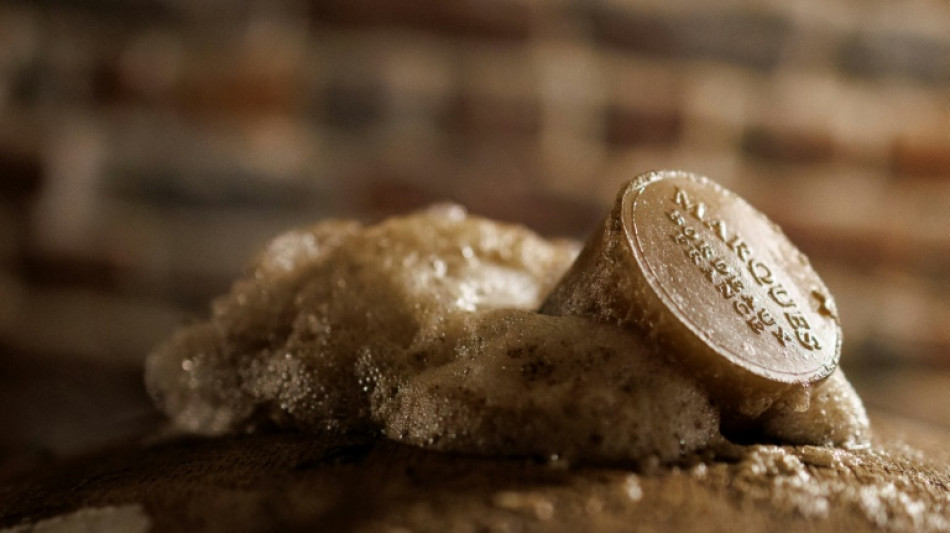
'Primitive' beers draw crowds at Belgian brewery / Photo: Simon Wohlfahrt - AFP

 Seeing pivotal election, Israelis fly from around world to vote

 South Korea's Eom 'racially abused' in England's Championship: club

 Asian markets mixed as tech firms claw back some losses

 India shuts down iconic Delhi protest site after three decades

 Japan urges Russia for 'impartial treatment' of arrested journalist

 Lula, Bolsonaro ordered to call off attempts at online censorship

 EU takes a page from Ireland's AI playbook

 Global deforestation slowed in 2025 but surged in Congo basin: study

 Saudi says Houthi attacks sparked Aramco fire, wounded 4 in Riyadh

 Few buyers for starving cattle in El Nino parched El Salvador

 Bybit Expands Beyond Crypto as CEO Outlines Next Phase of Financial Platform

 Bayern held by Viking after 'super dumb' Olise red in Champions League

 Why AI makes computer worms harder to stop

 US fines Bank of America $1.2 bn for anti-money laundering violations

 Bayern held by Viking after Olise sees red in Champions League

 Atletico down Carrick's struggling Man United

 Croatia trials full driverless robotaxi service

 US stocks dip ahead of inflation data as tech sell-off hits Asia

 No lights, no friends: Cuban youth grapple with loneliness

 Saudi coalition strikes Yemen oil sites after Houthi attacks

 French economy minister denies country caught in debt 'snowball'

 Judge extends halt to Trump's golf course tree-cutting

 Milan's Saelemaekers set for lenghty spell out after ankle surgery

 Nvidia says to invest in French medical website

 Real Madrid's Mourinho has 'trust' in referees despite complaints

Winding between copper vats and oak barrels, a cluster of early-morning visitors filed through a cavernous Brussels building for an up-close peek at craft beers brewed using a centuries-old method -- before sampling the result.
Since it was founded in 1900 in Anderlecht, a working-class district of the Belgian capital, Brasserie Cantillon has been turning out so-called primitive "lambic" beers that are steeped in local tradition.
What makes lambics special is they start with a process known as spontaneous fermentation -- through exposure to wild yeasts, specifically those native to Belgium's Zenne valley -- as opposed to cultivated brewer's yeast.
Aged in wood barrels for months to years, which allows for a secondary fermentation to occur as the beer's sugars convert to carbon dioxide, the result is a distinctive dry beer with a faintly tart aftertaste.
Cantillon's speciality is an even more niche type of beer known as "gueuze" -- a blend of lambics from different years and whose fruity varieties include kriek, or cherry in Flemish -- that has around 20 brewers in Belgium.
Towards the end of the 1970s, the brewery decided to set itself apart by turning its operations into a museum that today draws more than 30,000 visitors a year, amid a broader surge of enthusiasm for craft beers and micro-breweries.
On this November morning, tourists from Italy, France, Japan and Britain rubbed shoulders in what is billed as the last working lambic brewery in Brussels, watching its workers ply their craft.
- 'Long lost' -
Joining the tourists were two interns from Canada's Quebec including Isabelle Gignac -- a beer professional in her thirties who works at a micro-brewery on the shores of the Gaspe Peninsula.
Her boss sent her to Cantillon for five weeks to bring back some of its know-how.
"What makes a difference between the beers brewed here is how long they are aged, and what barrels are used," she said.
Morello cherry, haskap, elderberry flower: the brewery uses a whole palette of fruity aromas for its gueuze beers, adding them at the secondary fermentation stage.
"Lambic is what comes closest to primitive beer -- the kind that was made before Louis Pasteur and microbiologists discovered how yeast works in the second half of the 19th century," explained one of Cantillon's co-owners, Jean-Pierre Van Roy.
Compared to the 6.5 million hectolitres of beer imbibed in Belgium last year, Cantillon's output is a mere drop, with an annual 2,500 hectolitres (55,00 UK gallons) produced on average. Two-thirds of that are sold abroad.
Together with his wife Claude Cantillon, granddaughter of the brewery's founder Paul Cantillon, the couple remain majority stakeholders in the family business while the day to day is handled by their three children.
John Gallagher, an Irish academic based in Leeds in northern England, inherited his taste for Belgian brewing from a well-travelled uncle.
"That's what gives them such a reputation with beer lovers," Gallagher said. "In England, traditional methods have been long lost."
O.Mousa--SF-PST
