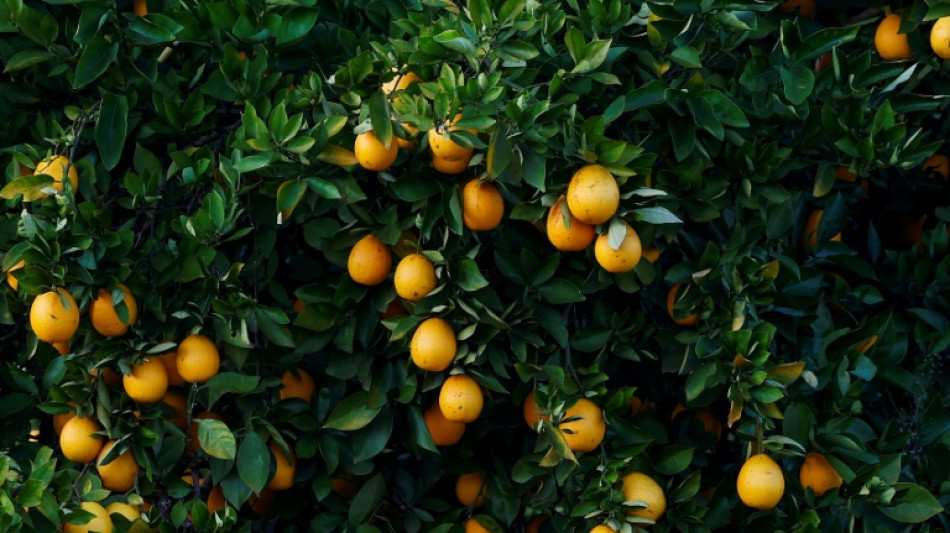
As Trump returns, African exporters torn between hope and horror / Photo: Phill Magakoe - AFP/File

 Fuel shortage triggers queues on resort island Bali

 Sao Tome's niche vanilla finds far-away fans
 China-North Korea bridge to open Thursday, 12 years late

 Asian stocks mostly down as tech firms struggle to claw back losses

 AI boom drives record sales at Dutch tech giant ASML

 Trump says 'massive' oil, gas, mineral exploration to begin in Greenland

 China heads for record trade surplus as exports surge

 Vietnam mourns 700 war dead in major push to identify missing

 Relentless Swiatek wins all-Polish battle to launch Wuhan campaign

 Seeing pivotal election, Israelis fly from around world to vote

 South Korea's Eom 'racially abused' in England's Championship: club

 Asian markets mixed as tech firms claw back some losses

 India shuts down iconic Delhi protest site after three decades

 Japan urges Russia for 'impartial treatment' of arrested journalist

 Lula, Bolsonaro ordered to call off attempts at online censorship

 EU takes a page from Ireland's AI playbook

 Global deforestation slowed in 2025 but surged in Congo basin: study

 Saudi says Houthi attacks sparked Aramco fire, wounded 4 in Riyadh

 Few buyers for starving cattle in El Nino parched El Salvador

 Bybit Expands Beyond Crypto as CEO Outlines Next Phase of Financial Platform

 Bayern held by Viking after 'super dumb' Olise red in Champions League

 Why AI makes computer worms harder to stop

 US fines Bank of America $1.2 bn for anti-money laundering violations

 Bayern held by Viking after Olise sees red in Champions League

 Atletico down Carrick's struggling Man United

Citrus growers in South Africa are among the businesses most nervous that duty-and-quota-free exports to the United States could be scrapped next year when Donald Trump takes office again.
The fruits are among 1,800 products across 32 African countries benefitting from preferential market access under the African Growth and Opportunity Act (AGOA), with companies in South Africa, Kenya, Nigeria and Ghana reaping the most dollars in profits.
But with president-elect Trump having vowed to impose at least a 10 percent tariff on all imports to the United States, there is no certainty that AGOA will be renewed.
Analysts say the legislation, passed in 2000 and set to expire next year, could be modified if not withdrawn altogether, with potential negative ramifications for companies and jobs across Africa.
"We need this competitive edge," Justin Chadwick, CEO of the Citrus Growers' Association of Southern Africa (CGA), which also represents Zimbabwe and Swaziland-based orchards, told AFP.
"Should South Africa be removed from AGOA, thousands of rural jobs could be impacted, as well as over a billion rand ($55.5 million) in export revenue could be lost," he said.
One food producer in the Eastern Cape province told AFP that if AGOA were not renewed, it would "kill" their business.
The South African company, which asked to remain anonymous, said it employed more than 3,000 people and exported an average of 350 containers of sorbet products per year to the United States, where they are sold at a major retailer.
- Hope for the best -
Another industry that could feel the heat if AGOA is shelved is the automotive sector, though some companies are betting that US consumers might accept higher prices.
"I don't foresee any major changes in the buying patterns of Americans around the products that we supply," said Ken Manners, managing director at SP Metal Forgings Group, a South African company that exports vehicle parts to the United States.
Even if tariffs were imposed, "it certainly wouldn't be life-changing in terms of our ability to supply competitively," he told AFP.
"The product base that we supply in the US is very difficult to source anywhere else, so ultimately even if the US put higher tariffs, the US consumer would end up paying for it."
Whether AGOA is renewed or not, it should not have much impact on the broader South African economy, analysts said, though companies should still prepare for changes.
"On the whole of the economy we're not even talking one percent," said Johannesburg-based economist Dawie Roodt.
But "in an environment where the economy is hardly growing or growing very weakly, every little bit helps and adds up", he said.
In any case, "it won't be business as usual," said Ronak Gopaldas of the London-based consultancy Signal Risk.
"The reality is that Trump and his economic policies are unpredictable, volatile and erratic. You don't know how far on the extreme he's going to go."
"So I would say an effective strategy is to expect the worst and hope for the best," he said.
- 'AGOA-lite' -
Kenyan and Ghanaian companies also benefit significantly from AGOA, especially in the textile industry.
Mukhisa Kituyi, a Kenyan politician who served as secretary-general of the United Nations Conference on Trade and Development, said he believed the next US administration could push for a renegotiated AGOA rather than a withdrawal.
"What America has been wanting... is restricting what they call third country rules of origin," Kituyi told AFP.
For example, this would prevent companies from bringing textiles from China or India, stitching them in Africa, and then selling them to America as African clothes.
"If they tighten the rules of origin, particularly on textiles and cars –- as Trump is obsessed with the manufacturing of particular cars -– we can see a diluted AGOA-lite going forward," Kituyi said.
Another question mark surrounds exports of critical minerals from the Democratic Republic of Congo, Zambia and Angola.
While the products are not eligible under AGOA, central African countries have received particular attention and investment under President Joe Biden.
"Are these relations going to persist... or will we see a walking back, a radical overhaul, on some of the gains made?" Gopaldas said.
Trump will probably "ignore Africa", according to Roodt, unless countries "get his attention for good or bad reasons".
A determining factor likely to influence trade relations is whether countries are seen as geopolitically aligned with the United States.
This could be an issue for a number of African governments that have shown support towards Russia and China or criticised Israel.
Having accused Israel of "genocide" in Gaza at the UN's top court, South Africa in particular will have to "walk a tightrope," Gopaldas said, "if the US becomes more explicit about being 'with us or against us'."
U.Shaheen--SF-PST