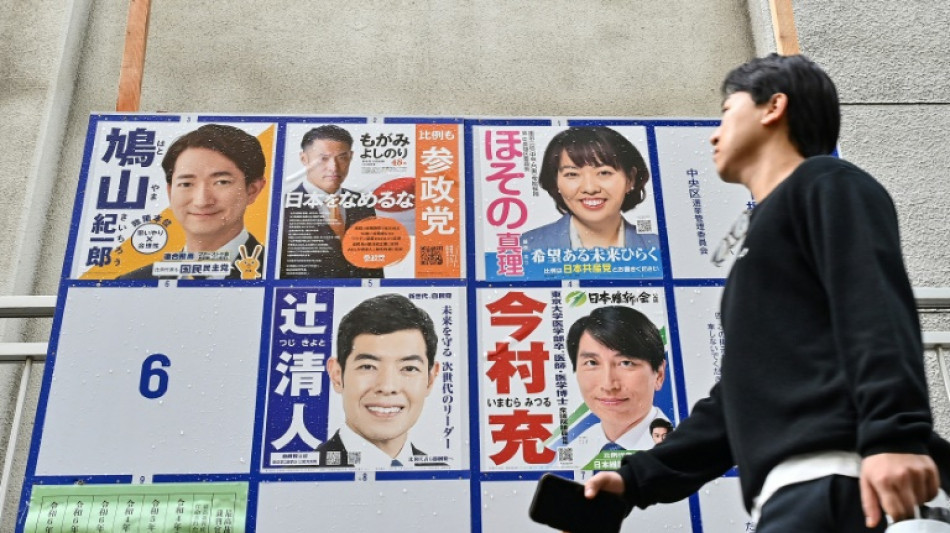
Japan's record number of women MPs still minority / Photo: Richard A. Brooks - AFP/File

 Rising Spanish tennis star handed code violation for swearing at ballboy

 Last of the French musketeers Monfils officially retired from tennis

 Ukraine ex-military officer stands trial over Nord Stream sabotage

 British and Irish Lions to play first women's match against France

 Fuel shortage triggers queues on resort island Bali

 Sao Tome's niche vanilla finds far-away fans

 China-North Korea bridge to open Thursday, 12 years late

 Asian stocks mostly down as tech firms struggle to claw back losses
 AI boom drives record sales at Dutch tech giant ASML

 Trump says 'massive' oil, gas, mineral exploration to begin in Greenland

 China heads for record trade surplus as exports surge

 Vietnam mourns 700 war dead in major push to identify missing

 Relentless Swiatek wins all-Polish battle to launch Wuhan campaign

 Seeing pivotal election, Israelis fly from around world to vote

 South Korea's Eom 'racially abused' in England's Championship: club

 Asian markets mixed as tech firms claw back some losses

 India shuts down iconic Delhi protest site after three decades

 Japan urges Russia for 'impartial treatment' of arrested journalist

 Lula, Bolsonaro ordered to call off attempts at online censorship

 EU takes a page from Ireland's AI playbook

 Global deforestation slowed in 2025 but surged in Congo basin: study

 Saudi says Houthi attacks sparked Aramco fire, wounded 4 in Riyadh

 Few buyers for starving cattle in El Nino parched El Salvador

 Bybit Expands Beyond Crypto as CEO Outlines Next Phase of Financial Platform

 Bayern held by Viking after 'super dumb' Olise red in Champions League

New lawmaker Saria Hino takes her seat on Monday as one of a record number of women in Japan's parliament, but while campaigning ahead of the recent election, a voter asked her: "Who's looking after your children?"
The mother-of-four was among 73 women elected to the 465-seat house of representatives in October's vote -- the most ever, but still a small minority at 16 percent.
Having won in central Japan's Aichi region, the 36-year-old is on a mission to "deliver a message from the front lines" of those raising children or caring for the elderly.
"The responsibility for children's growth should not lie solely on their parents' shoulders," said Hino, who was elected to the opposition Democratic Party for the People.
"I want to develop policies based on the overwhelming amount of information I have -- personally -- of what's going on" at preschools and nursing homes, she told AFP.
Japan has the world's second-oldest population after Monaco and its birth rate has been stubbornly low for decades.
There are a range of factors why women are choosing to have fewer children, including rising living costs and expecations that working mothers should still shoulder the domestic burden, child raising and caring for relatives.
Prime Minister Shigeru Ishiba, expected to lead a minority government after a parliament vote on Monday, has called the dearth of new babies a "quiet emergency" and has pledged to promote measures such as flexible working hours.
His predecessor Fumio Kishida also sounded the alarm on the looming demographic crisis, expanding parental leave policies and financial aid for families.
While the number of preschools is rising in Japan, workforce shortages mean difficult working conditions for nursery teachers, Hino said.
"Similarly, a recent government decision to lower funding for elderly care facilities is worsening caregivers' already tough work environments" she said, warning that they risk closure.
- Sexist jibes -
Women leaders are rare in politics but also in business in Japan, which ranked 118th of 146 in the 2024 World Economic Forum's Global Gender Gap report.
Veteran female lawmakers, such as former ministers Seiko Noda and Seiko Hashimoto, have highlighted the difficulties of being a mother and an MP in a parliament where debates often run on until nearly midnight.
Women made up just a quarter of candidates in the election and can still openly face sexist jibes.
Former deputy prime minister Taro Aso this year called then-foreign minister Yoko Kamikawa a "rising star" but also described her as an "aunty" who was "not that beautiful".
And one in four female electoral candidates said they faced sexual harassment during their campaigns, according to a 2021 cabinet office survey reported by local media.
- Lack of diversity -
Sachiko Inokuchi, a 68-year-old doctor elected in a Tokyo district, said her opposition Japan Innovation Party has set up a babysitting service for lawmakers to help improve the gender imbalance.
She wants to strengthen support for mothers in Japan, as "I don't want to pass on the unwanted effects of a rapidly ageing society with fewer children".
Ishiba's conservative Liberal Democratic Party (LDP) and its junior coalition party lost their majority for the first time since 2009 in the October 27 election.
One LDP lawmaker who won a seat was Jun Mukoyama, who faced the same question on the campaign trail over who was looking after her child -- "a question a male candidate wouldn't be asked," the 40-year-old told AFP.
She spent 13 years at a trading house but quit in her early 30s when she moved to the United States for her husband's work, while the couple was having fertility treatment.
"At that time, I thought, 'if I can never have a child, I want to make a society that is great for children'," and decided to become a politician, she said.
She was attracted to the LDP's "pragmatic security policy and proven capability of running the government".
But she felt the party "lacked diversity" in its policy-making, something she wanted to help change.
Mukoyama said her priority as a lawmaker was revitalising Japan's depressed, depopulated rural communities.
But, like Hino and Inokuchi, she also wants to ensure the voices of people "facing the difficulties of juggling work and family" are heard.
L.AbuAli--SF-PST