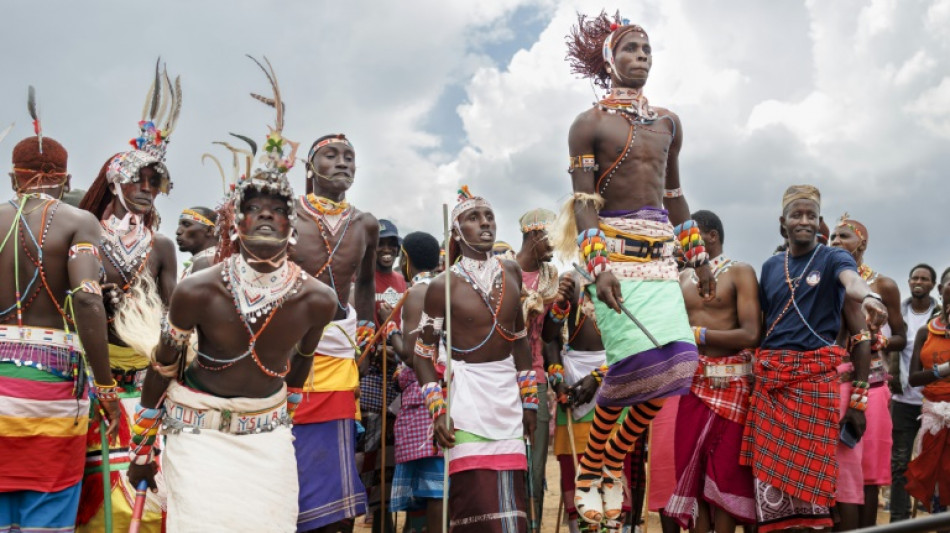
Resilient but threatened, Kenya celebrates Maa culture / Photo: Tony KARUMBA - AFP/File

 Rising Spanish tennis star handed code violation for swearing at ballboy

 Last of the French musketeers Monfils officially retired from tennis

 Ukraine ex-military officer stands trial over Nord Stream sabotage

 British and Irish Lions to play first women's match against France

 Fuel shortage triggers queues on resort island Bali

 Sao Tome's niche vanilla finds far-away fans

 China-North Korea bridge to open Thursday, 12 years late

 Asian stocks mostly down as tech firms struggle to claw back losses

 AI boom drives record sales at Dutch tech giant ASML

 Trump says 'massive' oil, gas, mineral exploration to begin in Greenland

 China heads for record trade surplus as exports surge

 Vietnam mourns 700 war dead in major push to identify missing

 Relentless Swiatek wins all-Polish battle to launch Wuhan campaign

 Seeing pivotal election, Israelis fly from around world to vote

 South Korea's Eom 'racially abused' in England's Championship: club

 Asian markets mixed as tech firms claw back some losses

 India shuts down iconic Delhi protest site after three decades

 Japan urges Russia for 'impartial treatment' of arrested journalist

 Lula, Bolsonaro ordered to call off attempts at online censorship

 EU takes a page from Ireland's AI playbook

 Global deforestation slowed in 2025 but surged in Congo basin: study

 Saudi says Houthi attacks sparked Aramco fire, wounded 4 in Riyadh

 Few buyers for starving cattle in El Nino parched El Salvador

 Bybit Expands Beyond Crypto as CEO Outlines Next Phase of Financial Platform

 Bayern held by Viking after 'super dumb' Olise red in Champions League

The Maa Festival celebrates one of the best-known parts of Kenya's culture, which has been remarkably resilient even as it is strained by modernisation and climate change.
At this week's festival, which brought members of Maa tribes from across Kenya to the Samburu national reserve in the north of the country, modern technology sits comfortably alongside ancient culture.
In a straw-topped dung-walled hut, a group of women pass around smartphones and a tablet to share pictures of members of other sub-tribes they have met.
On a main stage, groups combine contemporary beats with the hypnotic guttural throb of Maa chants, while elsewhere people in dazzling beads and headdresses leap and dance in circles that speak of much older traditions.
Kenya has dozens of tribes, but it is the pastoralist Maa communities -- named after the language they share -- that have held on to ancient dress and customs the longest, becoming beloved symbols of the country as a result.
- 'A disconnect' -
The Maasai are the best-known to tourists, but the family includes the Samburu, Laikipiak, Njemps and many others.
"The Maa lived very communally," said Stella Napanu of the Northern Rangelands Trust, a conservation group run by local indigenous communities.
"That strengthened them and helped protect their culture from outside influences."
Climate change is a threat to the Maa, however.
Dwindling water resources have forced herders to travel further from their families, straining community ties.
"There's a disconnect between elders and young people because of this and it has weakened our government structures," said Napanu.
Other changes have been more positive.
Maa musicians have new outlets like YouTube to foster pride in their culture. Some travel as far as France and Australia to perform.
"God has given us this culture, so we must preserve it for our children," said a woman who recently travelled to Germany to show off her beadwork.
But communal living is unlikely to survive the lure of the city.
"Some parts of our culture will not last much longer," said Nasieku Letipila, 42, who runs Samburu county's culture department.
"For the Maa, if I have 10 cows and my neighbour has none, I have to share -- I cannot eat if they cannot eat -- that is the most beautiful part of our culture," she said.
"It sustained us, but it is the most difficult part to maintain. Now I live in a city in a gated community and I don't know my neighbours."
The Maa festival, which is becoming an annual affair since its launch last year, is a chance to reconnect with that older way of being.
"I always have to go back to the village and live like that for a while," said Letipila.
"Our culture is the strongest in Kenya. It's a religion to us, we cannot live without it."
Q.Bulbul--SF-PST