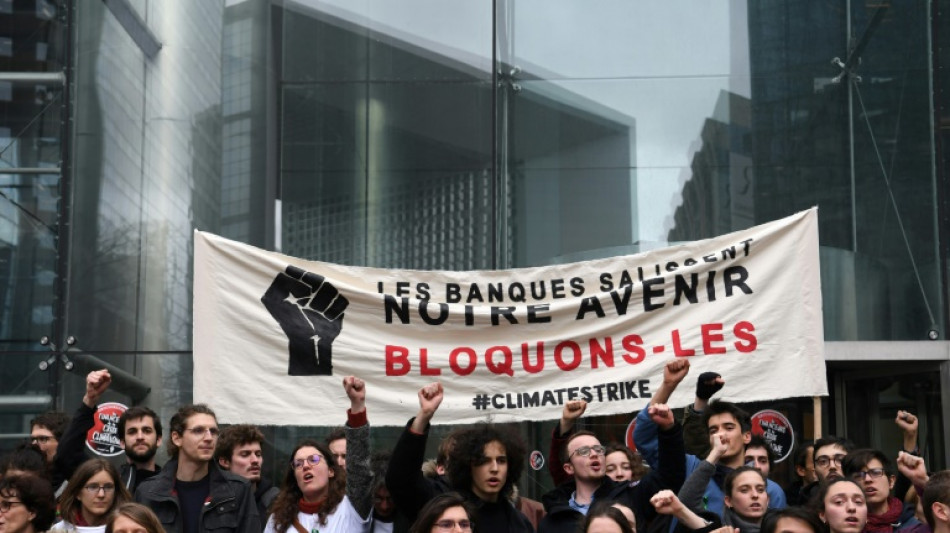
Climate change poses multiple risks for banks / Photo: CHRISTOPHE ARCHAMBAULT - AFP/File

 Rising Spanish tennis star handed code violation for swearing at ballboy

 Last of the French musketeers Monfils officially retired from tennis

 Ukraine ex-military officer stands trial over Nord Stream sabotage

 British and Irish Lions to play first women's match against France

 Fuel shortage triggers queues on resort island Bali

 Sao Tome's niche vanilla finds far-away fans

 China-North Korea bridge to open Thursday, 12 years late

 Asian stocks mostly down as tech firms struggle to claw back losses

 AI boom drives record sales at Dutch tech giant ASML

 Trump says 'massive' oil, gas, mineral exploration to begin in Greenland

 China heads for record trade surplus as exports surge

 Vietnam mourns 700 war dead in major push to identify missing

 Relentless Swiatek wins all-Polish battle to launch Wuhan campaign

 Seeing pivotal election, Israelis fly from around world to vote

 South Korea's Eom 'racially abused' in England's Championship: club

 Asian markets mixed as tech firms claw back some losses

 India shuts down iconic Delhi protest site after three decades

 Japan urges Russia for 'impartial treatment' of arrested journalist

 Lula, Bolsonaro ordered to call off attempts at online censorship

 EU takes a page from Ireland's AI playbook

 Global deforestation slowed in 2025 but surged in Congo basin: study

 Saudi says Houthi attacks sparked Aramco fire, wounded 4 in Riyadh

 Few buyers for starving cattle in El Nino parched El Salvador

 Bybit Expands Beyond Crypto as CEO Outlines Next Phase of Financial Platform

 Bayern held by Viking after 'super dumb' Olise red in Champions League

Climate change poses risks to banks on several levels: it can directly impact their finances, tarnish their image and land them in the courtroom.
Non-governmental organisations regularly criticise banks for the glacial speed at which they are moving to take climate change into account.
The latest was Reclaim Finance, which alongside several other NGOs took aim at European banks just days ahead of the COP 29 UN climate summit that begins on November 11 in Azerbaijan's capital Baku.
- Financial risk -
By continuing to finance fossil fuel projects, even as part of a transition to a green economy, banks are continuing to link their fates with the industry.
In an October 2022 report, Finance Watch calculated that the world's 60 largest banks held approximately $1.35 trillion in fossil fuel assets on their books.
There has been no major change since, according to the NGO's chief economist, Thierry Philipponnat.
The problem is that "there is no scenario where in 50 years fossil fuels will have any value," he told AFP.
Nations agreed at the COP28 climate summit in Dubai last year to transition away from fossil fuels.
And the International Energy Agency expects demand for oil, gas and coal to peak by 2030.
Economics professor Laurence Scialom at Paris-Nanterre University warned that "overnight entire asset classes will deteriorate."
Banks that hold shares and bonds of fossil fuel companies in their portfolios will see the value of those diminish, while fossil fuel companies could become credit risks as the sector's profitability is squeezed, she warned.
The fossil fuel industry represents a "financial time bomb" for banks and they still underestimate the danger, said Scialom.
Home mortgages are also at risk.
US consultancy Bain & Company last year warned that wildfires, drought and other climate risks threatened between 10 and 15 percent of the value of the real estate portfolios held by the world's top 50 banks.
- Reputation risk -
The research done by NGOs like Finance Watch and Reclaim Finance evaluating bank lending in light of climate change is regularly used by media and has begun to tarnish their public image.
Other groups have opted for more direct action such as disrupting shareholder meetings or demonstrating in front of headquarters buildings to draw attention to the behaviour of lenders.
These "name and shame" campaigns can be a powerful weapon for pressure groups as banks depend heavily on the confidence of clients.
- Legal risks -
NGOs have already challenged fossil fuel firms in court, with the most remarkable success to date being the 2021 victory by the Dutch chapter of Friends of the Earth against Shell.
Judges at The Hague District Court ruled three years ago that Shell must reduce its carbon emissions by 45 percent by 2030, as it was contributing to the "dire" effects of climate change.
That ruling was seen as an historic victory for climate change campaigners as it was the first time a company had been made to align its policy with the 2015 Paris climate change accords. Shell is appealing the ruling.
Activists are now turning to banks.
The Dutch chapter of Friends of the Earth launched in January of this year a case against the Netherlands' top bank, ING, for financing highly polluting companies.
Then in February Friends of the Earth, Oxfam France and another NGO filed suit against BNP Paribas accusing it of contributing to climate change via its financing of fossil fuel firms.
Valerie Demeure, who heads up research on ESG issues at Ofi Invest Asset Management, said the cases are "certainly the start in a series".
French law offers environmental activists a means to challenge companies.
Since 2017, large French firms are required to take effective measures throughout their supply chains to respect human rights and minimise environmental harm.
K.AbuTaha--SF-PST