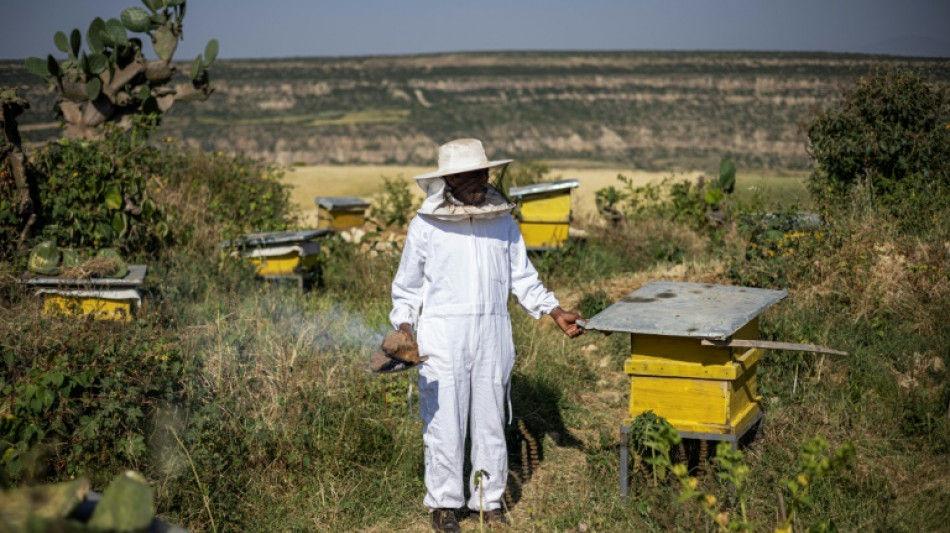
Ethiopia's famed honeybees make slow recovery from war / Photo: Michele Spatari - AFP

 Rising Spanish tennis star handed code violation for swearing at ballboy

 Last of the French musketeers Monfils officially retired from tennis

 Ukraine ex-military officer stands trial over Nord Stream sabotage

 British and Irish Lions to play first women's match against France

 Fuel shortage triggers queues on resort island Bali
 Sao Tome's niche vanilla finds far-away fans

 China-North Korea bridge to open Thursday, 12 years late

 Asian stocks mostly down as tech firms struggle to claw back losses

 AI boom drives record sales at Dutch tech giant ASML

 Trump says 'massive' oil, gas, mineral exploration to begin in Greenland

 China heads for record trade surplus as exports surge

 Vietnam mourns 700 war dead in major push to identify missing

 Relentless Swiatek wins all-Polish battle to launch Wuhan campaign

 Seeing pivotal election, Israelis fly from around world to vote

 South Korea's Eom 'racially abused' in England's Championship: club

 Asian markets mixed as tech firms claw back some losses

 India shuts down iconic Delhi protest site after three decades

 Japan urges Russia for 'impartial treatment' of arrested journalist

 Lula, Bolsonaro ordered to call off attempts at online censorship

 EU takes a page from Ireland's AI playbook

 Global deforestation slowed in 2025 but surged in Congo basin: study

 Saudi says Houthi attacks sparked Aramco fire, wounded 4 in Riyadh

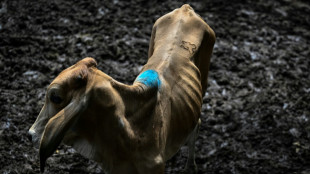 Few buyers for starving cattle in El Nino parched El Salvador

 Bybit Expands Beyond Crypto as CEO Outlines Next Phase of Financial Platform

 Bayern held by Viking after 'super dumb' Olise red in Champions League

In his stone house perched on a hill in northern Ethiopia, Amanuel Hiluf puts on his protective suit, carefully adjusting the hood and gloves.
"We have to hurry up, it starts to be hot, and the bees will be upset," he says.
In his garden in Hawidela, a village about an hour from Mekele, capital of the Tigray region, the beekeeper has about 40 hives from which clouds of bees are soon escaping.
For nearly 20 years, his hives have produced white honey, a creamy, highly prized variety for which the northernmost region of Ethiopia is famous.
Amanuel, 42, remembers a time when they produced "in abundance".
But that was before the war in Tigray between federal government troops and Tigrayan rebels that raged from 2020 to 2022, which forced him to flee with his wife and children.
"In this region, there was a lot of damage," he says, pointing to a hill from which shells were fired.
When he returned a few months later, all his hives -- and his livelihood -- had been destroyed.
Before the war, he could produce about 600 kilos (1,300 pounds) of white honey each year and earn some 900,000 birr (about $7,500 at today's rates).
That is a considerable sum in a country where more than a third of the population lives below the poverty line, according to the World Bank.
When he resumed production, Amanuel said he had lost 95 percent of his earnings. He has gradually rebuilt the hives, but still only produces 100 kilos.
- 'Sound of misery' -
The situation is replicated across Tigray.
Goshu Welealeabzgi, a specialist for the Tigray authorities' Bureau of Agriculture and Natural Resources, says 40 to 60 percent of hives were destroyed by the war.
Before the conflict, he estimates there were 500,000 colonies in Tigray, with 200,000 people directly dependent on beekeeping, in a region of around six million inhabitants.
Bees were also victim to the environmental damage caused by the conflict, especially as desperate locals were forced to cut down trees, particularly the acacias that covered the hills, to sell or use for firewood.
"If trees are lost and flowers are lost, production will decrease," says Amanuel.
"The conflict harmed everybody," he adds. "The sound of bullets has stopped, but there is still the sound of misery."
His hives are home to Apis mellifera monticola bees, a particularly productive species that can survive the region's high altitudes. Mekele sits at more than 2,200 metres above sea level.
Ethiopia, an East African country with a population of around 120 million, is the continent's largest producer of honey.
Nectar is particularly important in Ethiopian culture, with yellow honey used to produce tej, a popular local mead.
Amanuel regularly sells his honey to Birhanu Araya, who runs a small shop in Mekele where dozens of cans containing the precious nectar are piled up.
"There are only very few (bees) due to the war and drought," says 61-year-old Birhanu, who has been running his business for 25 years.
"The amount that's entering now is small and the price is very high," he adds.
Goshu says he remains optimistic.
"If resources are allocated and the community gets onboard, maybe it could recover in three to five years," he says.
"We have to look forward."
S.Barghouti--SF-PST