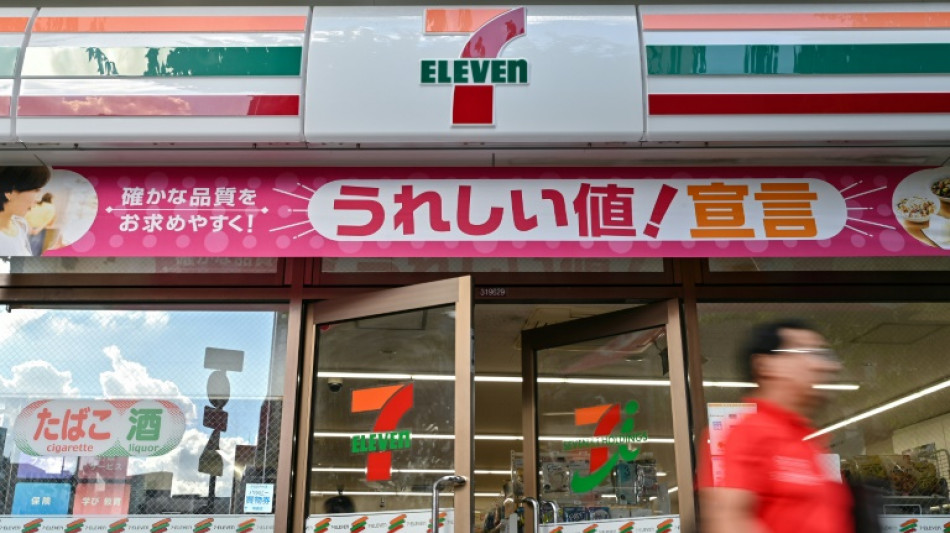
Your 'local everything': what 7-Eleven buyout battle means for Japan / Photo: Richard A. Brooks - AFP/File

 California puts first US billionaire tax to the vote

 School headscarf ban meets resistance in Austria

 World's top cocoa producer aims for a climate-tough bean

 Why is Shell facing lawsuits over climate disasters in Brazil and the Philippines?

 New four-lane bridge opens between China, North Korea

 Tech stocks lead rout after US inflation fuels rate hike bets

 'No time to recover': UNDP chief sounds alarm on growing poverty after Iran war shock

 Australia says won't let big tech have 'unfettered' access to kids

 Mobile clinics battle Mongolia's childhood dental 'disaster'

 Wallabies back Meredith as playmaker for second New Zealand Test

 Messi's Inter Miami book playoffs with 2-0 win over New York City

 Oil-rich Alberta tests Canada's unity with secession vote

 EU leaders head for showdown over bloc budget

 All Blacks make three changes for second Wallabies Test

 Mourinho blasts 'shameless' timing of Vinicius ban decision

 PSG beat Man City in Champions League thriller, Barcola hits Liverpool hat-trick

 US Treasury chief urges stronger IMF role against 'distortionary policies'

 Giant-killers Bodo sink Dortmund in Champions League

 PSG outgun embattled Man City in six-goal Champions League thriller

 In Chicago, pope's hometown, Catholics express shock and support

 Musk suggests US govt behind any slowdown in Ukraine's Starshield system

 Chiclayo prays for recovery and return of the 'Peruvian pope'

 Barcola scores hat-trick as Liverpool hit LASK for six

 Healthy corals help bleached neighbors regain color: study

 Hope ton helps West Indies level T20 series at 2-2 in India

In Japan more is at stake than money in the mammoth takeover battle for 7-Eleven, the world's biggest convenience chain, by Canadian retail giant Alimentation Couche-Tard.
It is a litmus test for government efforts to shake up corporate Japan, experts say, and one that may put more firms in the sights of foreign buyers.
The chain is a ubiquitous lifeline for an ageing population in Japan and a cherished one-stop shop for everything from egg sandwiches to concert tickets.
For tourists it's Instagram gold, sparking jokes about spending $1,000 on flights just to eat a $1 rice ball.
"It's part of the fabric of Japan, the infrastructure," Gavin H. Whitelaw, a researcher at Harvard who has worked at three Japanese convenience stores, told AFP.
"They've become a kind of global template for convenience retail" as "the equivalent of a 'local everything'", said Whitelaw, executive director of the Reischauer Institute of Japanese Studies.
As well as stocking up on fresh food, toiletries and snacks, 7-Eleven customers in Japan can pay bills, print photos and send suitcases across the country, or just use the ATM.
To operate smoothly, Japanese convenience stores have mastered a "byzantine-like distribution system" and crunch huge amounts of data on consumer behaviour, Whitelaw said.
"There's national pride to this," with the stores nicknamed "konbini" often acting as community hubs that contribute to local festivals and help in disasters, he added.
- Ito's idea -
7-Eleven began life in the United States but late billionaire Masatoshi Ito turned it into a Japanese empire with 85,000 stores worldwide, a quarter of them in Japan.
Last month its owner Seven & i -- Japan's biggest retailer -- rejected a $40-billion offer from ACT, saying it undervalued the company, while warning of regulatory hurdles.
But the Canadian group, which owns Circle K and runs nearly 17,000 outlets worldwide, has vowed to pursue what would be the biggest foreign takeover of a Japanese firm.
Seven & i shares surged on Wednesday after Bloomberg News reported that ACT had upgraded its offer to around $47 billion.
The group declined to comment, but Seven & i's CEO is due to speak on Thursday when second-quarter earnings are released.
"The timing of Couche-Tard's bid cannot be more perfect," said Kai Li, a professor and Canadian corporate governance expert at the UBC Sauder School of Business.
Japanese companies are "relatively cheap" thanks to the weak yen, she said, while the country also revised its merger and acquisition guidelines last year.
The new rules aim to make Japan's business world more competitive by discouraging companies from routinely dismissing foreign buyout offers.
- 'Core' industry -
In 2021, Couche-Tard dropped a takeover bid worth 16 billion euros ($17 billion today) for French supermarket Carrefour after Paris said it would veto the deal over food security concerns.
It's unclear if Japan's new government under Prime Minister Shigeru Ishiba would do the same, but last month, the finance ministry designated Seven & i a "core" industry.
The move gives authorities more power to block a takeover in certain cases.
Recent media reports have also said Seven & i wants to strengthen its hand by selling off other assets such as its banking unit.
Japanese companies were once famous for their huge global acquisitions -- but they have long spurned the idea of foreign buyouts the other way around.
"Traditionally speaking, companies were very stable" in Japan and considered mergers "a very, very foreign concept", said Nobuko Kobayashi from consulting firm EY.
"It's the end of your sort of business history if you sell out. So it had a bad connotation," she told AFP.
This is changing, however, as authorities and businesses try to drag Japan's economy out of stagnation, so the 7-Eleven buyout tussle is being closely watched -- with some saying it could unleash many similar deals.
The weak yen, Japanese companies being undervalued in the stock market, and China's economic woes and geopolitical risks making it less attractive to buyers mean "all eyes are on Japan", Kobayashi said.
However, prospective buyers should be wary that it can be difficult to enact a "transformation" within Japan's rigid management style, she said.
"You may need kind of a structural change in mindset to unlock the value of Japan."
C.Hamad--SF-PST
