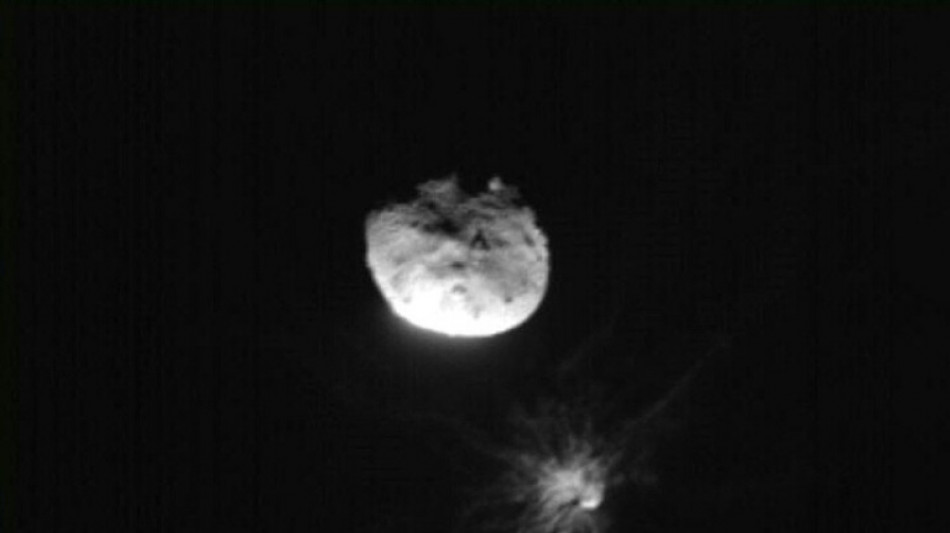
Europe's asteroid mission Hera launches despite hurricane / Photo: Handout - ASI/NASA/AFP/File

 California puts first US billionaire tax to the vote
 School headscarf ban meets resistance in Austria

 World's top cocoa producer aims for a climate-tough bean

 Why is Shell facing lawsuits over climate disasters in Brazil and the Philippines?

 New four-lane bridge opens between China, North Korea

 Tech stocks lead rout after US inflation fuels rate hike bets

 'No time to recover': UNDP chief sounds alarm on growing poverty after Iran war shock

 Australia says won't let big tech have 'unfettered' access to kids

 Mobile clinics battle Mongolia's childhood dental 'disaster'

 Wallabies back Meredith as playmaker for second New Zealand Test

 Messi's Inter Miami book playoffs with 2-0 win over New York City

 Oil-rich Alberta tests Canada's unity with secession vote

 EU leaders head for showdown over bloc budget

 All Blacks make three changes for second Wallabies Test

 Mourinho blasts 'shameless' timing of Vinicius ban decision

 PSG beat Man City in Champions League thriller, Barcola hits Liverpool hat-trick

 US Treasury chief urges stronger IMF role against 'distortionary policies'

 Giant-killers Bodo sink Dortmund in Champions League

 PSG outgun embattled Man City in six-goal Champions League thriller

 In Chicago, pope's hometown, Catholics express shock and support

 Musk suggests US govt behind any slowdown in Ukraine's Starshield system

 Chiclayo prays for recovery and return of the 'Peruvian pope'

 Barcola scores hat-trick as Liverpool hit LASK for six

 Healthy corals help bleached neighbors regain color: study

 Hope ton helps West Indies level T20 series at 2-2 in India

Europe's Hera probe launched Monday on a mission to inspect the damage done by a NASA spacecraft when it smashed into an asteroid during the first test of Earth's planetary defences.
Despite fears that an approaching hurricane could delay the launch, the probe blasted off on a SpaceX rocket into cloudy skies from Cape Canaveral in the US state of Florida just before 11:00 am local time (1500 GMT).
Hera's mission is to investigate the aftermath of NASA's Double Asteroid Redirection Test (DART), which deliberately crashed into the Dimorphos asteroid in 2022 roughly 11 million kilometres (6.8 million miles) from Earth.
The fridge-sized DART spacecraft successfully knocked the asteroid well off course, demonstrating that humanity may no longer be powerless against potentially planet-killing asteroids that could head our way.
The European Space Agency (ESA) said the Hera craft will investigate what it has called the "crime scene" in the hopes of learning how Earth can best fend off future space rocks.
The launch was met with applause from teams on the ground, according to an ESA broadcast.
Poor weather ahead of Hurricane Milton had put the launch into doubt, with SpaceX warning on Sunday that there was only a 15 percent chance of a launch.
Milton is the latest hurricane to hit the Gulf of Mexico after the deadly Hurricane Helene. It has been classified as "an extremely dangerous category 4 hurricane" and is expected to slam into Florida in the coming days.
- Green light after 'mishap' -
The launch had also faced a potential delay due to an anomaly involving a Falcon 9 rocket during the launch of SpaceX's Crew-9 astronaut mission late last month.
But on Sunday, the US Federal Aviation Administration gave the green light.
Hera is planned to fly past Mars next year and then arrive near Dimorphos in December 2026 to begin its six-month investigation.
Dimorphos, which is actually a moonlet orbiting its big brother Didymos, never posed a threat to Earth.
After DART's impact, Dimorphos shed material to the point where its orbit around Didymos was shortened by 33 minutes -- proof that it was successfully deflected.
But much about the impact remains unknown, including how much damage was done and exactly what the asteroid -- which is about the size of an Egyptian pyramid -- was like before it was hit.
Analysis of the DART mission has suggested that rather than being a single hard rock, Dimorphos was more a loose pile of rubble held together by gravity.
"The consequence of this is that, instead of making a crater" on Dimorphos, DART may have "completely deformed" the asteroid, the Hera mission's principal investigator Patrick Michel told a press conference.
But there are other possibilities, he said, adding that the behaviour of these low-gravity objects is little understood and "defies intuition".
- 'Able to protect ourselves' -
An asteroid wider than a kilometre (0.6 miles) -- which could trigger a global catastrophe on a scale that wiped out the dinosaurs -- is estimated to strike Earth every 500,000 years or so.
An asteroid around 140 metres (460 feet) wide -- which is a little smaller than Dimorphos but could still take out a major city -- hits our home planet around every 20,000 years.
Most of these celestial objects come from the asteroid belt between Mars and Jupiter. Almost all those bigger than a kilometre wide are known to scientists, and none are expected to threaten Earth in the next century.
There are also no known 140-metre asteroids on a collision course with Earth -- but only 40 percent of those space rocks are believed to have been identified.
Although asteroids are one of the least likely natural disasters to strike the planet, people now have the "advantage of being able to protect ourselves against them", the Hera mission's principal investigator Patrick Michel said.
The 363-million-euro ($400 million) mission will be equipped with 12 scientific instruments and two nanosatellites.
Once its job is done, the team on the ground hope that Hera can land gently on Dimorphos or Didymos, where it will spend the rest of its days.
N.AbuHussein--SF-PST