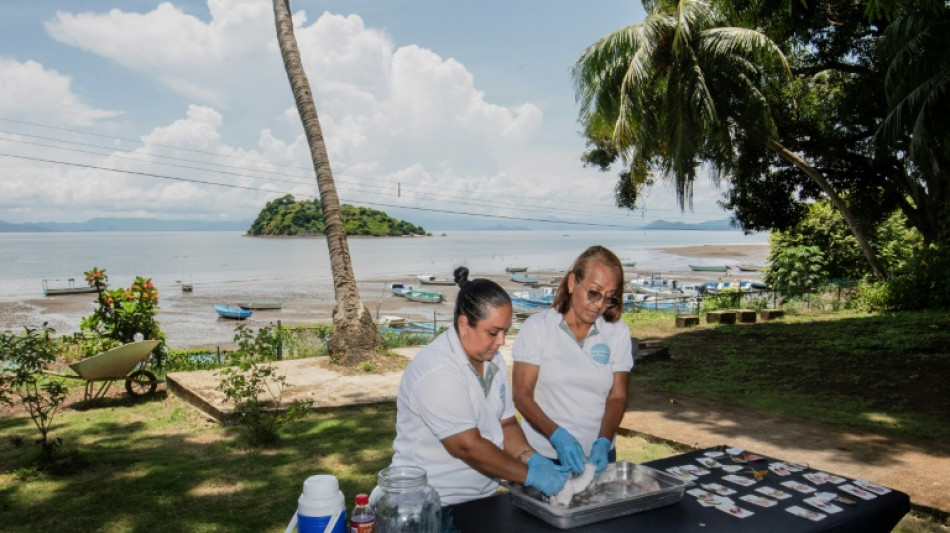
Carpe diem: the Costa Rican women turning fish into fashion / Photo: Ezequiel BECERRA - AFP

 Asian Cup in Saudi Arabia could be postponed but 'no hurry' to decide: AFC

 Conrad wields axe after South Africa loss to Australia

 School roof collapse kills teacher, 27 children in NW Pakistan

 Haze turns Indonesia skies orange, shuts schools in East Timor

 California puts first US billionaire tax to the vote

 School headscarf ban meets resistance in Austria

 World's top cocoa producer aims for a climate-tough bean

 Why is Shell facing lawsuits over climate disasters in Brazil and the Philippines?

 New four-lane bridge opens between China, North Korea

 Tech stocks lead rout after US inflation fuels rate hike bets

 'No time to recover': UNDP chief sounds alarm on growing poverty after Iran war shock

 Australia says won't let big tech have 'unfettered' access to kids

 Mobile clinics battle Mongolia's childhood dental 'disaster'

 Wallabies back Meredith as playmaker for second New Zealand Test

 Messi's Inter Miami book playoffs with 2-0 win over New York City

 Oil-rich Alberta tests Canada's unity with secession vote

 EU leaders head for showdown over bloc budget

 All Blacks make three changes for second Wallabies Test

 Mourinho blasts 'shameless' timing of Vinicius ban decision

 PSG beat Man City in Champions League thriller, Barcola hits Liverpool hat-trick

 US Treasury chief urges stronger IMF role against 'distortionary policies'

 Giant-killers Bodo sink Dortmund in Champions League

 PSG outgun embattled Man City in six-goal Champions League thriller

 In Chicago, pope's hometown, Catholics express shock and support

 Musk suggests US govt behind any slowdown in Ukraine's Starshield system

On a beach in Costa Rica, as fishermen land the day's catch, two women are hard at work on a slimy sea bass skin, rubbing, scraping, washing and tanning the hide to turn it into leather.
Two years ago, both Mauren Castro, 41, and Marta Sosa, 70, were stay-at-home mums dependent on their fishermen husbands to provide for their families of four and six, respectively.
Today, they are part of the all-female Piel Marina (Marine Skin) cooperative, which turns fish skins that used to be discarded at sea into sustainable fashion.
For generations, fishing was the economic mainstay in Costa de Pajaros, a village situated about 62 miles (100 kilometers) west of the capital San Jose.
But fishermen say that regulations aimed at making stocks more sustainable, which this year included a complete ban on fishing between May and July, have made it harder to live off the sea.
Enter the NGO MarViva, which helped train 15 women to establish themselves as seafront tanners two years ago.
The women were skeptical at first about the sartorial possibilities of fish skins.
"We said 'how can a skin, which is something that gets smelly, which is waste, be the raw material for women to be able to get ahead'"? Castro, 41, told AFP.
But over time they honed their trade and are helping supplementing their families' meagre incomes.
- Facebook and Instagram -
Wearing blue rubber gloves and white t-shirts bearing the words Piel Marina, Sosa and Castro show how a skin rescued from a filleted sea bass can become a pair of earrings, a necklace or even a handbag.
First they rub the skin gently between their fingers to remove the scales and any remaining flesh.
"Then we take it and wash it with soap, as if we were washing clothes. Then we dye it with glycerin and alcohol and natural dye, and then we dry it," Sosa explained.
The dyeing process takes four days, with another four needed for the leather to dry in the sun to produce a fabric that is soft and pliable but strong.
Crucially, it no longer smells of fish and has the advantage of being waterproof.
The women are not only tanners, but have also become jewellery designers who sell colourful earrings and necklaces on Instagram and Facebook.
A pair of earrings in the shape of a butterfly costs the equivalent of about seven dollars.
The women also sell some of the leather to small-scale textile producers in Puntarenas, the main port on Costa Rica's Pacific coast.
- Indigenous tradition -
Costa Rica is just the latest country to catch onto the potential of fish tanning, an age-old practise among Indigenous peoples from Alaska to Scandanavia to Asia.
While salmon skins were traditionally used by the Ainu people in Japan and the Inuit in northern Canada to make boots and clothes, and on the shores of Lake Victoria in Kenya they now use the local tilapia delicacy to make handbags.
Brazilian company Nova Kaeru meanwhile offers leather made from the discarded scales of the giant pirarucu fish, which is native to the Amazon.
On the internet, fish leather bags sell for hundreds of dollars.
One of the first big-name fashion designers to get hooked on the skins was former Dior creative director John Galliano, who sported an Atlantic salmon skin jacket and fish leather bag in his 2002 collections.
For the moment, the women of the Piel Marina cooperative are glad to have a job that gets them away from domestic chores and provides them with a small income.
But they dream of the day when the leather they make by hand on the beach struts the global stage.
Castro's eyes shine at the prospect.
"I would like it to be seen in Hollywood, in Canada or on the great catwalks in Paris!"
R.Shaban--SF-PST


