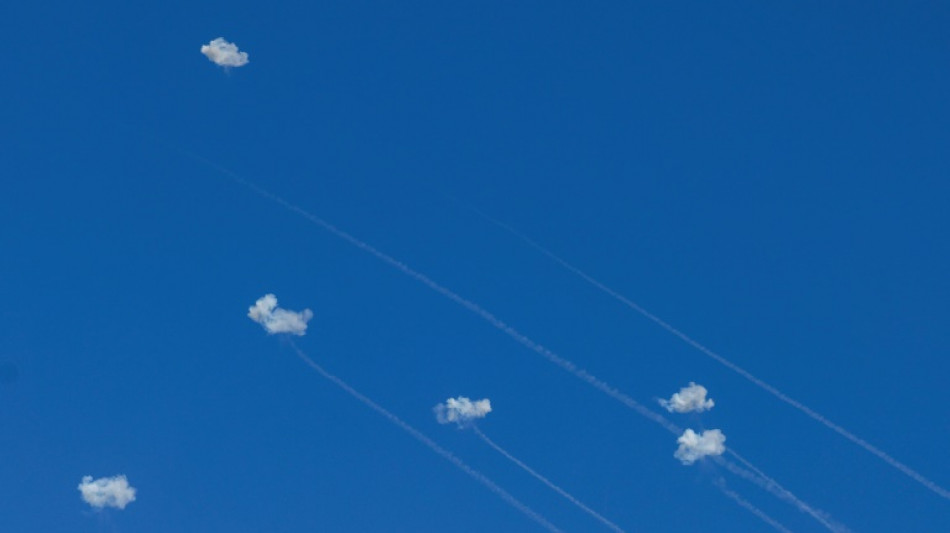
Iron Dome: Israel's key anti-missile shield / Photo: Menahem KAHANA - AFP

 Two dead as Istanbul endures heaviest rainfall in 80 years

 After latest Nepal flood, survivors fear for future

 EU leaders clash over budget as spectre of French elections looms

 'No place to breathe': life in Indonesia's fire epicentre

 'Can't sleep': Spain's housing crunch upends lives

 Musk calls on Ukraine's Zelensky to 'go' after satellite slowdown row

 Still smiling at 117, Albanian may be world's oldest woman

 Pope has 'good night' in hospital: Vatican

 China's economy seen missing target as global shocks bite: AFP poll

 Costa Rica opens jail inspired by El Salvador mega-prison

 Same-sex couple takes fight for equality to Slovakian court

 'High hopes' as Indonesian women get a football league, again

 'Expectations high' for Bordeaux-Begles' Champions Cup hat-trick bid, says Depoortere

 Rennie urges All Blacks to stay focused against 'hurting' Wallabies

 Palmeiras beat Fluminense 2-1 in Libertadores semi-final first leg

 Brewers blasts leave Dodgers on brink

 Tech stock lead rout after US inflation fuels rate hike bets

 Al-Fayed survivors say UK police missing 'bigger picture'

 Online 'witch hunt' sweeps up Asians misidentified as US rape accused

 Prospect of Bolsonaro win looms large over Brazil's Indigenous

 Freed from Belarus, founder of Lady Gaga's biggest fan site tells his story

 Behind AI's carbon footprint, a potential climate tool

 Trump's new press secretary faces scrutiny over credentials

 PSG 'got lucky' to win Man City thriller, says Luis Enrique

 Real Madrid comeback stuns Roma as Mourinho enjoys happy reunion

Israel's Iron Dome air defence system has intercepted thousands of rockets since it went into operation in 2011, providing the country with crucial cover during times of conflict.
It has been heavily relied upon to protect military and civilian sites from frequent barrages of rockets fired from Gaza and Lebanon in the ongoing war between Israel and Hamas.
Israel's air defences were in operation on Tuesday night, when Iran fired missiles at Israel in what it said was a response to Israel's killing of Tehran-backed militant leaders.
Israel's military chief Herzi Halevi said Tuesday that the Iranian barrage had been blunted partly by "a very strong aerial defence array".
The system had also intercepted more than 200 drones and missiles launched by Iran on April 13.
Israel initially developed the Iron Dome alone after the 2006 Lebanon War, and was later joined by the United States, which has provided its defence know-how and billions of dollars in financial support for the program.
The system has an interception rate of around 90 percent, according to Israeli defence firm Rafael, which helped design it.
Here's how it works:
- Three-part system -
The Iron Dome is one part of Israel's multi-tiered missile defence systems and is designed to intercept short-range rockets at a distance of up to 70 kilometres (43 miles).
Each Iron Dome battery is made up of three main sections: a radar detection system, a computer to calculate the incoming rocket's trajectory, and a launcher that fires interceptors if the rocket is deemed likely to hit a built-up or strategic area.
It sits alongside other missile defence systems like the Arrow, which counters ballistic missiles, and David's Sling, for medium-range rocket or missile attacks.
- How much does it cost?
Each Iron Dome interceptor costs $40,000 to $50,000 to produce, according to the Washington-based Center for Strategic and International Studies.
The think tank estimated that a complete system, including the radar, computer and three to four launchers -- each containing up to 20 interceptors -- costs around $100 million to produce.
Israel has 10 such systems in operation, according to Raytheon, which helps manufacture the Iron Dome. Other estimates have put the figure slightly higher.
- Bipartisan US support -
The Iron Dome is one of the strategic pillars of the US-Israeli alliance that has been followed by successive Democratic and Republican administrations.
In August 2019 the US Army signed a contract to purchase two Iron Dome batteries to enhance its own short-range missile defence capabilities.
K.AbuTaha--SF-PST